AEO and GEO tools can be useful, but they are not automatically worth it for every small business.
The simple answer is this:
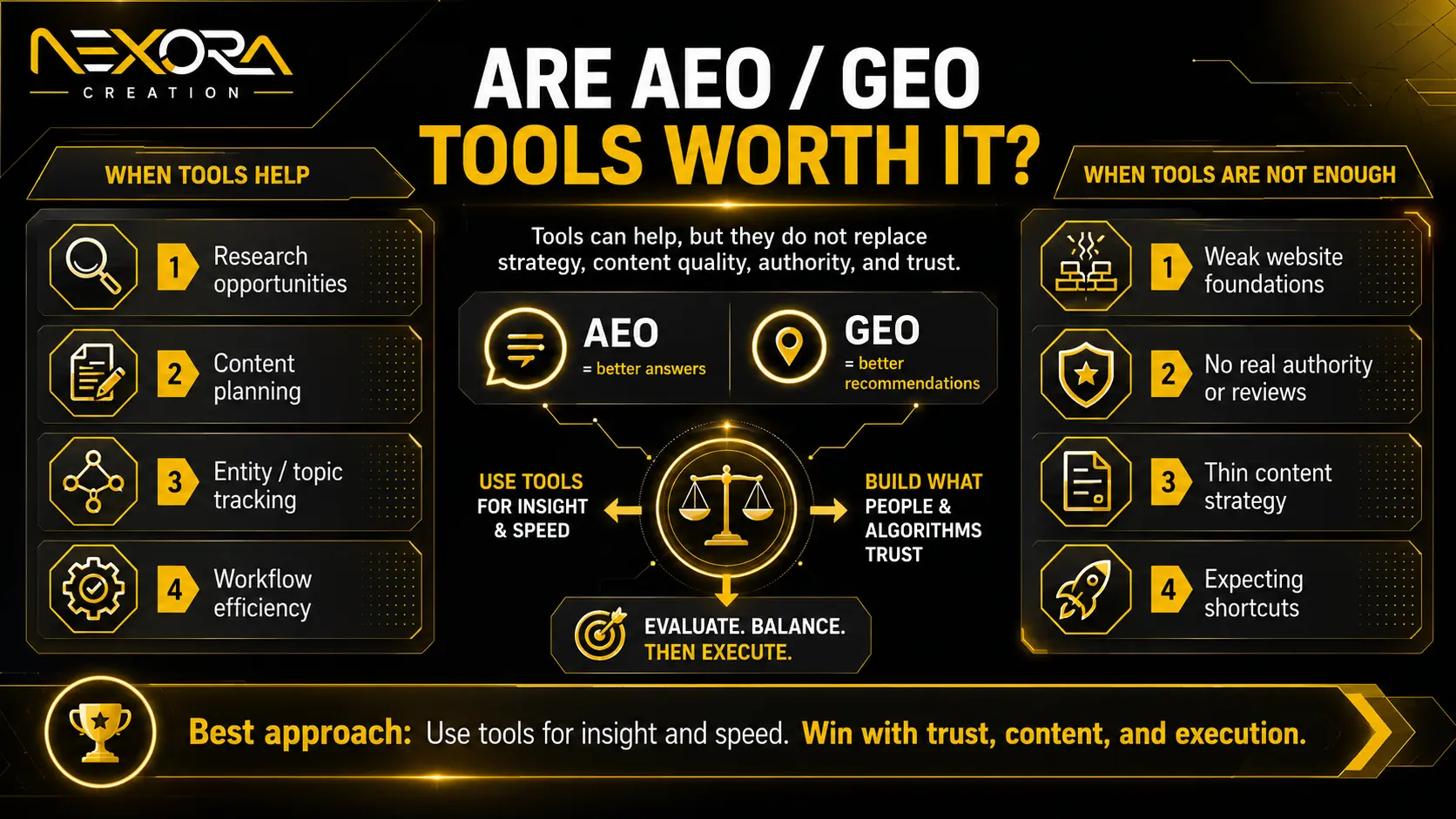
AEO/GEO tools are worth it if your website already has strong SEO foundations, helpful content, clear service pages, and you need to track how your brand appears in AI search results.
But if your website has weak content, poor technical SEO, unclear service pages, no topical authority, or no lead-generation structure, then buying an AEO or GEO tool may not solve the real problem.
Many businesses are now worried about AI Search, Google AI Overviews, ChatGPT, Gemini, Perplexity, Copilot, and other AI-powered discovery platforms. Because of this, many tools now promise to track AI visibility, AI citations, brand mentions, answer engine performance, and generative search presence.
These tools can help.
But they cannot replace strategy.
At Nexora Creation, we see AEO and GEO tools as useful measurement and research tools, not magic growth systems. A tool can show where your brand appears, where competitors appear, and what topics need improvement. But your website still needs strong SEO, helpful content, structured pages, trust signals, internal links, and clear conversion paths.
In this guide, we will explain what AEO/GEO tools are, when they are worth it, when they waste money, and what small businesses should fix before investing in them.
What are AEO and GEO tools?
AEO and GEO tools are software platforms that help businesses understand and improve their visibility in answer engines and AI-powered search experiences.
AEO stands for Answer Engine Optimization.
AEO tools usually focus on how your content answers user questions in search experiences such as:
- Featured snippets
- People Also Ask
- Voice search
- AI assistants
- Direct answer results
- Question-based search pages
GEO stands for Generative Engine Optimization.
GEO tools usually focus on how your brand, website, products, or services appear in generative AI answers.
These tools may track visibility across platforms like:
- Google AI Overviews
- Google AI Mode
- ChatGPT
- Perplexity
- Gemini
- Copilot
- Claude
- Other AI answer engines
AEO/GEO tools may help you monitor:
- Brand mentions
- AI citations
- Competitor mentions
- Prompt visibility
- Topic gaps
- AI answer sentiment
- Source visibility
- Content opportunities
- Questions users ask
- AI-generated recommendations
In simple words, these tools help you understand whether AI search systems can find, understand, and mention your business.
Why are AEO/GEO tools becoming popular?
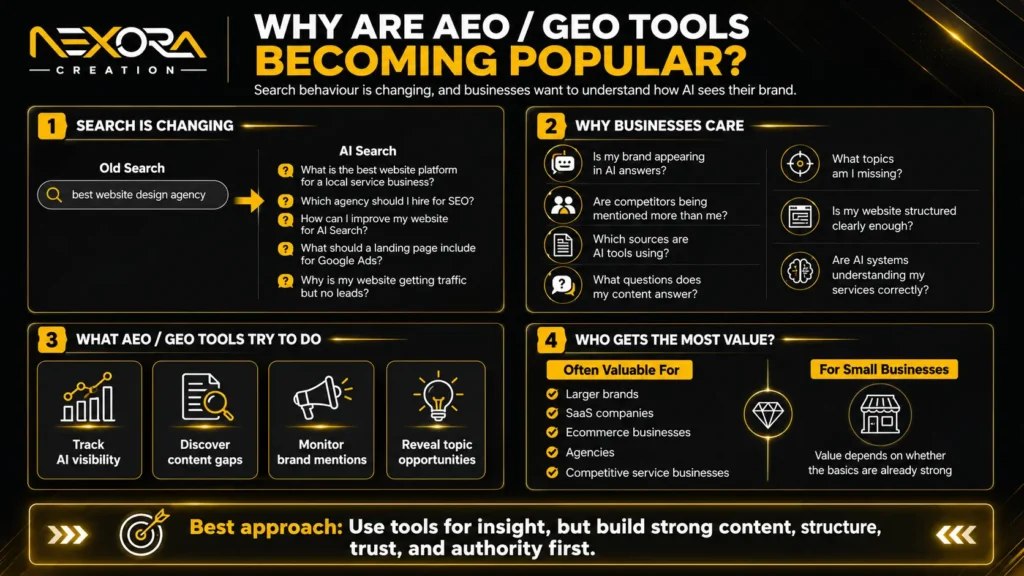
AEO/GEO tools are becoming popular because search behaviour is changing.
People are no longer only typing short keywords into Google and clicking blue links.
They now ask longer questions like:
- What is the best website platform for a local service business?
- Which agency should I hire for SEO?
- How can I improve my website for AI Search?
- What should a landing page include for Google Ads?
- Why is my website getting traffic but no leads?
AI tools often answer these questions directly.
That means users may form an opinion about your business before they ever visit your website.
This is why businesses want to know:
- Is my brand appearing in AI answers?
- Are competitors being mentioned more than me?
- Which sources are AI tools using?
- What questions does my content answer?
- What topics am I missing?
- Is my website structured clearly enough?
- Are AI systems understanding my services correctly?
AEO/GEO tools try to answer these questions.
For larger brands, SaaS companies, ecommerce businesses, agencies, and competitive service businesses, this information can be valuable.
For small businesses, the value depends on whether the basics are already strong.
Are AEO/GEO tools worth it for small businesses?
AEO/GEO tools can be worth it for small businesses, but only at the right stage.
They are worth it when your business already has:
- A proper website
- Clear service pages
- Strong SEO foundations
- Useful blog content
- Local SEO setup
- Trust signals
- Reviews or testimonials
- Conversion tracking
- A content strategy
- Competitor pressure in search
- Budget for ongoing optimization
In this case, AEO/GEO tools can help you see how your brand performs across AI search experiences.
But if your website is still weak, the tool may only confirm what you already know:
Your content is not strong enough yet.
For example, if your website has only a homepage, a basic service section, no blog, no FAQs, no internal links, no local SEO, and no structured content, then AEO/GEO tracking will not create visibility.
It will only show low visibility.
That is why small businesses should not buy these tools before fixing their content foundation.
Relevant Blog: SEO Foundations Every Growth Focused Website Needs
When are AEO/GEO tools useful?
AEO/GEO tools are useful when you need visibility data that traditional SEO tools may not show clearly.
They can help you understand how AI-powered platforms talk about your industry, competitors, and brand.
AEO/GEO tools can be useful for:
- Tracking brand mentions in AI answers
- Finding competitor visibility
- Discovering question-based content gaps
- Monitoring AI citations
- Checking whether your brand is recommended
- Understanding how AI describes your services
- Finding missing topics
- Testing prompts related to your niche
- Measuring content visibility beyond Google rankings
- Planning future content clusters
For example, a digital agency may want to know:
“Which agencies are AI tools recommending for small business website development?”
or:
“What sources are being cited when users ask about Google Ads landing pages?”
or:
“Is our brand visible when people ask for SEO agencies?”
This type of data can help shape content strategy.
But again, the tool gives insight. It does not automatically create authority.
When are AEO/GEO tools not worth it?
AEO/GEO tools are not worth it when a business is using them as a shortcut.
They are usually not worth it if:
- Your website has thin content
- Your service pages are weak
- Your technical SEO is poor
- Your content does not answer real questions
- Your website has no trust signals
- Your brand has no online authority
- Your local SEO is incomplete
- Your internal linking is missing
- You do not track leads
- You do not publish consistently
- You have no strategy for acting on the data
A tool can show that your business is not appearing in AI answers.
But if you do not have the content, structure, authority, and trust needed to improve, the tool will not fix the problem.
This is similar to buying an expensive analytics dashboard before fixing your website.
The dashboard may show the issue, but it will not solve it.
For small businesses, the better question is not:
“Which AEO/GEO tool should I buy first?”
The better question is:
“Is my website strong enough to deserve visibility in AI search?”
What should small businesses fix before buying AEO/GEO tools?
Small businesses should fix their SEO and content foundation before investing in AEO/GEO tools.
Start with these areas:
- Technical SEO
- Website speed
- Mobile experience
- Service page structure
- Local SEO
- Google Business Profile
- Helpful blog content
- Question-based headings
- FAQs
- Internal linking
- Schema markup where relevant
- Trust signals
- Reviews
- Conversion tracking
- Clear CTAs
- Lead capture forms
If these basics are missing, AEO/GEO tools will have limited value.
Before tracking AI visibility, make sure your website clearly answers:
- What do you offer?
- Who do you help?
- Where do you provide services?
- Why should people trust you?
- What problems do you solve?
- What questions do customers ask?
- What should users do next?
If your website does not answer these clearly, AI systems may struggle to understand and recommend your business.
How do AEO/GEO tools help with content strategy?
AEO/GEO tools can help with content strategy by showing which questions, prompts, and topics matter in AI-powered discovery.
They may help you identify:
- Questions users ask AI tools
- Competitors appearing in AI answers
- Topics your website does not cover
- Sources AI systems cite
- Content formats that perform well
- Gaps in your authority
- Brand visibility trends
- AI answer sentiment
- Industry-related prompt opportunities
For example, if you run a roofing company, a tool may show that AI tools answer questions like:
- What should I check before hiring a roofer?
- How do I know if my roof needs repair?
- How much does roof repair cost?
- Is roof replacement better than repair?
- What questions should I ask a roofing contractor?
These questions can become blog posts, FAQs, service page sections, or lead-generation content.
For a digital agency, prompts may include:
- What should a small business website include?
- How do I choose an SEO agency?
- What is AEO?
- How can AI Search affect local businesses?
- What makes a landing page convert?
AEO/GEO tools can help you discover content opportunities.
But your team still needs to create high-quality content that answers these questions better than competitors.
Can AEO/GEO tools improve rankings by themselves?
No, AEO/GEO tools do not improve rankings by themselves.
They can help with research, monitoring, and reporting, but they do not replace optimization work.
To improve visibility, you still need to:
- Improve website structure
- Write helpful content
- Build strong service pages
- Answer questions clearly
- Add trust signals
- Improve technical SEO
- Strengthen internal links
- Improve page experience
- Build topical authority
- Keep content updated
- Track leads and conversions
A tool can tell you:
“You are not mentioned for this prompt.”
But it cannot automatically make your business trustworthy, useful, and relevant.
That comes from strategy and execution.
This is why AEO/GEO tools are best used after your business already has a strong SEO and content system.
How do AEO/GEO tools compare with traditional SEO tools?
Traditional SEO tools usually focus on search engine data.
They may help with:
- Keyword research
- Ranking tracking
- Backlink analysis
- Technical audits
- Competitor research
- Content gaps
- Site health
- Traffic estimates
- SERP analysis
AEO/GEO tools focus more on AI search visibility.
They may help with:
- Prompt tracking
- AI answer monitoring
- AI citations
- Brand mentions
- Competitor mentions in AI tools
- AI recommendation tracking
- Source analysis
- Question-based visibility
Both types of tools can be useful.
Traditional SEO tools help you understand how your website performs in search engines.
AEO/GEO tools help you understand how your brand appears in AI-powered answer systems.
For most small businesses, traditional SEO tools and basic analytics should come first.
AEO/GEO tools become more useful after you already have content and visibility worth monitoring.
Should local businesses use AEO/GEO tools?
Local businesses can use AEO/GEO tools, but they may not need them immediately.
A local business should first focus on:
- Google Business Profile optimization
- Local service pages
- Reviews
- NAP consistency
- Local content
- Website speed
- Mobile usability
- FAQs
- Service area pages
- Local schema
- Clear contact options
- Lead tracking
For example, a local plumber, dentist, HVAC company, roofing business, clinic, or law firm may get more immediate value from improving local SEO and service pages than from buying an AI visibility tool.
AEO/GEO tools may become useful when the business wants to monitor:
- How AI tools recommend local service providers
- Whether competitors are mentioned more often
- Which local questions are being answered
- What trust signals appear in AI responses
- Whether reviews and service pages are influencing visibility
But for many local businesses, the first priority should be content and local SEO foundation.
If your local business website is getting traffic but not enough enquiries, Nexora Creation can review your website structure, local service pages, CTA placement, and conversion path through its SEO and website development services.
Should agencies use AEO/GEO tools?
Agencies may get more value from AEO/GEO tools because they manage visibility for multiple clients.
An agency can use these tools for:
- AI visibility reporting
- Competitor comparisons
- Content planning
- Prompt monitoring
- Brand mention tracking
- Client education
- AI search audits
- Industry trend tracking
- Content gap discovery
- Campaign measurement
For agencies, AEO/GEO tools can help create a clearer picture of how clients appear in AI-powered search environments.
However, agencies should still avoid selling tool screenshots as strategy.
A good agency should use tool data to guide real improvements, such as:
- Better service pages
- Stronger content clusters
- More useful FAQs
- Improved internal linking
- Better technical SEO
- Stronger trust signals
- Clearer conversion paths
The tool should support the strategy, not replace it.
What features should you look for in an AEO/GEO tool?
If you decide to use an AEO/GEO tool, look for features that help you make better decisions.
Useful features may include:
- Multi-platform AI visibility tracking
- Prompt monitoring
- Competitor comparison
- Brand mention tracking
- Citation tracking
- Source analysis
- Topic gap analysis
- Sentiment analysis
- Reporting dashboards
- Exportable reports
- Historical tracking
- Location-based tracking, if relevant
- Content recommendations
- Integration with SEO tools
- Clear action items
Avoid tools that only give vague scores without explaining what to do next.
A good tool should help you answer:
- Where is my brand appearing?
- Where are competitors appearing?
- Which questions do we need to answer?
- Which pages need improvement?
- Which sources are being cited?
- What content gaps exist?
- What should we do next?
Data is only useful when it leads to action.
What are the risks of relying too much on AEO/GEO tools?
Relying too much on AEO/GEO tools can create the wrong focus.
Businesses may start chasing AI mentions instead of serving customers.
Common risks include:
- Writing robotic content
- Over-optimizing for prompts
- Ignoring real users
- Ignoring traditional SEO
- Publishing low-quality AI content
- Chasing vanity metrics
- Measuring mentions without measuring leads
- Treating AI visibility as a shortcut
- Ignoring conversion optimization
- Forgetting local SEO
- Spending money before fixing basics
AI search visibility matters, but it should not replace business fundamentals.
Your website still needs to:
- Load fast
- Explain services clearly
- Build trust
- Answer real questions
- Capture leads
- Track conversions
- Help users take action
A tool may tell you that your brand appeared in an AI answer.
But if your website does not convert visitors into leads, that visibility may not create business value.
How much should small businesses spend on AEO/GEO tools?
Small businesses should only spend on AEO/GEO tools after they have budget for core website and SEO improvements.
If your budget is limited, prioritize:
- Website improvements
- Service page optimization
- Technical SEO
- Local SEO
- Content strategy
- Blog creation
- Trust signals
- Conversion tracking
- CRM setup
- Lead follow-up process
These areas usually create more direct business value.
AEO/GEO tools may be worth the cost when:
- You already publish helpful content
- You compete in a high-value niche
- You need AI visibility reporting
- You want to track competitors
- You have a content team
- You can act on the tool data
- You are serious about long-term visibility
If you buy the tool but do not create better content or improve your website, the monthly cost may become wasted budget.
How can internal linking improve AEO and GEO performance?
Internal linking helps search engines, AI systems, and users understand how your website content connects.
AEO and GEO are not only about publishing blogs.
They are about building a clear topic network.
For example, if you write blogs about:
- AI Search optimization
- SEO vs AEO vs GEO
- Google Ads landing pages
- Website lead generation
- CRM automation
- AI chatbots
Those blogs should naturally connect to relevant service pages.
A blog about AI Search should link to SEO services.
A blog about landing page mistakes should link to website development or UI/UX services.
A blog about slow follow-up should link to CRM automation services.
A blog about AI support should link to AI chatbot services.
This helps readers take the next step.
It also helps search engines and AI systems understand your topic authority.
Internal links should not feel forced.
They should appear where the reader already has a problem and needs a solution.
For example:
If your content is clear but your website structure is weak, Nexora Creation can help improve your website architecture, service pages, internal linking, and conversion flow through its website development services.
What should small businesses do before buying AEO/GEO tools?
Before buying AEO/GEO tools, small businesses should follow a simple checklist.
1. Fix the website foundation
Make sure your website is fast, mobile-friendly, crawlable, and easy to navigate.
2. Improve service pages
Create clear pages for each important service.
3. Add helpful content
Write blogs that answer real customer questions.
4. Use question-based headings
Structure content around search intent and customer problems.
5. Add FAQs
Answer common questions directly.
6. Build internal links
Connect blogs to relevant service pages and lead-generation pages.
7. Add trust proof
Use reviews, testimonials, case studies, portfolio examples, and clear contact details.
8. Track leads
Measure calls, forms, bookings, and CRM leads.
9. Improve follow-up
Make sure leads are contacted quickly.
10. Review competitor visibility manually
Search important questions in Google and AI tools to see what appears.
After this foundation is in place, AEO/GEO tools can provide more meaningful insights.
How can Nexora Creation help with AEO and GEO strategy?
Nexora Creation helps small businesses build SEO-friendly, answer-focused, and AI-search-ready websites that are designed for both visibility and lead generation.
AEO and GEO tools can help track visibility, but your website still needs the right foundation.
Our services can help with:
- SEO strategy
- Website development
- Technical SEO
- Service page optimization
- Blog content structure
- AEO-friendly headings
- GEO-focused content planning
- Internal linking strategy
- Local SEO
- Landing page optimization
- Conversion-focused CTAs
- CRM automation
- AI chatbot integration
If your business wants to prepare for AI Search, do not start with tools only.
Start with the website, content, structure, and conversion system that AI tools and real customers can understand.
What is the best answer: are AEO/GEO tools worth it?
AEO/GEO tools are worth it when they help you make better decisions.
They are not worth it when they become a replacement for strategy.
For small businesses, the best approach is:
- Build a strong website first.
- Improve SEO foundations.
- Create helpful service pages.
- Answer real customer questions.
- Add internal links that guide readers to services.
- Build trust signals.
- Track leads.
- Improve follow-up.
- Then use AEO/GEO tools to monitor AI visibility.
If your website is weak, fix the foundation first.
If your foundation is strong and you want to understand AI visibility, competitor mentions, and prompt performance, AEO/GEO tools can be useful.
The tool should answer one question:
“What should we improve next?”
If it does that clearly, it may be worth it.
If it only gives another dashboard without action, it may not be worth your budget.
Conclusion
AEO/GEO tools are useful, but they are not magic.
They can help you track AI visibility, monitor brand mentions, compare competitors, discover content gaps, and understand how AI systems talk about your industry.
But they cannot replace strong SEO, helpful content, clear service pages, technical structure, trust signals, internal links, and conversion-focused design.
For small businesses, the best path is simple:
Fix the foundation first.
Then use tools to measure and improve.
If your website does not clearly explain your services, answer customer questions, build trust, and convert visitors into leads, an AEO/GEO tool will not solve the real problem.
But if your website is already strong and you are serious about AI Search visibility, these tools can give you useful insights.
The value is not in the tool itself.
The value is in what you do with the data.
FAQs
Are AEO/GEO tools worth it?
AEO/GEO tools are worth it if your website already has strong SEO foundations, helpful content, and you need to track AI visibility. They are not worth it if your website lacks basic content, structure, and lead-generation systems.
What do AEO/GEO tools do?
AEO/GEO tools help track visibility in answer engines and generative AI platforms. They may monitor brand mentions, AI citations, competitor visibility, prompt performance, and content gaps.
Do small businesses need AEO/GEO tools?
Small businesses do not always need AEO/GEO tools immediately. They should first build strong service pages, local SEO, helpful blogs, internal links, trust signals, and conversion tracking.
Can AEO/GEO tools improve rankings?
No, AEO/GEO tools do not improve rankings by themselves. They provide insights, but you still need to improve content, technical SEO, service pages, trust signals, and website structure.
What should I do before buying an AEO/GEO tool?
Before buying an AEO/GEO tool, fix your technical SEO, service pages, blog content, internal linking, local SEO, trust proof, CTAs, forms, and lead tracking.
Are AEO and GEO different from SEO?
AEO and GEO are related to SEO. AEO focuses on answer-based visibility, while GEO focuses on generative AI answers. For most businesses, they should build on top of strong SEO foundations.
How can I improve AI visibility without expensive tools?
You can improve AI visibility by creating helpful content, answering real questions, building clear service pages, adding FAQs, improving internal links, showing trust signals, and keeping your website technically strong.
What is the biggest mistake with AEO/GEO tools?
The biggest mistake is buying tools before fixing the website foundation. If your content is weak and your service pages are unclear, tracking AI visibility will not create results.