SEO is not only about adding keywords to a website.
A growth-focused website needs strong SEO foundations from the start. That means your website should be easy for search engines to crawl, easy for users to navigate, fast on mobile, structured clearly, and built around content that answers real customer questions.
Many businesses publish pages and blogs without fixing the basics first. They target keywords, write content, and wait for traffic, but their website structure, speed, internal links, metadata, and user experience hold them back.
The result is usually the same:
- Pages get indexed slowly
- Rankings stay weak
- Visitors leave quickly
- Content does not generate leads
- Paid ads become more expensive
- The website fails to support business growth
As a website development and SEO team, we see SEO differently. A website should not only look professional. It should help search engines understand your business and help visitors take the next step.
In this guide, we will explain the SEO foundations every growth-focused website needs and how to build a stronger website for visibility, traffic, trust, and lead generation.
What Are SEO Foundations and Why Is SEO Foundation Setup Important?
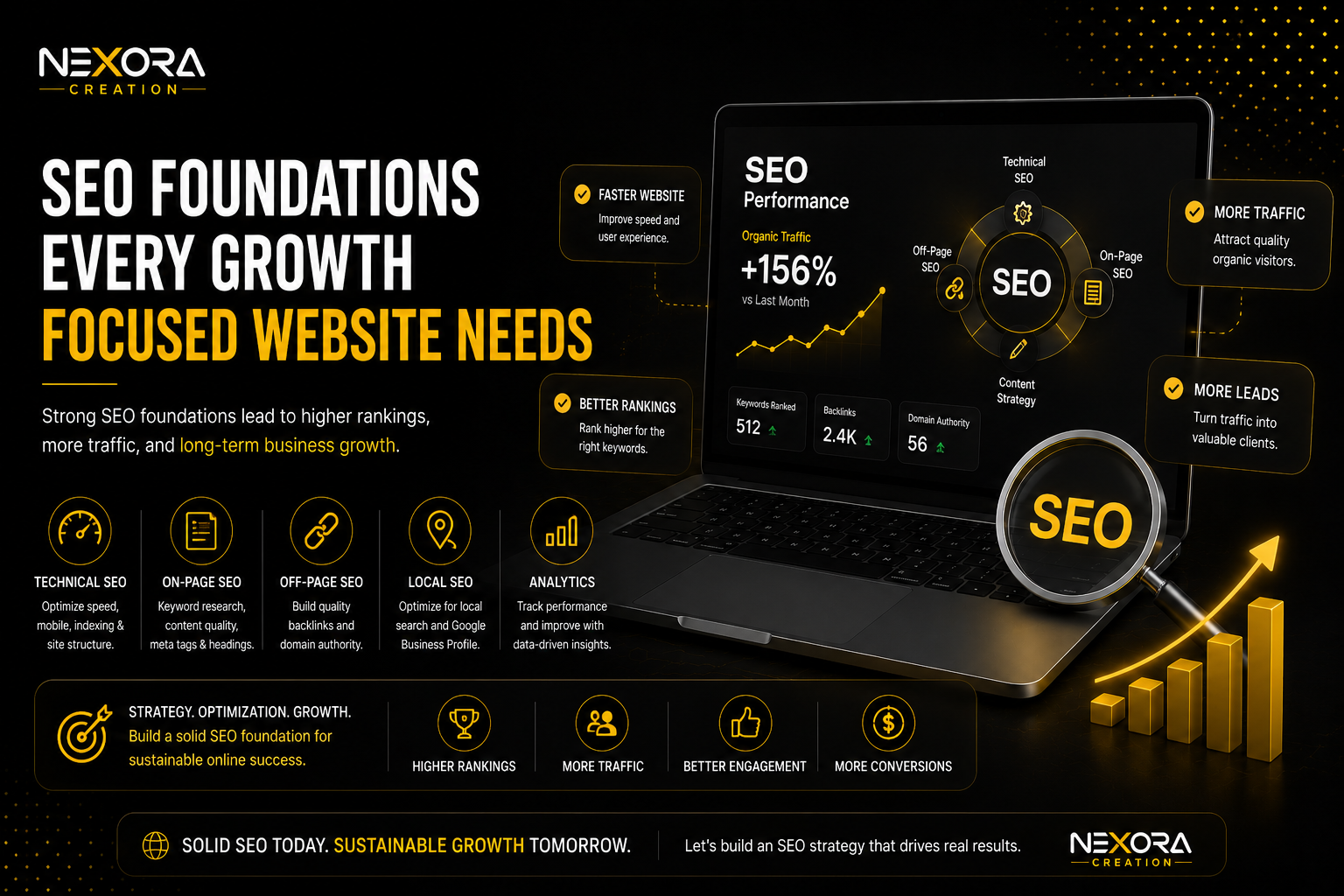
SEO foundations are the core technical, content, and user experience elements that help a website perform better in search engines.
A proper SEO foundation setup gives search engines the structure they need to crawl, understand, and rank your website more effectively. Whether you call it SEO foundations or foundation SEO, the goal is the same: building a technically sound website before investing heavily in content creation or paid marketing.
They include:
- Technical SEO
- Website speed
- Mobile responsiveness
- Crawlability
- Indexing
- Site structure
- Page titles
- Meta descriptions
- Heading hierarchy
- Internal linking
- Content quality
- User experience
- Local SEO
- Backlinks
- Conversion tracking
These foundations help search engines understand what your website is about.
They also help users find the right information quickly.
A website without strong SEO foundations may still look good, but it can struggle to rank, attract traffic, or convert visitors into leads.
Why do growth-focused websites need SEO foundations?
Growth-focused websites need SEO foundations because organic traffic depends on more than content alone.
If your website is slow, confusing, poorly structured, or hard to crawl, search engines may struggle to understand it. Users may also leave before they contact you.
A strong SEO foundation helps your website:
- Get discovered by search engines
- Rank for relevant keywords
- Support long-term organic traffic
- Improve user experience
- Build topical authority
- Connect content to service pages
- Generate better quality leads
- Reduce dependence on paid ads
For small businesses and service-based companies, SEO foundations are especially important because the website often works as the main trust and lead generation channel.
If people search for your services and your website does not appear, competitors get the opportunity.
If people find your website but cannot understand your offer, they leave.
SEO foundations help solve both problems.
Relevant Blog: Are AEO/GEO Tools Worth It?
How to Build SEO Foundations for a Growth-Focused Website
Building SEO foundations starts with creating a technically healthy website. Begin by checking crawlability, indexing, site speed, mobile responsiveness, and page structure. Next, organize your service pages logically, write clear page titles and meta descriptions, strengthen internal linking, and publish content that matches real search intent. Once these SEO foundations are in place, you can focus on authority building, backlinks, and ongoing content improvements with much greater confidence.
Why is technical SEO the starting point?
Technical SEO is the starting point because it helps search engines crawl, render, index, and understand your website.
Before you think about blogs or backlinks, your website should be technically healthy.
Technical SEO includes:
- Fast loading speed
- Mobile-friendly design
- Clean URL structure
- XML sitemap
- Robots.txt setup
- Indexing control
- Canonical tags
- Redirect management
- HTTPS security
- Structured data
- Broken link fixes
- Image optimization
- Clean code
- Core Web Vitals improvements
If technical SEO is weak, your best content may not perform well.
For example, a service page may have strong copy, but if it loads slowly, has poor mobile design, or is blocked from indexing, it will struggle to bring results.
Technical SEO does not replace good content. It supports it.
Think of technical SEO as the foundation of a building. If the foundation is weak, everything above it becomes unstable.
How does website speed affect SEO and conversions?
Website speed affects both SEO and user experience.
If a page loads slowly, users may leave before they even see your offer. This can reduce engagement, leads, and conversions.
Speed matters because visitors expect websites to respond quickly, especially on mobile.
Common speed issues include:
- Large uncompressed images
- Heavy themes
- Too many plugins
- Poor hosting
- Unused scripts
- No caching
- Large videos
- Poor page builder setup
- Unoptimized fonts
- Bloated code
To improve website speed, focus on:
- Compressing images
- Using WebP format
- Removing unnecessary plugins
- Using reliable hosting
- Enabling caching
- Reducing unused JavaScript
- Optimizing CSS
- Avoiding heavy animations
- Testing mobile performance
- Cleaning database bloat
A fast website creates a better user experience.
It also helps visitors move from page to page without frustration.
For a growth-focused website, speed is not just a technical metric. It directly affects leads, trust, and business performance.
Why is mobile optimization important for SEO?
Mobile optimization is important because many users visit websites from mobile devices.
If your website looks good on desktop but feels difficult on mobile, you may lose traffic and leads.
A mobile-friendly website should have:
- Readable text
- Easy-to-tap buttons
- Clear navigation
- Fast loading speed
- Short forms
- Proper spacing
- No horizontal scrolling
- Click-to-call buttons
- Clean section layout
- Responsive images
- Simple CTA placement
For service businesses, mobile optimization is even more important because users often search when they need fast help.
For example:
- A homeowner searching for roof repair
- A patient looking for a clinic
- A business owner searching for website services
- A customer looking for a local plumber
- A buyer comparing service providers
If the mobile experience is weak, they may leave and contact a competitor.
A growth-focused website should be built mobile-first, not mobile-later.
How should your website structure support SEO?
Your website structure should help both users and search engines understand your services clearly.
A weak structure confuses visitors and makes SEO harder.
A strong website structure usually includes:
- Homepage
- About page
- Main service pages
- Individual service pages
- Location pages if relevant
- Blog section
- Case studies or portfolio
- Contact page
- FAQ sections
- Clear navigation
For example, a digital agency website should not only have one general “Services” page.
It should have dedicated pages for each core service:
- Website Development
- SEO Services
- UI/UX Design
- CRM Automation
- AI Chatbots
- Graphic Design
- Landing Page Design
Each service page should target a clear keyword and answer a specific user intent.
This helps search engines understand the website better.
It also helps visitors find the exact service they need.
A clear structure improves both SEO and conversion flow.
Why are page titles and meta descriptions important?
Page titles and meta descriptions help users and search engines understand what a page is about.
A strong title can improve click-through rate from search results.
A strong meta description can help users decide whether your page answers their question.
Good page titles should be:
- Clear
- Keyword-focused
- Relevant to the page
- Written for users
- Not too long
- Unique for every page
Good meta descriptions should:
- Explain the value of the page
- Include the main topic naturally
- Match search intent
- Encourage the user to click
- Stay concise
- Avoid keyword stuffing
For example, a weak title would be:
“SEO Services”
A stronger title would be:
“SEO Services for Small Businesses That Need More Leads”
The second title is clearer because it connects the service with the business outcome.
Every important page on a growth-focused website should have a unique title and meta description.
Why does heading structure matter for SEO?
Heading structure helps organize your content.
It also helps users scan the page and understand the main points quickly.
A good heading structure uses:
- One H1 for the main page title
- H2 headings for main sections
- H3 headings for supporting points
- Clear question-based headings where useful
For example:
H1: SEO Foundations Every Growth-Focused Website Needs
H2: Why is technical SEO important?
H2: How does website speed affect SEO?
H2: Why does internal linking matter?
H2: How can SEO help generate leads?
Question-based headings are useful because they match how users search.
They also make content easier to understand and more suitable for AI-style answers.
However, headings should not be written only for search engines. They should help readers move through the content naturally.
Why is content structure important for SEO?
Content structure helps search engines understand the purpose of a page.
It also helps users find answers quickly.
A strong content structure includes:
- Clear introduction
- Direct answer early
- Logical sections
- Short paragraphs
- Bullet points
- Helpful examples
- Internal links
- FAQs
- Clear CTA
- Relevant images
- Updated information
For SEO, content should not only be long. It should be useful.
A 2,000-word article that says nothing new will not help much.
A strong article should:
- Answer the search intent
- Solve a real problem
- Include expert insight
- Use clear formatting
- Guide the user to the next step
- Connect to relevant service pages
For example, if a blog explains website speed, it should naturally link to a website development or technical SEO service page where the reader can get help.
This is how content supports both rankings and leads.
How does internal linking improve SEO and lead generation?
Internal linking helps search engines understand the relationship between your pages.
It also helps users move from educational content to service pages, contact pages, or relevant landing pages.
A strong internal link should not be added randomly.
It should appear where the reader has a clear problem and needs a next step.
For example, if a blog section explains that slow websites lose visitors, the internal link can guide the reader to a website development or speed optimization service.
Good internal links help with:
- Crawlability
- User navigation
- Topical authority
- Service page visibility
- Lead generation
- Content-to-conversion flow
For Nexora Creation, internal links should not only support SEO. They should also help turn readers into leads.
Example CTA:
If your website is slow, hard to use, or not converting visitors into enquiries, Nexora Creation can help improve your site structure, speed, and conversion flow through its website development services.
This type of internal link feels natural because it appears exactly where the reader has a relevant problem.
Why does user experience matter for SEO?
User experience matters because SEO is not only about search engines. It is also about people.
If users land on your website and struggle to navigate, read, or take action, your website will not support growth properly.
A good user experience includes:
- Clear navigation
- Fast loading pages
- Mobile-friendly layouts
- Readable content
- Strong visual hierarchy
- Clear CTAs
- Simple forms
- Helpful page structure
- Trust signals
- Accessible design
- No confusing popups
For example, a website may rank well, but if users cannot find the contact button, the page may not generate leads.
SEO brings visitors.
UX helps convert them.
That is why growth-focused websites need both SEO and user experience working together.
How do CTAs support SEO-driven growth?
CTAs support SEO-driven growth by turning organic visitors into business opportunities.
A website can rank and get traffic, but if it does not guide visitors to take action, that traffic may not create value.
A strong CTA should be:
- Clear
- Relevant
- Easy to find
- Connected to the page topic
- Focused on one next step
Weak CTAs include:
- Learn More
- Submit
- Click Here
- Contact Us
Stronger CTAs include:
- Request a Free Website Audit
- Book a Strategy Call
- Get a Custom Website Quote
- Schedule an SEO Consultation
- Improve My Website Performance
Every important page should have a clear CTA.
For example:
- SEO blog → SEO audit CTA
- Website speed blog → Website development CTA
- CRM blog → CRM automation CTA
- AI chatbot blog → Chatbot demo CTA
- Landing page blog → Landing page design CTA
This makes the website more useful for visitors and more effective for lead generation.
Why does helpful content build long-term SEO authority?
Helpful content builds authority because it answers real questions, solves real problems, and creates trust over time.
Search engines want to show useful results to users.
That means your content should be written for people first, not only for rankings.
Helpful content should:
- Answer the main question clearly
- Match search intent
- Provide practical solutions
- Use real examples
- Avoid generic explanations
- Show expertise
- Stay updated
- Guide the reader naturally
- Support business goals without being pushy
For example, a blog called “What is SEO?” may be too broad.
A more useful topic could be:
“Why Is My Website Getting Traffic But No Leads?”
That topic targets a real business problem.
It attracts readers who may need SEO, website development, UX improvements, or conversion optimization.
That is how helpful content connects visibility with lead generation.
Why is local SEO important for growth-focused websites?
Local SEO helps businesses appear for searches in specific cities, regions, or service areas.
It is especially important for:
- Clinics
- Dentists
- Lawyers
- Contractors
- Roofing companies
- HVAC companies
- Plumbers
- Restaurants
- Local agencies
- Home service businesses
Local SEO foundations include:
- Google Business Profile optimization
- Local service pages
- Location-specific content
- Consistent business information
- Reviews
- Local schema
- Local backlinks
- Service area details
- Contact information
- Map and direction signals
If your business serves a local area, your website should make that clear.
A local service page should answer:
- What service do you offer?
- Where do you offer it?
- Who do you help?
- Why should local customers trust you?
- How can they contact you?
- What happens after they enquire?
Local SEO helps your website attract visitors who are more likely to become customers.
Why are backlinks still important?
Backlinks are still important because they help build authority and trust.
A backlink is a link from another website to your website.
Search engines can use backlinks as signals that your website is valuable or trustworthy.
However, quality matters more than quantity.
Strong backlinks can come from:
- Local business directories
- Industry websites
- Guest posts
- Digital PR
- Partner websites
- Sponsorships
- Local chambers
- Case study features
- Resource pages
- Useful tools or guides
Avoid low-quality link schemes, spam links, and irrelevant backlinks.
A growth-focused website should earn links by publishing useful content, building real relationships, and creating resources people want to reference.
Backlinks should support authority, not manipulate rankings.
How does schema markup help SEO?
Schema markup helps search engines understand the content and context of your pages.
It does not guarantee rankings, but it can support better search understanding.
Useful schema types include:
- Organization schema
- LocalBusiness schema
- Article schema
- FAQ schema
- Service schema
- Breadcrumb schema
- Review schema where appropriate
For example, a blog post can use Article schema.
A service page can use Service schema.
A local business page can use LocalBusiness schema.
A FAQ section can use FAQ schema if the content is visible on the page and follows search guidelines.
Schema is not a replacement for good content.
It simply adds clearer context for search engines.
Why does conversion tracking matter for SEO?
Conversion tracking matters because rankings and traffic are not the final goal.
The real goal is business growth.
If your website gets traffic but no leads, you need to know why.
Track important actions like:
- Form submissions
- Phone calls
- WhatsApp clicks
- Email clicks
- Booking clicks
- Quote requests
- Newsletter signups
- CRM leads
- Chatbot conversations
- Service page conversions
You should also review:
- Which pages bring traffic
- Which pages generate leads
- Which keywords bring qualified visitors
- Which blogs support service page visits
- Which CTAs get clicks
- Where users drop off
Search Console helps you understand impressions, clicks, queries, and page performance.
Analytics and CRM data help you understand what happens after the click.
A growth-focused SEO strategy should connect search visibility with real business outcomes.
How often should you update SEO content?
You should update SEO content when it becomes outdated, too thin, poorly structured, or starts getting impressions without enough clicks or conversions.
If a blog is getting impressions in Google Search Console, that is a sign Google has started testing it.
That does not always mean the content is strong enough yet.
You can improve it by updating:
- Meta title
- Meta description
- Headings
- Intro
- Content depth
- FAQs
- Internal links
- CTA placement
- Images
- Examples
- Schema
- Search intent alignment
For example, if a short blog about SEO foundations gets impressions, it should be expanded into a complete guide that answers more related questions and connects users to relevant services.
That is how you turn a basic post into a stronger SEO asset.
SEO Foundation Setup Checklist for Growth-Focused Websites
Every growth-focused website should start with a simple SEO foundation audit.
Use this checklist:
Technical SEO
- Is the website indexable?
- Does it have an XML sitemap?
- Are important pages blocked?
- Are there broken links?
- Are redirects working properly?
- Is HTTPS active?
- Are canonical tags correct?
Speed and performance
- Does the website load quickly?
- Are images compressed?
- Is caching enabled?
- Are unnecessary scripts removed?
- Does the site perform well on mobile?
Site structure
- Are service pages clearly organized?
- Is navigation simple?
- Are important pages easy to find?
- Is there a clear page hierarchy?
On-page SEO
- Does every page have one H1?
- Are headings structured properly?
- Are page titles unique?
- Are meta descriptions optimized?
- Are keywords used naturally?
Content quality
- Does the content answer real questions?
- Is it helpful and specific?
- Does it include examples?
- Does it guide the reader to the next step?
Internal linking
- Do blogs link to service pages?
- Do service pages link to related resources?
- Are links placed where users need help?
- Do links support lead generation?
User experience
- Is the website easy to use?
- Are CTAs clear?
- Are forms simple?
- Does the mobile layout work well?
- Are trust signals visible?
Tracking
- Is Google Search Console connected?
- Is analytics tracking set up?
- Are conversions tracked?
- Are form submissions recorded?
- Are calls and CTA clicks measured?
This checklist helps you find the weak points before spending more money on content or ads.
How can Nexora Creation help build SEO-ready websites?
Nexora Creation helps businesses build SEO-ready websites designed for visibility, speed, structure, and lead generation.
A strong website should not only look good. It should support the full growth journey from search visibility to user trust and conversion.
Our website development and SEO services can help with:
- SEO-friendly website structure
- Technical SEO setup
- Fast-loading WordPress websites
- Service page optimization
- Blog structure
- Internal linking strategy
- Mobile-first design
- On-page SEO
- Local SEO foundations
- CTA placement
- Conversion-focused layouts
- Tracking setup
- CRM and automation integration
If your website is not ranking, not converting, or not supporting long-term growth, the first step is to review the SEO foundations.
Conclusion
SEO foundations are the base of every growth-focused website.
Keywords matter, but they are only one part of SEO.
A strong website needs technical health, fast performance, mobile optimization, clear structure, useful content, internal links, local SEO, trust signals, and conversion tracking.
Without these foundations, your website may struggle to rank.
Even if it gets traffic, it may fail to turn visitors into leads.
The best SEO strategy connects visibility with business growth.
That means your website should help search engines understand your content and help users take the next step.
At Nexora Creation, we build SEO-ready websites that are structured for search visibility, user experience, and long-term lead generation.
If your website has started getting impressions but is not bringing enough clicks or enquiries, this is the right time to update your content, improve your structure, and strengthen your SEO foundations.
FAQs
What are SEO foundations?
SEO foundations are the core technical, content, and user experience elements that help a website rank, attract traffic, and convert visitors into leads. They include technical SEO, site speed, mobile design, page structure, metadata, internal links, helpful content, and tracking.
Why is technical SEO important?
Technical SEO is important because it helps search engines crawl, render, index, and understand your website. If technical SEO is weak, your content may struggle to perform even if the information is useful.
Does website speed affect SEO?
Yes, website speed affects user experience and can influence SEO performance. A fast website helps users access content quickly, reduces frustration, and supports better conversion rates.
Why does internal linking matter for SEO?
Internal linking helps search engines understand your website structure and helps users move from one useful page to another. It can also guide readers from blogs to relevant service pages, improving lead generation opportunities.
What is the difference between SEO and user experience?
SEO helps users find your website through search engines. User experience helps visitors understand, navigate, and take action once they arrive. A growth-focused website needs both.
How often should SEO content be updated?
SEO content should be updated when it becomes outdated, too thin, poorly structured, or starts getting impressions without enough clicks or leads. Regular updates can improve relevance, depth, and conversion potential.
Can a website rank without backlinks?
A website can rank for some low-competition topics without many backlinks, but backlinks can help build authority. Strong content, technical SEO, internal linking, and topical relevance should come first.
What is the first SEO step for a business website?
The first step is to audit the website’s technical health, page structure, speed, mobile experience, metadata, content quality, internal links, and conversion tracking.