
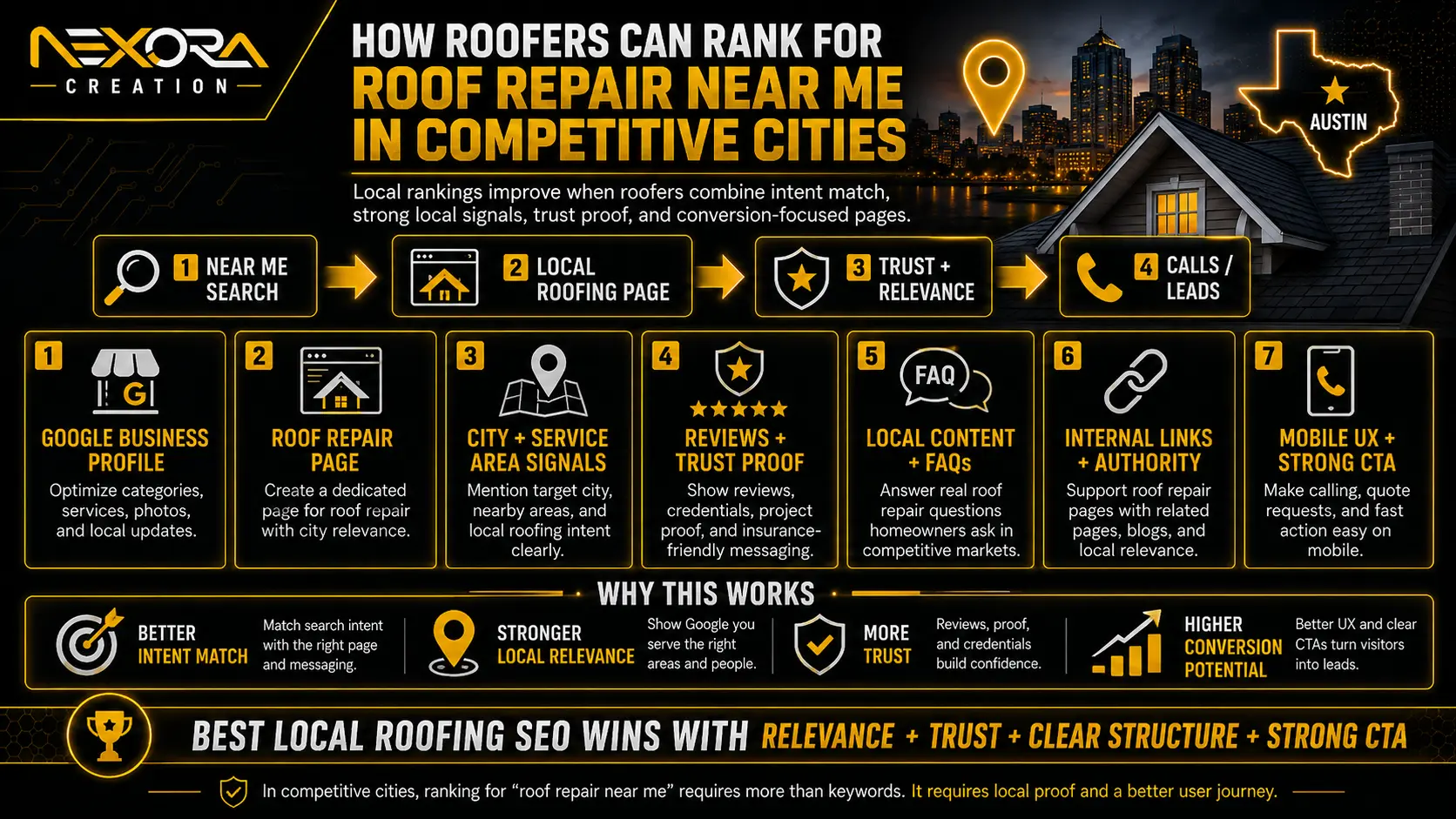
Roofers can rank for “roof repair near me” in competitive cities by building strong local SEO signals across Google Business Profile, website service pages, reviews, local content, citations, backlinks, and mobile conversion paths.
But there is one important point:
You cannot rank for “roof repair near me” everywhere just by adding that phrase to your website.
Near me searches are local.
Google looks at where the searcher is located, how relevant your business is, and how prominent your business appears compared to competitors.
That means a roofing company in Austin, Dallas, Tampa, Phoenix, Houston, Orlando, or another competitive city needs more than a basic website.
It needs a complete local SEO system.
A homeowner searching “roof repair near me” may have an urgent problem such as:
- Roof leak
- Missing shingles
- Storm damage
- Hail damage
- Wind damage
- Damaged flashing
- Ceiling stains
- Emergency roof repair need
- Roof inspection concern
This visitor is often close to calling.
That makes the keyword valuable.
At Nexora Creation, we see “roof repair near me” SEO as a combination of visibility and conversion. Ranking is important, but the page also needs to turn visitors into calls, inspections, and quote requests.
In this guide, we will explain how roofers can rank for “roof repair near me” in competitive cities and what actually moves local visibility.
What does “roof repair near me” mean for SEO?
“Roof repair near me” is a local-intent keyword.
When someone searches it, they usually want a roofing contractor close enough to help them.
Google may show:
- Google Maps results
- Local Pack results
- Google Business Profiles
- Organic roofing websites
- Review-based results
- Local service pages
- Ads
For roofers, this keyword is valuable because it shows strong intent.
The searcher is not only learning about roofing.
They may need a contractor.
But ranking for “roof repair near me” depends on multiple signals.
These include:
- Your physical location or service area
- Google Business Profile relevance
- Roof repair service page quality
- Reviews
- Local prominence
- Website authority
- Local citations
- Backlinks
- User engagement
- Mobile experience
- Trust signals
The phrase “near me” is not the main thing to optimize.
The local roofing system is what matters.
Why is “roof repair near me” so competitive?
“Roof repair near me” is competitive because it can produce high-value leads.
A roof repair lead can turn into:
- Emergency repair
- Storm damage inspection
- Roof leak repair
- Hail damage inspection
- Wind damage repair
- Roof replacement opportunity
- Insurance-related inspection support
- Long-term customer relationship
Many roofing companies want those leads.
That means competitive cities often have:
- Many roofing contractors
- Strong Google Business Profiles
- High review counts
- Paid ads
- Local SEO agencies
- Strong service pages
- Local backlinks
- Storm damage campaigns
- Competitive Google Maps results
If your roofing company has a weak website, incomplete profile, few reviews, and thin roof repair page, it will be difficult to compete.
The goal is not to trick Google.
The goal is to become a stronger local result.
How does Google rank roofers for near me searches?
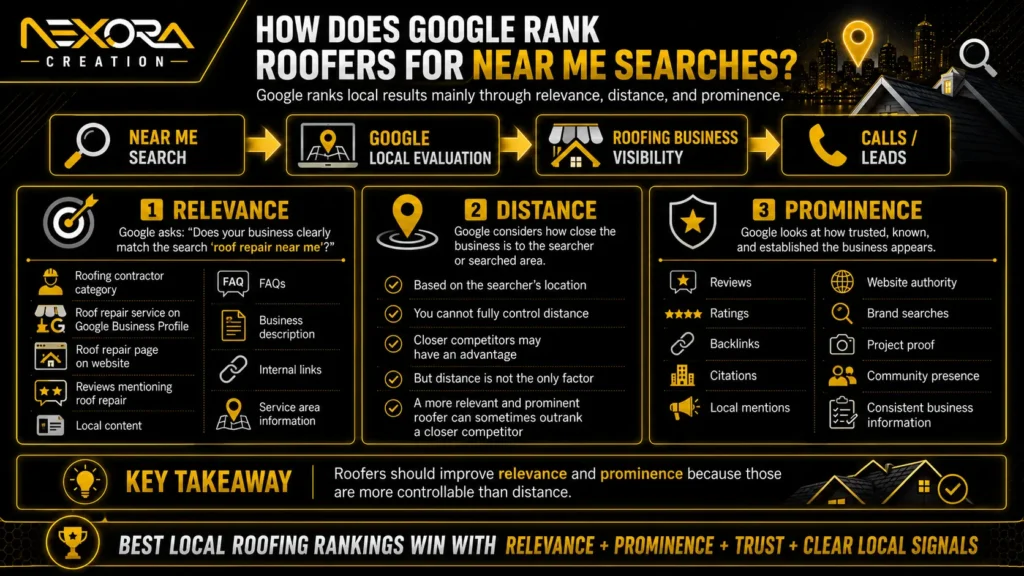
Google ranks local results mainly through relevance, distance, and prominence.
For roofers, that means:
Relevance
Does your business clearly match the search “roof repair near me”?
Relevance is supported by:
- Roofing contractor category
- Roof repair service listed on Google Business Profile
- Roof repair page on your website
- Reviews mentioning roof repair
- Local content
- FAQs
- Business description
- Internal links
- Service area information
Distance
How close is your business to the searcher or the area in the search?
You cannot fully control distance.
A roofer closer to the searcher may have an advantage.
But distance is not the only factor.
A more relevant and prominent business can sometimes outrank a closer competitor.
Prominence
How trusted, known, and established does your business appear?
Prominence is supported by:
- Reviews
- Ratings
- Backlinks
- Citations
- Local mentions
- Website authority
- Brand searches
- Project proof
- Community presence
- Consistent business information
Roofers should improve relevance and prominence because those are more controllable than distance.
Step 1: Optimize Google Business Profile for roof repair
Google Business Profile is one of the most important assets for “roof repair near me” rankings.
Your profile should clearly show that you offer roof repair.
Optimize these areas:
- Primary category
- Secondary categories
- Services
- Business description
- Service areas
- Photos
- Reviews
- Questions and answers
- Business hours
- Website link
- Appointment or contact link
- Posts and updates
For most roofers, the primary category should accurately match the main business type.
Then add relevant services such as:
- Roof repair
- Emergency roof repair
- Roof leak repair
- Storm damage repair
- Hail damage inspection
- Wind damage repair
- Roof inspection
- Roof replacement
Keep everything accurate.
Do not add services you do not provide.
Do not stuff keywords into the business name unless they are part of the real business name.
The profile should look complete, active, and trustworthy.
Step 2: Build a dedicated roof repair service page
A dedicated roof repair service page is essential.
Do not rely only on your homepage.
A strong roof repair page helps Google and homeowners understand your service.
The page should target searches like:
- Roof repair near me
- Roof repair in [city]
- Roof leak repair near me
- Emergency roof repair
- Storm damage roof repair
- Roofing repair contractor
A strong roof repair page should include:
- Clear H1
- City or service area mention
- Roof repair problems
- Inspection process
- Benefits
- Reviews
- Trust proof
- Service areas
- FAQs
- Click-to-call CTA
- Short form
- Internal links
- Final CTA
Example H1:
“Roof Repair in Austin”
or:
“Roof Repair Services for Local Homeowners”
Avoid making the page too generic.
It should clearly explain what roof repair issues you handle.
Step 3: Mention real roof repair problems
Roof repair pages should mention real problems homeowners face.
This helps users and search engines understand the page.
Common roof repair problems include:
- Roof leaks
- Missing shingles
- Lifted shingles
- Damaged flashing
- Cracked pipe boots
- Damaged roof vents
- Granule loss
- Storm damage
- Hail damage
- Wind damage
- Ceiling stains
- Sagging areas
- Loose ridge caps
- Damaged gutters
- Tree limb damage
- Water intrusion
Example copy:
“Call for roof repair if you notice missing shingles, ceiling stains, roof leaks, lifted shingles, damaged flashing, or storm-related roof damage.”
This is more useful than simply saying:
“We offer quality roof repair.”
Specific problems help match search intent.
They also help visitors confirm they are in the right place.
Step 4: Add local service area signals
For competitive cities, service area clarity matters.
A roofing website should clearly show where the contractor works.
For example, an Austin roofer may mention:
- Austin
- Round Rock
- Cedar Park
- Pflugerville
- Georgetown
- Leander
- Buda
- Kyle
- Lakeway
- Bee Cave
A Dallas roofer may mention:
- Dallas
- Plano
- Irving
- Garland
- Richardson
- Frisco
- McKinney
- Arlington
- Fort Worth
A Tampa roofer may mention:
- Tampa
- Brandon
- Riverview
- Clearwater
- St. Petersburg
- Wesley Chapel
- Carrollwood
Only list areas you actually serve.
A service area section can say:
“We provide roof repair services across Austin, Round Rock, Cedar Park, Pflugerville, Georgetown, and nearby communities.”
This helps visitors know whether you serve them.
It also supports local relevance.
Step 5: Build location pages carefully
Location pages can help roofers rank in competitive cities, but only when they are useful.
Do not create hundreds of duplicate pages with only city names changed.
That creates thin content.
A good location page should include:
- Local roofing services offered
- Local service area details
- Common roof problems in that area
- Project photos, if available
- Reviews from nearby customers, if available
- Service-specific FAQs
- Clear CTA
- Internal links
- Contact options
For example:
“Roof Repair in Round Rock”
should not be the same as:
“Roof Repair in Austin”
Each page should have real local value.
If your roofing website needs better service and location page structure, Nexora Creation can help build SEO-friendly pages that support local rankings and lead generation.
Step 6: Get more detailed roof repair reviews
Reviews are important for local SEO and conversions.
For “roof repair near me,” homeowners often compare businesses by reviews before calling.
Strong review signals include:
- Number of reviews
- Average rating
- Review freshness
- Review detail
- Service mentions
- Location mentions
- Owner responses
- Overall trust
A detailed review is more useful than a vague one.
Strong review example:
“They repaired a roof leak after heavy rain, replaced missing shingles, and explained the inspection clearly.”
Weak review example:
“Great company.”
Ask happy customers for honest reviews after service.
Do not buy fake reviews.
Do not pressure customers.
Do not review-gate.
Respond to reviews professionally.
A good response can mention the service naturally:
“Thank you for trusting our team with your roof repair. We are glad we could help inspect the leak and explain the next steps.”
Reviews help ranking and trust.
Step 7: Add roof repair photos and project proof
Roofing is visual.
Photos can improve trust and engagement.
A roofing website and Google Business Profile should include real photos such as:
- Roof repair projects
- Missing shingles
- Roof leak areas
- Flashing repair
- Storm damage
- Hail damage examples
- Before and after photos
- Team photos
- Service vehicles
- Roof inspection photos
- Emergency tarping photos
Photos help homeowners see that the company does real work.
Optimize photos with:
- Compressed file size
- WebP format where possible
- Descriptive file names
- Helpful alt text
- Correct dimensions
- Fast loading
Example file name:
roof-repair-austin-missing-shingles.webp
Example alt text:
“Roof repair in Austin showing missing shingles replaced after storm damage.”
Do not use only stock images.
Real project proof is stronger.
Step 8: Improve on-page SEO for roof repair pages
On-page SEO helps Google understand the page.
A strong roof repair page should have:
- SEO-friendly URL
- Optimized title tag
- Clear meta description
- One strong H1
- Question-based H2s
- Natural keyword use
- Roof repair terms
- Location terms
- Service area section
- Internal links
- FAQs
- Image alt text
- Schema where relevant
- Clear CTA
Example URL:
/roof-repair-austin/
Example title:
Roof Repair in Austin | Local Roofing Contractor
Example meta description:
Need roof repair in Austin? Get help with leaks, missing shingles, storm damage, inspections, and emergency repair from a local roofing team.
Avoid keyword stuffing.
Do not repeat “roof repair near me” unnaturally.
Write for homeowners first.
Step 9: Build internal links to the roof repair page
Internal links help strengthen your roof repair page.
Link to it from:
- Homepage
- Roofing services page
- Storm damage page
- Hail damage page
- Wind damage page
- Roof leak blog posts
- Emergency roof repair page
- Service area pages
- Blog posts
- Footer or service menu
Useful internal link examples:
- Roof Repair Services
- Emergency Roof Repair
- Storm Damage Roof Repair
- Roof Leak Repair
- Schedule Roof Inspection
A blog about roof leaks should link to roof repair.
A blog about hail damage should link to storm damage or roof inspection.
A blog about missing shingles should link to roof repair.
Internal links should guide visitors to the next step.
If your roofing blogs get traffic but do not generate leads, Nexora Creation can help improve internal linking and CTA structure through its SEO services.
Step 10: Create storm damage content
Storm damage content can support “roof repair near me” rankings because many roof repair searches happen after weather events.
Useful storm damage pages include:
- Storm Damage Roof Repair
- Hail Damage Roof Inspection
- Wind Damage Roof Repair
- Emergency Roof Repair
- Roof Leak Repair After Storms
- Roof Tarping Services
Useful blog topics include:
- How to Tell If Your Roof Has Hail Damage
- What to Do After a Roof Leak
- Signs Your Shingles Were Damaged by Wind
- Should You Get a Roof Inspection After a Storm?
- Roof Repair vs Roof Replacement
- How Long Can Roof Damage Go Unnoticed?
Each storm content piece should link to the roof repair page or inspection page.
This builds topical authority around roof repair and storm damage.
Step 11: Build local citations
Citations are online mentions of your business information.
They usually include:
- Business name
- Address
- Phone number
- Website
- Category
- Hours
- Description
Roofers should make sure business information is consistent across:
- Google Business Profile
- Bing Places
- Apple Maps
- Yelp
- BBB, if applicable
- Local directories
- Roofing directories
- Chamber of commerce
- Industry associations
- Local business listings
Inconsistent information can create confusion.
Common citation problems include:
- Wrong phone number
- Old address
- Different business names
- Duplicate listings
- Wrong website URL
- Incorrect hours
- Wrong categories
Citations alone will not rank you.
But they support trust and consistency.
Step 12: Earn local backlinks and mentions
Backlinks and local mentions help build prominence.
Useful backlink sources for roofers include:
- Local news websites
- Chamber of commerce
- Local sponsorships
- Community organizations
- Supplier websites
- Partner businesses
- Construction directories
- Roofing associations
- Local event pages
- Neighborhood websites
- Local blogs
Avoid spammy backlinks.
Do not buy cheap link packages.
Do not rely on private blog networks.
A few relevant local links can be more valuable than many low-quality links.
Prominence takes time.
The goal is to build real local credibility.
Step 13: Improve mobile speed and call flow
Many “roof repair near me” searches happen on mobile.
A homeowner may be looking for help after noticing a leak, storm damage, or missing shingles.
Your mobile website should make action easy.
Important mobile features include:
- Fast loading
- Click-to-call button
- Sticky mobile call bar
- Short form
- Clear service headline
- Reviews near CTA
- Service area section
- Easy navigation
- No blocking popups
- Readable text
- Large tap targets
A good mobile test:
Can a visitor call in less than 3 seconds?
If not, improve the call flow.
Mobile UX affects leads.
A roofing website can rank but still lose customers if the mobile experience is weak.
Step 14: Add schema markup
Schema markup can help search engines understand your website more clearly.
Useful schema types for roofers may include:
- LocalBusiness schema
- RoofingContractor schema, where supported
- Service schema
- FAQ schema
- Breadcrumb schema
- Review schema, where eligible
- Article schema for blogs
Schema does not guarantee rankings.
But it supports clarity.
Make sure schema matches visible content.
Do not add fake reviews or misleading data.
Step 15: Track calls, forms, and booked jobs
Ranking is not enough.
Roofers should track whether “roof repair near me” visibility turns into leads.
Track:
- Google Business Profile calls
- Website calls
- Click-to-call taps
- Form submissions
- Inspection requests
- Quote requests
- Service page visits
- Blog-to-service clicks
- CRM leads
- Missed calls
- Booked inspections
- Closed jobs
This helps answer:
- Which pages generate leads?
- Which locations perform best?
- Which keywords bring calls?
- Which campaigns waste budget?
- Which leads become jobs?
- Which follow-ups are missed?
SEO should be measured by leads and booked jobs, not only rankings.
Step 16: Use CRM automation to protect roofing leads
CRM automation can help roofers follow up faster.
Roof repair leads can be urgent.
If a homeowner contacts multiple roofers and your team responds late, the lead may be lost.
A CRM can help:
- Capture form submissions
- Store lead source
- Tag service type
- Notify the team
- Assign follow-up
- Send confirmation messages
- Track calls
- Record inspection requests
- Measure booked jobs
- Follow up with missed calls
If your roofing SEO generates leads but your team loses them during follow-up, Nexora Creation can help connect your website forms, calls, and inspection requests with CRM automation.
Can AI chatbots help roof repair near me traffic?
AI chatbots can help capture visitors who are not ready to call.
A chatbot can answer:
- Do you serve my area?
- Can I request a roof inspection?
- Do you repair roof leaks?
- Do you handle storm damage?
- What should I do if my roof is leaking?
- Can someone call me back?
It can collect:
- Name
- Phone number
- ZIP code
- Roofing issue
- Urgency level
- Preferred contact time
This can improve lead capture from SEO traffic.
But for emergency roof repair, the phone CTA should still be primary.
AI Voice Agent & Chatbot Services
What mistakes stop roofers from ranking for roof repair near me?
Common mistakes include:
- Incomplete Google Business Profile
- Wrong primary category
- No dedicated roof repair page
- Thin service content
- No local service area section
- Few reviews
- No review responses
- No project photos
- Inconsistent citations
- Weak backlinks
- Slow mobile website
- Hidden phone number
- No internal links
- Duplicate city pages
- Keyword stuffing
- No storm damage content
- No conversion tracking
- No CRM follow-up
Each mistake weakens the local SEO system.
Fix the foundation first.
Then improve authority, content, and conversion paths.
How long does it take to rank for roof repair near me?
Ranking time depends on competition, location, website strength, reviews, profile quality, and local authority.
In less competitive areas, improvements may show faster.
In competitive cities, it can take months of consistent work.
Factors that affect timing include:
- Current rankings
- Competitor strength
- Review gap
- Website quality
- Technical SEO
- Local citations
- Backlinks
- Content depth
- Google Business Profile activity
- Service page quality
- User engagement
Do not expect overnight results.
Local SEO is an ongoing process.
The roofers that win usually keep improving their profile, website, reviews, content, and lead flow.
How can Nexora Creation help roofers rank locally?
Nexora Creation helps roofing contractors build local SEO systems designed to improve visibility and generate leads.
For roofers trying to rank for “roof repair near me,” we can help with:
- Google Business Profile optimization
- Roof repair service pages
- Storm damage pages
- Hail damage content
- Local SEO strategy
- Website development
- Internal linking
- Service area pages
- Review strategy
- Technical SEO
- Mobile call flow
- Landing page design
- CRM automation
- AI chatbot integration
- Conversion tracking
If your roofing company is not ranking for roof repair searches or not getting enough calls from local traffic, the issue may be your full local SEO and website system.
What is the best strategy to rank for roof repair near me?
The best strategy is to build a complete local SEO system around roof repair intent.
That system should include:
- Optimized Google Business Profile
- Correct roofing categories
- Dedicated roof repair page
- Strong service area section
- Detailed reviews
- Real roof repair photos
- Local citations
- Local backlinks
- Storm damage content
- Internal links
- Fast mobile website
- Click-to-call CTA
- Schema markup
- Lead tracking
- CRM follow-up
Do not only add “near me” to your page.
Near me rankings come from local relevance, distance, and prominence.
Build those signals consistently.
Conclusion
Roofers can rank for “roof repair near me” in competitive cities by improving the full local SEO system, not by using one keyword trick.
Google needs to understand:
- What services you offer
- Where you serve
- Why your business is relevant
- Why homeowners should trust you
To compete, roofers should focus on:
- Google Business Profile optimization
- Dedicated roof repair pages
- Reviews
- Project photos
- Service area clarity
- Internal links
- Citations
- Backlinks
- Storm damage content
- Mobile speed
- Click-to-call flow
- CRM follow-up
- Lead tracking
The goal is not only to rank.
The goal is to turn local roofing searches into calls, inspections, quotes, and booked jobs.
A strong “roof repair near me” strategy helps your roofing company become easier to find, easier to trust, and easier to contact.
FAQs
Can roofers rank for “roof repair near me”?
Yes, roofers can rank for “roof repair near me” by improving Google Business Profile, service pages, reviews, local relevance, citations, backlinks, mobile UX, and lead tracking.
Should I add “near me” to my roofing website?
You can use “near me” naturally in some content, but rankings depend more on local relevance, distance, and prominence than repeating the phrase.
What page should rank for roof repair near me?
A dedicated roof repair service page is usually the best page to target this intent. It should include service details, location relevance, reviews, FAQs, CTAs, and trust proof.
Do Google reviews help roofers rank locally?
Yes, reviews can support local prominence and trust. Detailed, recent, honest reviews can help both rankings and conversions.
Does Google Business Profile matter for roof repair searches?
Yes, Google Business Profile is essential for near me searches because many local roofing results appear in Google Maps and the Local Pack.
How can roofers improve local relevance?
Roofers can improve local relevance with accurate profile categories, roof repair services, service area content, local pages, reviews, FAQs, and strong service pages.
How long does roofing local SEO take?
It depends on competition and current website strength. In competitive cities, local SEO usually requires months of consistent improvements.
What is the biggest mistake roofers make with near me SEO?
The biggest mistake is relying on one generic homepage instead of building a complete local SEO system with service pages, reviews, profile optimization, local content, and tracking.