
To build topical authority for a new business website, you need to create a clear website structure, publish helpful content around your core services, connect related pages with internal links, answer real customer questions, and show experience in one focused topic area before trying to rank for everything.
A new website usually has a trust problem.
Google does not know the website yet.
Users do not know the brand yet.
The site may have:
- Few indexed pages
- Few backlinks
- Few internal links
- No content history
- No topical depth
- No service-page authority
- No strong search signals
- No consistent publishing pattern
- No clear content clusters
- No proof that the business understands the topic
That is why new websites often struggle to rank.
The solution is not to publish random blogs.
The solution is to build topical authority.
Topical authority means your website becomes a trusted source around a specific subject, service, industry, or problem area.
As an SEO expert and website developer, I build topical authority by connecting:
- Core service pages
- Supporting blogs
- Internal links
- Search intent
- Helpful answers
- Technical SEO
- Conversion paths
- Trust signals
- Lead tracking
At Nexora Creation, I do not treat topical authority as only a content strategy. I treat it as a full website system. A new website should help Google understand what the business does, help users trust the service, and guide visitors toward a clear next step.
In this guide, I will explain how to build topical authority for a new business website from the ground up.
What is topical authority in SEO?
Topical authority means your website has strong, useful, and connected content around a specific topic.
It shows that your website is not only targeting one keyword.
It is covering the topic deeply.
For example, a website trying to build authority around SEO should not only publish one page called “SEO Services.”
It should also cover related topics like:
- Local SEO
- Technical SEO
- Google Search Console
- Content decay
- Lost keywords
- SEO recovery
- Internal linking
- Website structure
- On-page SEO
- Service-page SEO
- SEO reporting
- Search intent
- AI search optimization
These pages should connect to each other.
They should also support the main SEO Services page.
That is topical authority.
Google and users can see that the website has depth, structure, and consistency around the topic.
Why does topical authority matter for a new business website?
Topical authority matters because new websites usually do not have strong trust, backlinks, or history.
A new site needs to prove relevance.
Topical authority helps a new business website:
- Build search visibility
- Improve crawl understanding
- Support service pages
- Create content depth
- Answer customer questions
- Build trust with users
- Improve internal linking
- Target long-tail keywords
- Support local SEO
- Improve AI search visibility
- Create lead-generation paths
- Reduce random content publishing
- Build a stronger brand position
Without topical authority, a new website may look thin.
It may have a homepage, a few service pages, and a contact page.
That is often not enough to compete.
A new website needs a focused content system.
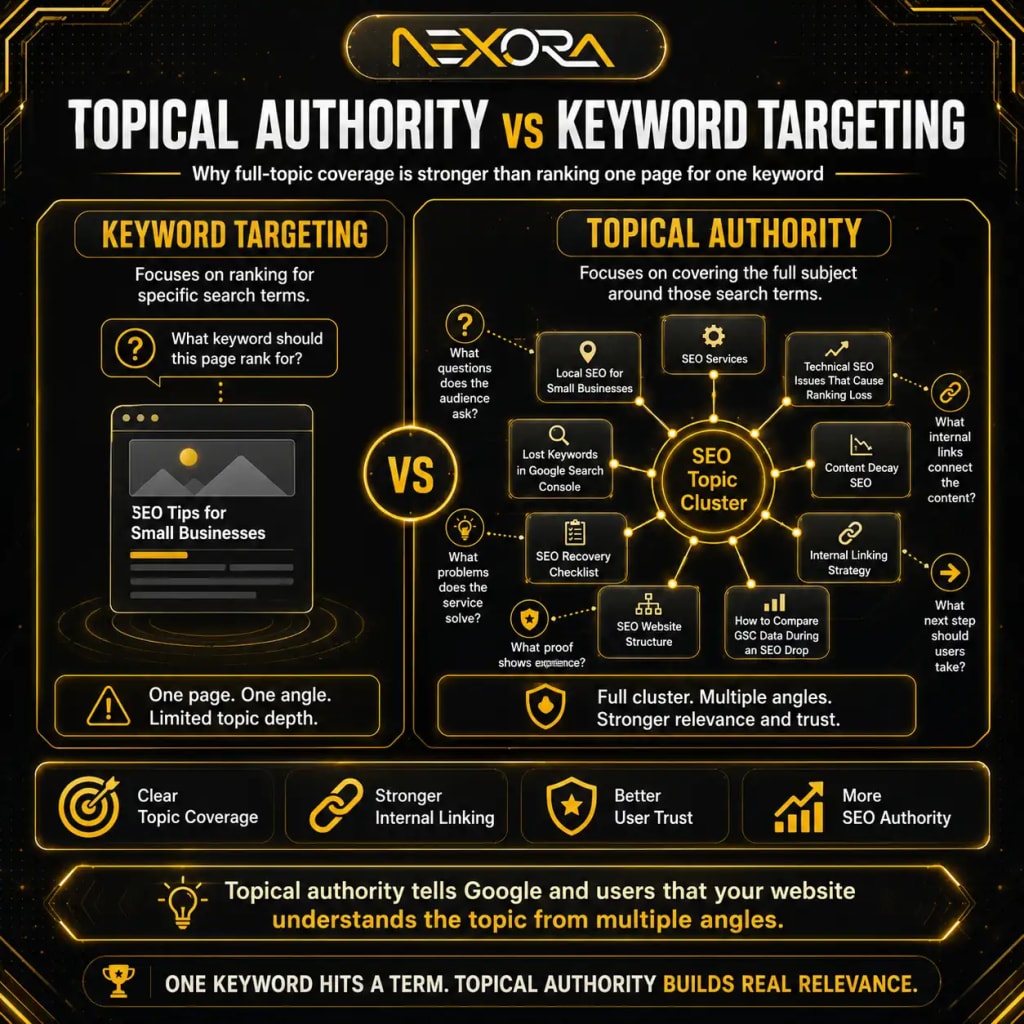
How is topical authority different from keyword targeting?
Keyword targeting focuses on ranking for specific search terms.
Topical authority focuses on covering the full subject around those search terms.
Keyword targeting asks:
- What keyword should this page rank for?
Topical authority asks:
- What topic should this website become known for?
- What questions does the audience ask?
- What problems does the service solve?
- What related pages should support the main page?
- What internal links should connect the content?
- What proof shows experience?
- What next step should users take?
For example, keyword targeting may create one blog:
- “SEO Tips for Small Businesses”
Topical authority creates a full cluster:
- SEO Services
- Local SEO for Small Businesses
- Technical SEO Issues That Cause Ranking Loss
- Lost Keywords in Google Search Console
- Content Decay SEO
- SEO Recovery Checklist
- Internal Linking Strategy
- SEO Website Structure
- How to Compare GSC Data During an SEO Drop
This is much stronger.
It tells Google and users that the website understands the topic from multiple angles.
What should a new business website focus on first?
A new business website should first focus on one core service or topic area.
Do not try to rank for every service at once.
Start with the service that has the strongest business value.
For example, a digital agency may offer:
- Website Development
- SEO Services
- CRM Automation
- AI Voice Agents and Chatbots
- UI/UX Design
- Graphic Design
Instead of publishing random content across all services, choose one primary cluster first.
Good starting clusters may include:
- SEO for service businesses
- Website development for lead generation
- CRM automation for missed leads
- AI chatbots for service businesses
- Landing pages for Google Ads
This helps the website build depth faster.
A focused site grows stronger than a scattered site.
How do you choose the first topic cluster?
Choose the first topic cluster based on business value, search demand, service expertise, and lead potential.
Ask:
- Which service brings the best clients?
- Which service has strong profit potential?
- Which service solves urgent problems?
- Which service has enough search demand?
- Which service connects to many useful blog topics?
- Which service can generate leads from content?
- Which service do you want to be known for?
- Which service can you prove with examples?
- Which service has clear customer pain points?
For a new agency website, SEO can be a strong first cluster because it connects to:
- Ranking drops
- Google Search Console
- Lost keywords
- Content decay
- Website structure
- Internal linking
- Local SEO
- Technical SEO
- Lead generation
- Website conversion
Website Development can also be a strong cluster because it connects to:
- Poor UX
- Slow pages
- Weak CTAs
- Landing pages
- Service pages
- Mobile design
- SEO structure
- Lead capture
- Conversion-focused design
Choose one cluster.
Build it properly.
Then expand.
What pages do you need to build topical authority?
A new business website needs a mix of core pages and supporting content.
Important pages include:
- Homepage
- Main services page
- Individual service pages
- Blog or resource hub
- Topic cluster blogs
- About page
- Contact page
- Case studies or portfolio
- Testimonials
- FAQ sections
- Location pages, if local
- Industry pages, if niche-focused
For topical authority, the most important pages are:
- Main service page
- Supporting blog posts
- Related service pages
- Internal link hub
- Case study or proof page
- Contact page
A service page tells users what you offer.
Supporting blogs answer questions around that service.
Internal links connect them.
Proof pages build trust.
Contact pages convert interest into leads.
How should service pages support topical authority?
Service pages are the foundation of topical authority for a business website.
Each main service should have a dedicated page.
A strong service page should include:
- Clear H1
- Service overview
- Target audience
- Problems solved
- Benefits
- Process
- Deliverables
- Trust signals
- FAQs
- Related blogs
- Related services
- Strong CTA
- Contact path
For example, an SEO Services page should explain:
- Technical SEO
- Content strategy
- Local SEO
- Google Search Console analysis
- Internal linking
- Ranking recovery
- Search intent
- On-page SEO
- Reporting
- Lead-focused SEO strategy
Then supporting blogs should link back to that page.
This creates a strong topic connection.
How should blogs support topical authority?
Blogs build topical authority by answering specific questions around your main services.
Each blog should have a clear role.
A blog should not be published only because it has search volume.
It should support a topic cluster.
For example, an SEO cluster can include blogs like:
- How to Compare Before and After GSC Data During an SEO Drop
- Lost Keywords in Google Search Console
- Content Decay SEO
- Technical SEO Issues That Cause Sudden Ranking Loss
- SEO Recovery Checklist
- SEO Website Structure
- Internal Linking Strategy
- Local SEO for Small Businesses
- Why Your Website Is Not Ranking on Google
Each blog should:
- Answer one main question
- Target one search intent
- Link to related blogs
- Link to the main service page
- Include FAQs
- Use clear headings
- Provide practical examples
- Add a natural CTA
Blogs should build depth.
They should not compete with each other.
What is a topic cluster and how do you build one?
A topic cluster is a group of connected pages around one main topic.
It usually includes:
- Main service page
- Supporting blogs
- Related FAQs
- Internal links
- Case studies
- Conversion path
Example topic cluster for SEO:
- Main page: SEO Services
- Supporting blog: Lost Keywords in Google Search Console
- Supporting blog: Content Decay SEO
- Supporting blog: SEO Recovery Checklist
- Supporting blog: Technical SEO Issues
- Supporting blog: Internal Linking Strategy
- Supporting blog: SEO Website Structure
- Supporting blog: GSC Data Comparison
The main page should link to the best supporting blogs.
Supporting blogs should link back to the main service page.
Related blogs should link to each other when useful.
This creates a clear structure.
Google can understand the topic better.
Users can move through the journey more easily.
How many pages do you need to build topical authority?
There is no fixed number of pages.
Quality, structure, and relevance matter more than volume.
But for a new business website, a strong first cluster may include:
- 1 main service page
- 8 to 12 supporting blogs
- 1 case study or proof page
- 1 FAQ section
- 1 contact path
- Internal links between all relevant pages
For competitive topics, you may need more.
For local or niche topics, fewer strong pages may work.
A weak cluster has:
- One service page
- Two random blogs
- No internal links
- No supporting FAQs
- No proof
- No clear CTA
A stronger cluster has:
- One detailed service page
- Multiple supporting blogs
- Internal links
- Related examples
- FAQs
- Proof
- Conversion path
Topical authority is built with connected depth.
How should you plan content before publishing?
Before publishing, create a topical map.
A topical map shows which pages you need and how they connect.
Include:
- Main topic
- Service page
- Supporting keywords
- Search intent
- Blog titles
- FAQs
- Internal link targets
- CTA target
- Priority
- Publishing order
Example topical map:
Main topic: SEO Services
Supporting pages:
- Lost Keywords in Google Search Console
- Content Decay SEO
- Technical SEO Issues
- SEO Recovery Checklist
- GSC Data Comparison
- Internal Linking Strategy
- SEO Website Structure
- Local SEO for Small Businesses
- WordPress SEO Optimization
Each page should have:
- Main keyword
- Search intent
- Related questions
- Internal links
- Target service page
- CTA
Planning prevents duplicate content and keyword cannibalization.
How do you avoid publishing random blogs?
Avoid random blogs by connecting every topic to a business goal.
Before writing a blog, ask:
- Which service does this support?
- Which user problem does it solve?
- Which search intent does it target?
- Which internal links will it include?
- Which page should it link to?
- Which CTA should it use?
- Does this topic attract buyers or only readers?
- Does it support topical authority?
- Does it help the user take action?
If a topic does not support a service, cluster, or user journey, it may not be worth publishing right now.
Random content creates scattered authority.
Focused content creates topical authority.
How should internal linking build topical authority?
Internal linking is one of the most important parts of topical authority.
It connects related pages into a clear system.
Use internal links to connect:
- Blogs to service pages
- Service pages to supporting blogs
- Related blogs to each other
- Homepage to main services
- Case studies to services
- Location pages to services
- Contact page to conversion sections
For example, a blog about content decay should link to:
- SEO Services
- Internal Linking Strategy
- Technical SEO Issues
- Contact Us
A blog about website structure should link to:
- Website Development Services
- SEO Services
- Internal Linking Strategy
- Contact Us
Internal links tell Google:
“These pages belong together.”
They tell users:
“This is the next useful step.”
How should anchor text support topical authority?
Anchor text helps explain what the linked page is about.
Use clear, natural anchor text.
Good examples:
- SEO Services
- technical SEO audit
- content decay audit
- website development services
- internal linking strategy
- CRM automation setup
- AI chatbot lead capture
- local SEO services
- ranking recovery plan
Avoid vague anchor text:
- Click here
- Read more
- This page
- Learn more
- More info
Use natural variation.
Do not use the exact same anchor text every time.
For example, instead of always using “SEO Services,” you can use:
- SEO audit support
- search visibility strategy
- ranking recovery help
- technical SEO review
- SEO services for business growth
Anchor text should help users and Google understand the link.
How does website structure support topical authority?
Website structure helps Google understand how your pages are organized.
A strong structure includes:
- Clear homepage
- Dedicated service pages
- Blog categories
- Topic clusters
- Breadcrumbs
- Clean URLs
- Internal links
- Footer links
- XML sitemap
- Contact paths
For example:
/services/search-engine-optimization//services/website-development//blog/content-decay-seo//blog/internal-linking-strategy//blog/seo-website-structure/
A clean structure helps Google understand:
- Which pages are services
- Which pages are blogs
- Which pages support the same topic
- Which pages are most important
- Which pages should rank for commercial intent
- Which pages should answer informational intent
Do not hide important pages deep inside the site.
A new website needs simple structure.
How does EEAT help build topical authority?
EEAT stands for experience, expertise, authoritativeness, and trust.
Topical authority is stronger when your content shows real experience.
Add EEAT by including:
- Practical examples
- First-hand observations
- Process explanations
- Case studies
- Screenshots, where useful
- Client feedback
- Clear author or company expertise
- Honest recommendations
- Updated information
- Trust signals
- Service examples
- Clear limitations
- Real business context
Weak content says:
“Build more content to improve SEO.”
Stronger content says:
“When I build topical authority for a new service business website, I start with the main service page, then build 8 to 12 supporting blogs around customer pain points, connect them with internal links, and track which pages send users to service pages or forms.”
That sounds experienced.
It shows process.
It builds trust.
How do FAQs help topical authority?
FAQs help topical authority because they answer specific questions users ask around a topic.
FAQs also support AI search and featured-answer style content.
A strong topic cluster should include FAQs on:
- Service pages
- Blog posts
- Location pages
- Landing pages
- Category pages, if useful
Good FAQ questions include:
- What is topical authority in SEO?
- How long does topical authority take?
- How many blogs do I need?
- Should I build service pages first?
- How do internal links help?
- Can a new website rank without backlinks?
- How do I choose the first topic cluster?
- How do I avoid keyword cannibalization?
FAQs should not be generic filler.
They should answer real decision-making questions.
Can a new website build topical authority without backlinks?
Yes, a new website can start building topical authority without many backlinks, but backlinks can help strengthen authority over time.
For a new website, start with what you can control:
- Website structure
- Service pages
- Helpful blogs
- Internal links
- Technical SEO
- Local SEO
- EEAT
- FAQs
- User experience
- Conversion paths
- Content consistency
Backlinks are useful, but they are not the first step.
A website with poor structure, thin service pages, and random blogs will struggle even if it earns some links.
Build the foundation first.
Then promote the best content and earn relevant backlinks.
How does technical SEO support topical authority?
Technical SEO helps Google crawl, index, and understand your pages.
A new website needs clean technical foundations.
Check:
- Indexability
- Robots.txt
- XML sitemap
- Canonical tags
- Redirects
- URL structure
- Page speed
- Mobile usability
- Core Web Vitals
- Structured data
- Internal links
- Broken links
- Duplicate pages
- JavaScript rendering
- Security issues
Technical SEO does not create topical authority alone.
But technical problems can block authority from building.
For example:
- If blogs are not indexed, they cannot support the cluster.
- If internal links are broken, Google cannot follow the structure.
- If canonicals are wrong, Google may ignore pages.
- If pages are slow, users may leave.
- If mobile UX is poor, leads may drop.
Technical SEO keeps the authority system healthy.
How does local SEO support topical authority for new businesses?
Local SEO helps new businesses build authority in a specific service area.
For local businesses, topical authority should connect service topics with location relevance.
Use:
- Local service pages
- City pages
- Google Business Profile
- Local FAQs
- Local case studies
- Local reviews
- Service-area content
- Local internal links
- Location-specific examples
- Consistent NAP details
Example:
A new roofing company could build topical authority around:
- Roof repair
- Storm damage
- Emergency roof repair
- Roof inspection
- Insurance claim support
- Local city pages
- Local storm damage guides
A new digital agency could build local authority around:
- SEO services in a city
- Website development in a city
- Local SEO for service businesses
- Google Business Profile optimization
- Local landing pages
Local topical authority helps Google understand what you do and where you do it.
How does content quality affect topical authority?
Content quality is the difference between real authority and keyword stuffing.
High-quality topical content should be:
- Helpful
- Specific
- Practical
- Accurate
- Easy to scan
- Written for users
- Connected to search intent
- Supported with examples
- Updated when needed
- Linked to related pages
- Connected to a clear next step
Low-quality topical content often has:
- Generic definitions
- Repeated keywords
- Thin sections
- No examples
- No internal links
- No experience
- No FAQs
- No service connection
- No clear CTA
- No original insight
Topical authority is not built by publishing more words.
It is built by publishing better answers.
How does content consistency build topical authority?
Consistency helps Google and users see that your website is active and focused.
A new website should publish content regularly, but not randomly.
A good early publishing plan may include:
- 1 main service page
- 2 to 4 supporting blogs per month
- 1 content refresh per month
- Internal links added after every new blog
- Quarterly topic cluster review
- Monthly Google Search Console review
Do not publish 20 random posts and then stop.
A better plan is consistent publishing around one topic cluster.
For example:
Month 1:
- SEO Services page
- Lost Keywords in Google Search Console
- Content Decay SEO
- Technical SEO Issues
Month 2:
- SEO Recovery Checklist
- GSC Data Comparison
- SEO Website Structure
- Internal Linking Strategy
Month 3:
- Local SEO for Small Businesses
- WordPress SEO Optimization
- Website Not Ranking on Google
- SEO Content Refresh Guide
This creates momentum.
How do you prevent keyword cannibalization while building authority?
Keyword cannibalization happens when multiple pages target the same search intent.
It can weaken topical authority.
Prevent it by giving every page a clear role.
Before publishing, define:
- Primary keyword
- Search intent
- Page type
- Target audience
- Main question
- Internal link target
- CTA
- Related pages
Avoid creating multiple pages with the same purpose.
For example, do not create separate blogs for:
- How to build topical authority
- Topical authority SEO guide
- Topical authority for websites
- Topical authority content strategy
If they all answer the same intent, create one strong guide.
Use supporting pages only when they answer different subtopics.
How should new websites measure topical authority growth?
Topical authority is measured through visibility, coverage, engagement, and leads.
Track SEO metrics:
- Indexed pages
- Impressions
- Clicks
- Average position
- CTR
- Ranking queries
- Long-tail keywords
- Service-page visibility
- Internal link growth
- Topic cluster visibility
- Branded searches
- Non-branded searches
Track business metrics:
- Service-page visits
- Contact form submissions
- Phone calls
- Consultation requests
- Chatbot leads
- CRM leads
- Assisted conversions
- Lead quality
- Booked calls
- Revenue from organic search
A new website may first see impressions before clicks.
Then clicks may increase.
Then service-page visits may improve.
Then leads may follow.
Topical authority takes time.
Track progress over months, not days.
How long does it take to build topical authority?
Topical authority takes time because Google needs to discover, crawl, index, understand, and test your pages.
For a new website, early signals may appear in:
- 30 to 60 days for indexing and early impressions
- 3 to 6 months for stronger long-tail visibility
- 6 to 12 months for more competitive rankings
- 12 months or more for strong competitive authority
The timeline depends on:
- Competition
- Website quality
- Content quality
- Publishing consistency
- Internal links
- Technical SEO
- Backlinks
- Local relevance
- Service demand
- Search intent fit
- Conversion quality
Do not expect a new website to rank for every competitive keyword quickly.
Build the foundation.
Then improve it consistently.
How can CRM data support topical authority strategy?
CRM data helps you understand which topics create real business opportunities.
SEO data shows visibility.
CRM data shows lead quality.
Use CRM data to track:
- Which blog assisted a lead
- Which service page converted
- Which topic generated enquiries
- Which CTA was clicked
- Which lead became a customer
- Which service has higher demand
- Which content supports sales conversations
- Which location pages produce leads
This helps you focus topical authority on profitable topics.
For example, if blogs about SEO recovery generate better leads than broad SEO tips, publish more content around ranking drops, GSC audits, technical SEO, and content decay.
If content brings traffic but not leads, the topic may be too broad.
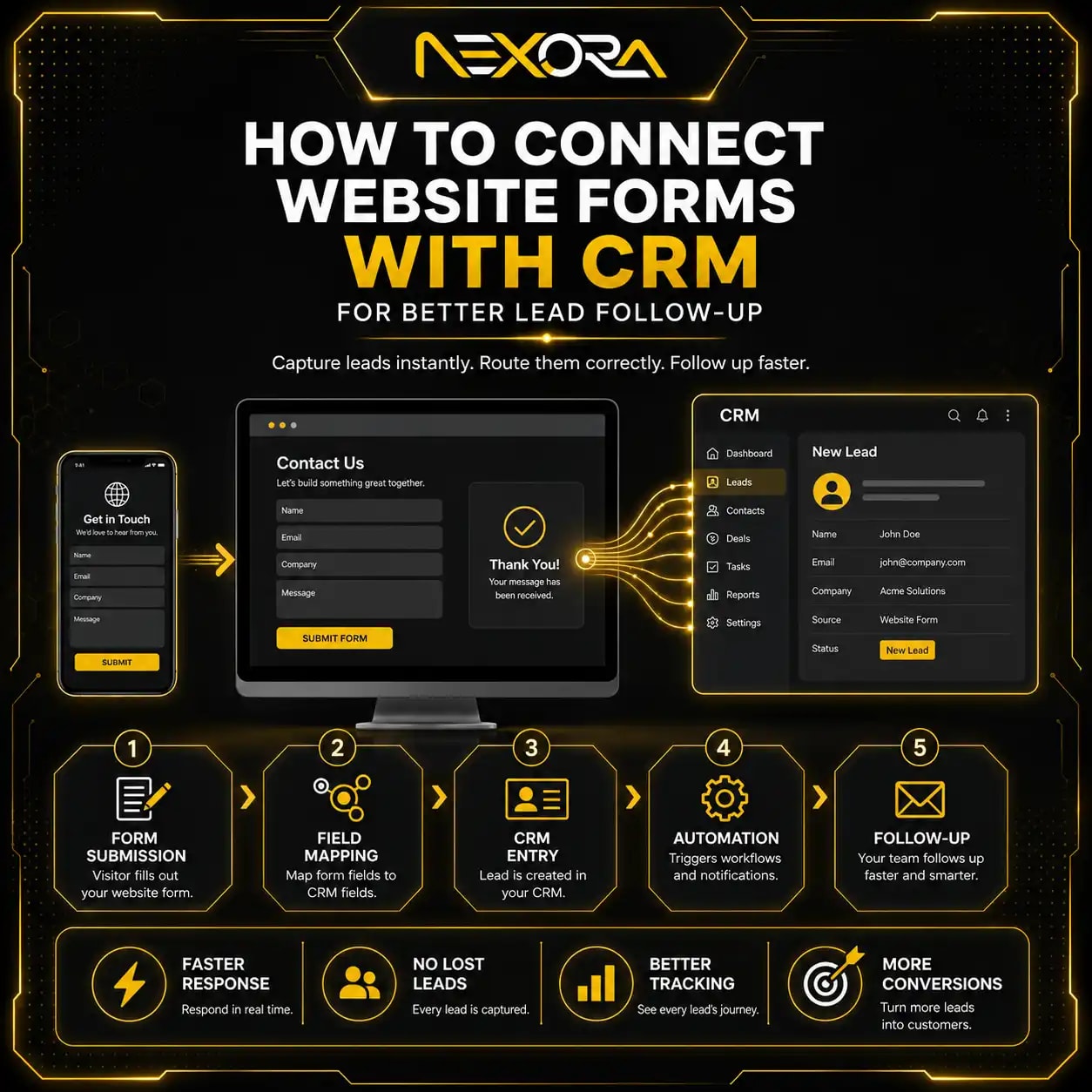
Nexora Creation can help connect website forms, content journeys, chatbot leads, and CRM automation so topical authority can be measured by real enquiries, not only rankings.
Can AI chatbots help new websites build trust?
Yes, AI chatbots can help new websites build trust and capture leads while organic authority is still growing.
A new website may not have strong brand recognition yet.
Visitors may have questions before contacting you.
An AI chatbot can help answer:
- What services do you offer?
- Do you work with my type of business?
- How does your process work?
- Can you review my website?
- Do you offer SEO audits?
- Can I request a quote?
- What happens after I contact you?
- How long does a project take?
It can collect:
- Name
- Phone
- Website URL
- Service interest
- Main problem
- Preferred contact time
This improves lead capture from the traffic you already have.
AI chatbots do not replace topical authority.
But they support conversion while authority grows.
Voice Agent & Chatbot Services
How can Nexora Creation help build topical authority?
Nexora Creation helps new business websites build topical authority with SEO strategy, website structure, content planning, internal links, technical SEO, and conversion-focused pages.
For topical authority, we can help with:
- Website structure planning
- Service-page creation
- Topic cluster mapping
- SEO content strategy
- Keyword intent research
- Blog planning
- Internal linking strategy
- Technical SEO setup
- Local SEO planning
- Content refresh planning
- EEAT improvements
- AI search formatting
- Website development
- CTA placement
- CRM lead tracking
- AI chatbot routing
- SEO performance reporting
The goal is not only to publish content.
The goal is to build a website that Google can understand, users can trust, and leads can flow through.
If your new website has only a few pages, no content clusters, weak internal links, or unclear service structure, topical authority should become a priority.
What is the best topical authority strategy for a new business website?
The best topical authority strategy is to start narrow, build depth, connect pages, and measure business impact.
Use this process:
How do you choose the main topic?
Choose one topic based on:
- Business value
- Search demand
- Lead potential
- Service expertise
- Customer pain points
- Competitive opportunity
How do you build the foundation?
Create:
- Main service page
- Clear homepage links
- Supporting blog list
- Clean URLs
- Blog category
- Internal link map
- Contact path
How do you publish supporting content?
Publish blogs that answer:
- Common problems
- Buyer questions
- Comparison questions
- Local questions
- Technical questions
- Decision-stage questions
How do you connect the cluster?
Add links:
- Blogs to service page
- Service page to blogs
- Blogs to related blogs
- Case studies to services
- CTAs to contact page
How do you measure success?
Track:
- Impressions
- Clicks
- Ranking queries
- Service-page visits
- Form submissions
- Calls
- Chatbot leads
- CRM leads
This creates a focused and measurable authority system.
Conclusion
Topical authority helps a new business website become more trusted, visible, and useful around a specific subject.
A new website should not publish random content.
It should build focused depth around its most important services.
To build topical authority, create:
- Clear service pages
- Helpful supporting blogs
- Topic clusters
- Internal links
- Clean website structure
- Question-based headings
- FAQs
- EEAT signals
- Technical SEO foundations
- Local relevance, if needed
- Conversion paths
- CRM lead tracking
- AI chatbot support, where useful
Topical authority takes time.
But it gives a new website a stronger SEO foundation than random keyword targeting.
When Google understands your expertise and users can find helpful answers, your website has a better chance to rank, build trust, and generate qualified leads.
FAQs
What is topical authority?
Topical authority means your website has deep, useful, and connected content around a specific topic, service, or industry.
Why is topical authority important for a new website?
It helps a new website prove relevance, build trust, support service pages, rank for long-tail keywords, and create stronger SEO foundations.
How do I build topical authority from scratch?
Start with one main service page, create supporting blogs around related questions, connect them with internal links, add FAQs, improve technical SEO, and track results.
How many blogs do I need for topical authority?
There is no fixed number, but a strong first cluster may include one main service page and 8 to 12 supporting blogs around related search intents.
Should I build service pages before blogs?
Yes. Service pages should come first because blogs need a main service page to support and link back to.
Can a new website rank without backlinks?
A new website can start ranking for long-tail and lower-competition topics with strong structure and helpful content, but relevant backlinks can help authority grow faster.
What is a topic cluster?
A topic cluster is a group of related pages around one main topic, connected through internal links and organized around search intent.
How do internal links help topical authority?
Internal links connect related pages, help Google understand topic relationships, support important service pages, and guide users to the next useful step.
How long does topical authority take?
A new website may see early impressions in 30 to 60 days, stronger visibility in 3 to 6 months, and more competitive authority in 6 to 12 months or longer.
Can topical authority help lead generation?
Yes. When topic clusters connect to service pages, CTAs, forms, CRM tracking, and chatbot lead capture, topical authority can support qualified enquiries.
What is the biggest topical authority mistake?
The biggest mistake is publishing random blogs without service-page structure, internal links, search intent mapping, or a clear lead-generation path.
How do I measure topical authority?
Track indexed pages, impressions, clicks, ranking queries, service-page visits, form submissions, calls, chatbot leads, CRM leads, and assisted conversions.