
To turn SEO blog traffic into service business leads, your content must do more than rank.
It must connect the visitor’s problem to a relevant service, build trust, present a clear next step, and track what happens after the visitor clicks.
Many service businesses publish blogs that generate:
- Impressions
- Rankings
- Organic clicks
- Website sessions
- Long-tail keyword visibility
But those visits do not produce:
- Quote requests
- Consultation bookings
- Phone calls
- Contact form submissions
- Chatbot enquiries
- Qualified CRM leads
The problem is usually not traffic alone.
The problem is the journey after the visitor lands.
A blog may answer the search query but fail to show:
- How the problem affects the business
- What service can solve it
- Why the company is qualified
- What the visitor should do next
- Where the service page is
- How to ask a question
- How to request help
- What happens after contact
At Nexora Creation, we treat SEO blogs as part of a lead-generation system.
A blog should attract the right audience, answer the immediate question, build confidence, and guide qualified visitors toward a relevant service.
In this guide, I will explain how to turn SEO blog traffic into service business leads without making every article feel like a sales page.
Why does SEO blog traffic often fail to generate leads?
SEO blog traffic often fails to generate leads because the content attracts readers but does not create a clear path toward action.
Common problems include:
- Topic has low commercial relevance
- Visitor intent is too broad
- No service connection
- No internal links to service pages
- Generic CTA
- CTA appears only at the end
- Service page is weak
- No trust signals
- No contact option
- No chatbot
- Form is too long
- No CRM tracking
- No lead follow-up
- Blog attracts the wrong location
- Content answers the question completely but gives no next step
A blog can rank well and still have little business value.
Traffic becomes valuable when it supports:
- Service discovery
- Brand trust
- Lead qualification
- Contact actions
- Assisted conversions
- Sales conversations
The goal is not to turn every reader into a lead.
The goal is to make it easy for the right reader to become one.
What kind of blog traffic is most likely to convert?
Problem-aware and commercial-research traffic usually converts better than very broad informational traffic.
A visitor searching:
“What is SEO?”
may only be learning.
A visitor searching:
“Why did my website rankings suddenly drop?”
already has a problem.
A visitor searching:
“SEO recovery service for small business”
may be closer to hiring.
For service businesses, high-value blog intent often includes:
- Problem queries
- Cost questions
- Comparison searches
- Checklist searches
- Service-process questions
- Local questions
- Urgent troubleshooting
- Buying objections
- Provider selection questions
Examples include:
- Why is my website not generating leads?
- Why are my rankings falling?
- How much does a small business website cost?
- SEO vs Google Ads for local businesses
- What should an SEO audit include?
- Why are website visitors not filling out forms?
- How do I automate lead follow-up?
- Do I need an AI chatbot for my website?
These topics naturally connect to services.
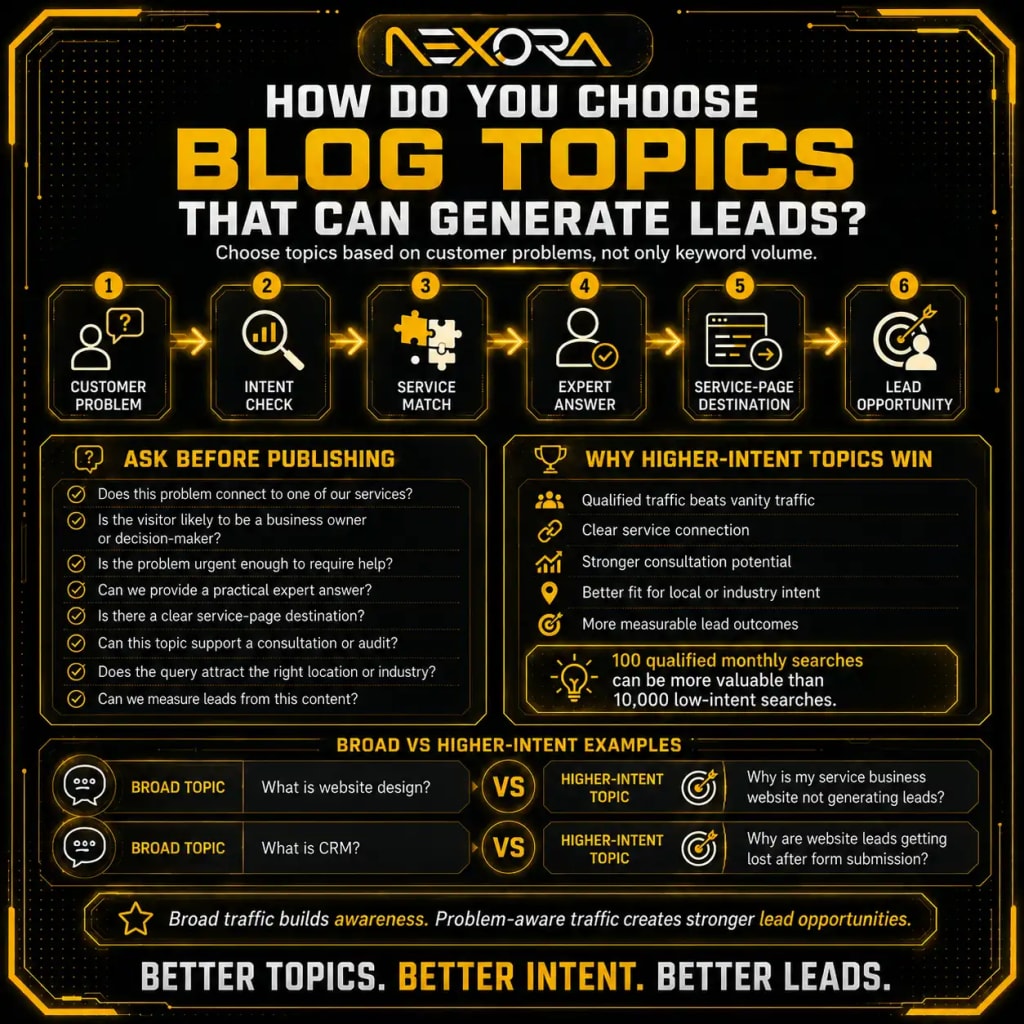
How do you choose blog topics that can generate leads?
Choose topics based on customer problems, not only keyword volume.
Before publishing a topic, ask:
- Does this problem connect to one of our services?
- Is the visitor likely to be a business owner or decision-maker?
- Is the problem urgent enough to require help?
- Can we provide a practical expert answer?
- Is there a clear service-page destination?
- Can this topic support a consultation or audit?
- Does the query attract the right location or industry?
- Can we measure leads from this content?
A topic with 100 qualified monthly searches may be more valuable than a broad topic with 10,000 low-intent searches.
For example:
Broad topic:
- What is website design?
Higher-intent topic:
- Why is my service business website not generating leads?
Broad topic:
- What is CRM?
Higher-intent topic:
- Why are website leads getting lost after form submission?
Broad traffic builds awareness.
Problem-aware traffic creates stronger lead opportunities.
How should blogs connect to service pages?
Every lead-focused blog should connect naturally to one or more relevant service pages.
The link should appear when the reader understands the problem and may need professional help.
For example:
A blog about ranking loss should link to:
- SEO Services
- Website Development Services
- Contact Us
A blog about weak website conversions should link to:
- Website Development Services
- UI/UX Design
- CRM Automation
A blog about missed enquiries should link to:
- CRM Automation Services
- AI Voice Agent and Chatbot Services
A blog about poor contact form performance should link to:
- Website Development Service
- CRM Automation Services
- AI Chatbot Services
The service link should feel like a useful next step.
It should not feel forced.
Where should service links appear inside a blog?
Do not place all service links in one block at the bottom.
Use contextual links throughout the article.
Useful placements include:
- After explaining the main problem
- After listing common causes
- Inside a solution section
- After a diagnostic checklist
- Near a relevant example
- Before the conclusion
- Inside an FAQ answer
- In a dedicated CTA section
For example:
“If your organic rankings dropped after a redesign, the issue may involve redirects, indexing, internal links, or page structure. A technical SEO and website audit can help identify the cause before more content is changed.”
This is a natural place to link to SEO Services and Website Development.
The reader already understands the issue.
The link supports the next step.
What makes a blog CTA effective?
An effective blog CTA matches the topic, visitor intent, and stage of awareness.
Weak CTAs include:
- Contact Us
- Learn More
- Get Started
- Click Here
- Submit
These are too generic.
Better blog CTAs include:
- Request an SEO Recovery Audit
- Get Your Website Conversion Reviewed
- Fix Your Lead Tracking
- Schedule a Service-Page Review
- Automate Your Lead Follow-Up
- Add After-Hours Lead Capture
- Request a Local SEO Consultation
The CTA should answer:
- What will the visitor get?
- Why is it relevant?
- What happens next?
- How much commitment is required?
A reader who just discovered a problem may not be ready to “Hire Us.”
They may be ready to:
- Request a review
- Ask a question
- Get an audit
- Check availability
- Book a short consultation
Lower-friction CTAs often work better inside informational content.
How many CTAs should an SEO blog include?
A long SEO blog can include multiple CTA opportunities, but they should not overwhelm the reader.
A practical structure may include:
- One soft CTA near the introduction or first major solution
- One contextual CTA in the middle
- One stronger CTA near the conclusion
For example:
Early soft CTA:
“See how our SEO Services support ranking recovery.”
Mid-page CTA:
“Request a website and technical SEO review.”
Final CTA:
“Schedule a consultation to identify what is blocking traffic and leads.”
The CTA frequency should match article length.
A short article may need only one or two CTAs.
A detailed guide may need three or four.
Relevance matters more than quantity.
How should the introduction support lead generation?
The introduction should immediately answer the search intent and establish why the topic matters.
A strong introduction should:
- Confirm the visitor’s problem
- Explain the likely cause
- Show the business impact
- Preview the solution
- Establish expertise
- Create a reason to continue
For example:
“If your blog traffic is growing but enquiries remain flat, the problem may be the conversion path between your articles, service pages, CTAs, forms, and follow-up system.”
This is stronger than:
“Blogging is an important part of digital marketing.”
The introduction should make the reader feel understood.
Do not begin with a long history of the topic.
How do you turn informational content into a buyer journey?
An informational blog should guide the reader through a natural journey.
Use this structure:
- Problem
- Cause
- Impact
- Diagnosis
- Practical fixes
- When professional help is needed
- Relevant service
- Clear next step
For example:
A blog about slow WordPress websites can guide the reader through:
- Why the site is slow
- Theme and plugin causes
- How speed affects SEO and conversions
- Basic fixes
- When a rebuild is needed
- Website Development service
- Request a website review
This keeps the content helpful.
The service becomes a logical continuation rather than an interruption.
How do you match CTAs to search intent?
Different queries require different CTAs.
What CTA fits an informational query?
For early-stage readers, use:
- Read a related guide
- View the service process
- Download a checklist
- Ask a question
- Start a chatbot conversation
What CTA fits a problem-aware query?
For visitors who know something is wrong, use:
- Request an audit
- Get a website review
- Diagnose the problem
- Schedule a consultation
- Check your current setup
What CTA fits a commercial query?
For visitors comparing solutions, use:
- Request a quote
- Book a strategy call
- View service details
- See case studies
- Discuss your project
What CTA fits an urgent local query?
For urgent needs, use:
- Call Now
- Request Same-Day Service
- Check Availability
- Book an Inspection
- Get Emergency Help
The CTA should match the urgency and commitment level of the search.
How do service pages affect blog lead conversion?
A blog cannot generate strong leads if the service page it links to is weak.
The service page should continue the same message and answer deeper buying questions.
A strong service page should include:
- Clear H1
- Service explanation
- Customer problems
- Benefits
- What is included
- Process
- Trust proof
- Case studies
- FAQs
- Strong CTA
- Contact options
If the blog says:
“Improve your website lead generation”
but the service page says:
“We provide innovative digital solutions”
the journey breaks.
The service page should match:
- Topic
- Language
- Problem
- Audience
- Offer
- CTA
Message consistency improves confidence.
How do internal links support blog conversions?
Internal links help visitors continue their research without leaving the website.
A useful blog can link to:
- Main service page
- Related problem blog
- Comparison guide
- Case study
- Contact page
- Location page
- FAQ resource
For example, a blog about contact form problems can link to:
- Website Development Services
- CRM Automation Services
- Above-the-Fold Conversion Guide
- Service Page Optimization Guide
- Contact Us
Internal links should answer the next likely question.
They also help Google understand:
- Topic relationships
- Important service pages
- Content clusters
- Page hierarchy
- Commercial destinations
A strong internal link strategy improves both SEO and conversion paths.
Should blogs link directly to the contact page?
Yes, but not as the only next step.
A direct Contact Us link can work near the conclusion or in a strong CTA.
However, many blog visitors need more information first.
A better journey may be:
- Blog
- Relevant service page
- Case study or proof
- Contact page
For high-intent articles, a direct contact CTA may be appropriate.
For example:
- Website migration caused ranking loss
- Contact form is broken
- CRM is losing leads
- Google Ads landing page is not converting
Use the path that best matches intent.
How can lead magnets convert blog visitors?
Lead magnets can capture visitors who are interested but not ready to book a call.
Useful lead magnets for service businesses include:
- SEO audit checklist
- Website conversion checklist
- Local SEO checklist
- Service-page template
- Website redesign planning guide
- CRM follow-up checklist
- Google Ads landing page checklist
- Content planning worksheet
A good lead magnet should:
- Connect directly to the article
- Solve a small but useful problem
- Require minimal form fields
- Lead into a relevant service
- Trigger a helpful follow-up sequence
Do not use unrelated downloads.
A generic newsletter signup is usually weaker than a topic-specific resource.
How should lead magnet forms be designed?
Keep lead magnet forms simple.
For most resources, ask for:
- Name
Optional fields may include:
- Website URL
- Business type
- Main challenge
Do not ask for:
- Full address
- Detailed budget
- Long project description
- Too many qualifying fields
The goal is to start a relationship.
You can qualify the lead later through:
- Email follow-up
- Chatbot
- Booking form
- CRM workflow
- Consultation
The form should clearly explain what the visitor will receive.
How can an AI chatbot convert blog traffic?
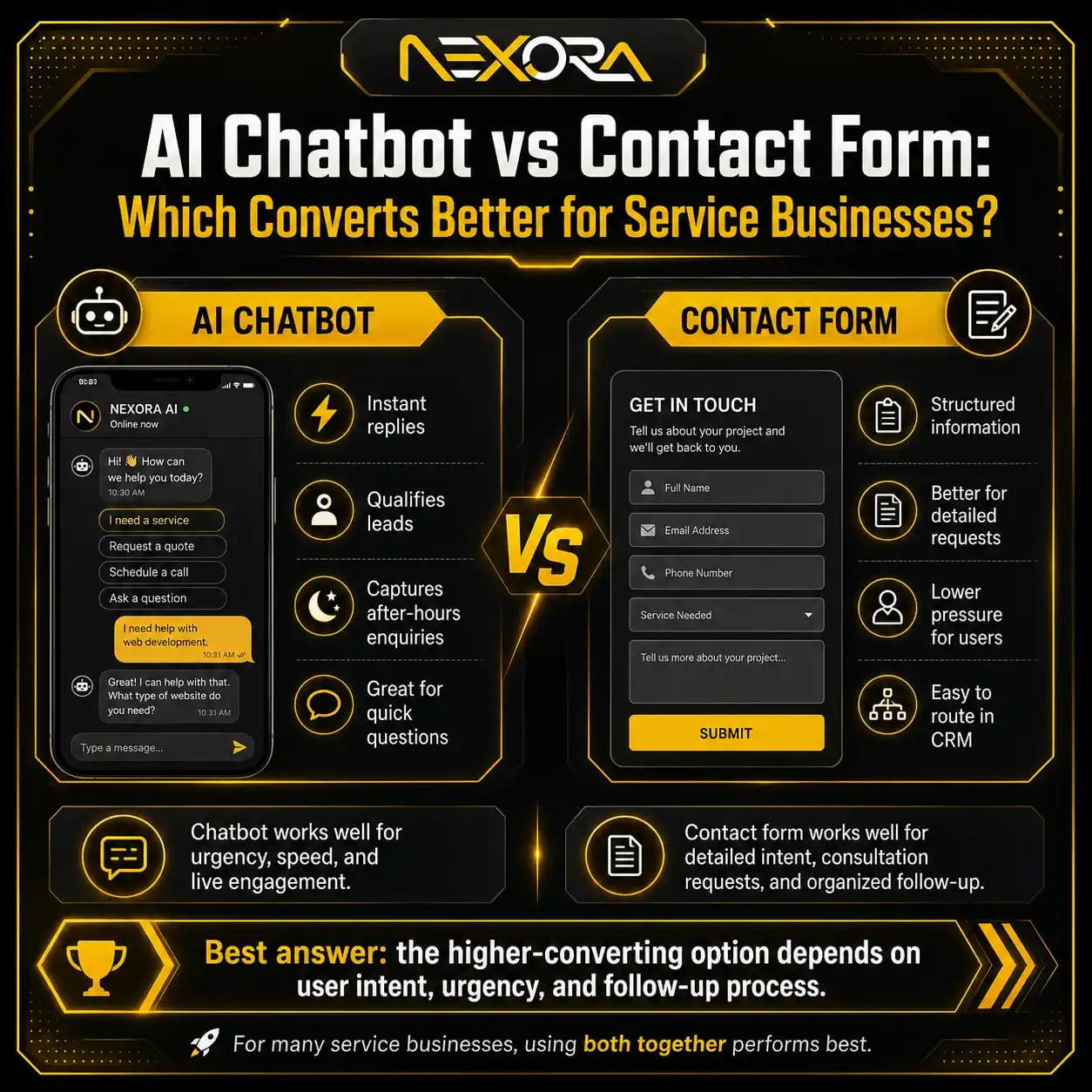
An AI chatbot can engage visitors who have questions but are not ready to submit a form.
A chatbot on a blog can ask:
- What problem are you trying to solve?
- Are your rankings dropping?
- Is your website getting traffic but no leads?
- Do you need SEO, website, CRM, or chatbot help?
- What is your website URL?
- Would you like a consultation?
It can guide visitors to:
- SEO Services
- Website Development Services
- CRM Automation Services
- AI Voice Agent and Chatbot Services
- Contact page
A chatbot can also:
- Qualify leads
- Capture contact details
- Route users to the right service
- Answer common questions
- Offer booking options
- Collect after-hours enquiries
The chatbot should support the content.
It should not open aggressively and block the article.
AI Voice Agent & Chatbot Services
How can CRM automation turn blog enquiries into leads?
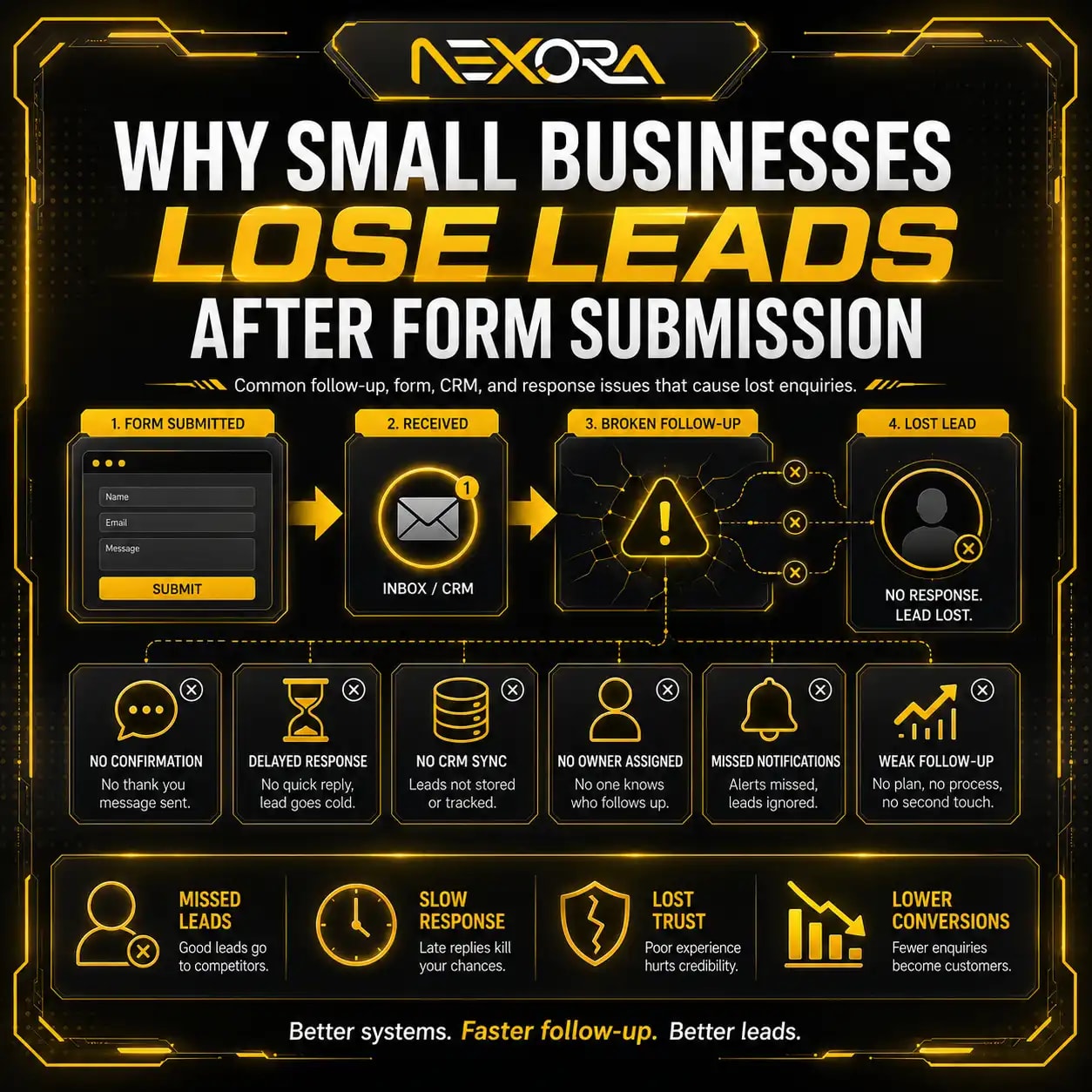
A blog conversion is not complete when someone submits a form.
The lead must be captured and followed up.
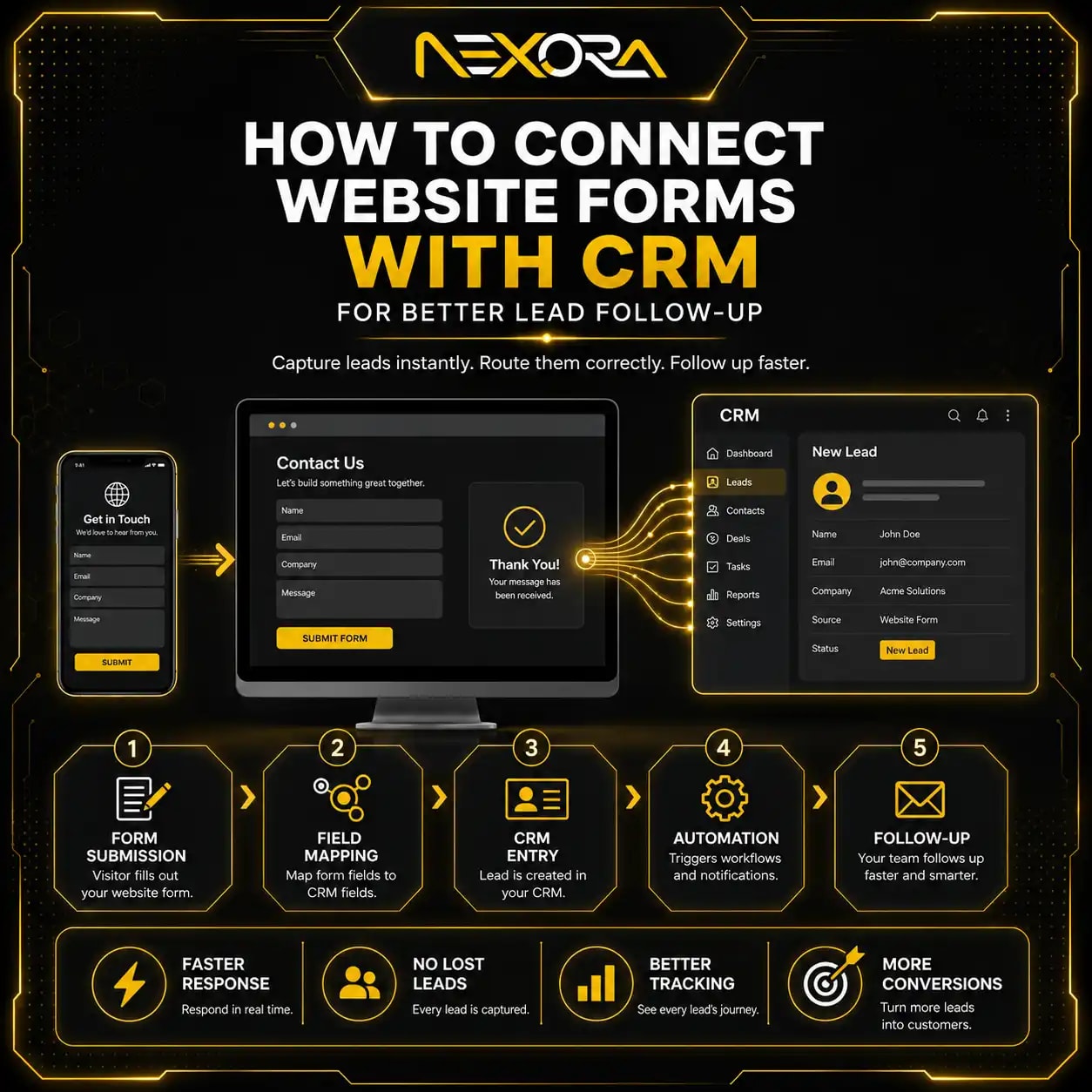
CRM automation can:
- Create a lead record
- Record the source article
- Record the service interest
- Tag the campaign
- Notify the team
- Send a confirmation email
- Create a follow-up task
- Assign the lead
- Track deal stage
- Measure which blogs assist sales
For example, a visitor reads:
“Why Website Visitors Are Not Filling Out Contact Forms”
Then requests a website review.
The CRM can record:
- Source: Organic Search
- Landing page: Contact Form Conversion Blog
- Service interest: Website Development
- Secondary interest: CRM Automation
- Status: New Lead
This helps the business understand which content generates real opportunities.
How quickly should blog leads receive a response?
Blog leads should receive an immediate confirmation and a timely human follow-up.
The exact response process depends on the business.
A useful workflow may include:
- Instant confirmation email
- Internal team notification
- Lead assignment
- Follow-up task
- Human response within the stated time
- Additional reminder if no response occurs
Tell visitors what to expect.
Examples:
- “We usually respond within one business day.”
- “Our team will review your website before the consultation.”
- “You will receive a confirmation email immediately.”
Clear expectations improve trust.
How do case studies help convert blog traffic?
Case studies provide proof that your service works in real situations.
Link to a case study when the reader may need evidence before contacting you.
A case study should explain:
- Client type
- Initial problem
- Strategy
- Work completed
- Result
- Timeline
- Related service
For example, a blog about ranking loss can link to a case study showing:
- Technical issues found
- Content updated
- Internal links improved
- Visibility recovered
- Leads increased
A blog about website conversion can link to a redesign case study.
Proof reduces risk.
How do testimonials help blog visitors become leads?
Testimonials can strengthen CTA sections inside blogs.
Use testimonials that match the topic.
For an SEO blog, use a testimonial about:
- Better rankings
- More qualified traffic
- Clear reporting
- Lead growth
For a website conversion blog, use a testimonial about:
- Clearer design
- Better mobile UX
- More form submissions
- Improved lead flow
For a CRM blog, use a testimonial about:
- Faster follow-up
- Better organization
- Fewer lost leads
A topic-specific testimonial is stronger than a generic review.
Should every SEO blog promote a service?
Every business blog should have a purpose, but not every article needs an aggressive sales pitch.
A blog can support:
- Service discovery
- Internal linking
- Topical authority
- Trust
- Email capture
- Retargeting
- Sales enablement
- Existing customer education
However, most service-business blogs should include at least one relevant next step.
That next step may be:
- Related service page
- Supporting guide
- Checklist
- Chatbot
- Contact page
- Consultation
- Case study
The article should not end with nowhere to go.
How do you avoid making a blog feel too sales-focused?
Keep the article helpful first.
Use this balance:
- Answer the question clearly
- Provide actionable advice
- Explain limitations honestly
- Mention services only when relevant
- Use contextual CTAs
- Avoid repeating the same offer
- Do not interrupt every section
- Do not hide useful information behind forms
A service CTA works best when the reader understands:
- The problem is real
- The solution is more complex than a quick fix
- Professional help may save time or reduce risk
- The offered service matches the problem
Help first.
Then guide.
How do you use related posts for lead generation?
Related posts can keep visitors on the site and move them closer to a service decision.
Choose related posts based on journey stage.
For example, after a blog about ranking loss, show:
- SEO Recovery Checklist
- Technical SEO Issues That Cause Ranking Loss
- Content Decay SEO
- How to Compare GSC Data
- SEO Services
After a blog about contact forms, show:
- Above-the-Fold Conversion Issues
- WordPress Website Not Generating Leads
- Service Pages That Rank and Convert
- CRM Automation Services
Do not show random recent posts.
Show the most relevant next questions.
How should blog design support conversions?
Blog design affects whether visitors continue reading and take action.
A lead-focused blog layout should include:
- Clear title
- Short introduction
- Readable typography
- Short paragraphs
- Useful headings
- Proper bullet points
- Table of contents for long guides
- Contextual internal links
- CTA blocks
- Mobile-friendly layout
- Visible author or brand expertise
- Related posts
- Clear final CTA
Avoid:
- Excessive popups
- Distracting sidebars
- Tiny text
- Poor contrast
- Large empty sections
- Intrusive banners
- Too many unrelated links
- CTA buttons that blend into the page
The reading experience should build confidence.
How does mobile UX affect blog lead generation?
Many readers discover blogs on mobile.
A mobile blog should make it easy to:
- Read the content
- Open internal links
- Tap CTA buttons
- Start a chat
- Call the business
- Complete a short form
- Navigate to services
Check for:
- Readable font size
- Short paragraphs
- Proper spacing
- Large enough buttons
- Fast loading
- No overlapping widgets
- No full-screen popups
- Easy navigation
- Short forms
- Clickable phone numbers
A CTA that works on desktop may be invisible or difficult on mobile.
Test real devices.
How does page speed affect blog conversions?
Slow blog pages lose visitors before the conversion opportunity appears.
Common speed problems include:
- Large featured images
- Too many ads
- Heavy plugins
- Embedded videos
- Chat widgets loading too early
- Large scripts
- Poor hosting
- Unoptimized fonts
- Excessive related-post plugins
Improve speed by:
- Compressing images
- Using modern image formats
- Lazy-loading media
- Removing unnecessary scripts
- Improving caching
- Reducing plugin bloat
- Optimizing fonts
- Using better hosting
The article, CTA, and internal links should become usable quickly.
How do you measure whether blog traffic generates leads?
Track both SEO and conversion data.
SEO metrics include:
- Impressions
- Clicks
- Average position
- CTR
- Ranking queries
- Organic landing pages
- New users
Engagement metrics include:
- Scroll depth
- Internal link clicks
- Service-page visits
- CTA clicks
- Chatbot starts
- Form starts
- Time on page
Lead metrics include:
- Form submissions
- Phone calls
- Consultation bookings
- Quote requests
- Chatbot leads
- CRM leads
- Qualified leads
- Closed deals
- Assisted conversions
Do not judge content only by traffic.
A blog with modest traffic can be highly valuable if it generates qualified enquiries.
What is an assisted conversion from blog content?
An assisted conversion happens when a blog supports the customer journey but is not the final page before contact.
Example journey:
- User finds a blog through Google.
- User visits a service page.
- User leaves.
- User returns later through branded search.
- User submits a form.
The blog assisted the conversion.
Without proper attribution, the service page or branded search may receive all the credit.
Use analytics and CRM data to understand:
- First landing page
- Pages visited
- CTA clicked
- Lead source
- Return visits
- Final conversion page
This gives a more accurate picture of content value.
Which blog conversion metrics matter most?
Focus on metrics that show progress toward business outcomes.
Useful metrics include:
- Blog-to-service-page click rate
- CTA click rate
- Form start rate
- Form completion rate
- Chatbot start rate
- Booking rate
- Phone click rate
- Lead conversion rate
- Qualified lead rate
- Cost per lead, where relevant
- Revenue influenced by organic content
Traffic alone is not enough.
Track movement through the journey.
How do you improve a blog that gets traffic but no leads?
Start by reviewing the full journey.
Check:
- Does the topic attract the right audience?
- Is the search intent connected to a service?
- Is the introduction clear?
- Are service links relevant?
- Is the CTA visible?
- Does the CTA match intent?
- Is the service page strong?
- Is there trust proof?
- Does the form work?
- Is mobile UX strong?
- Are leads tracked?
- Is follow-up fast?
Possible fixes include:
- Add contextual service links
- Rewrite the CTA
- Add a mid-article CTA
- Add a relevant case study
- Improve the service page
- Add a chatbot
- Shorten the form
- Add response-time text
- Improve internal links
- Connect the form to CRM
- Update the content for stronger intent
Do not immediately delete a traffic-generating article.
Improve its conversion path first.
What are the biggest blog-to-lead mistakes?
Avoid these common mistakes:
- Publishing topics with no service relevance
- Linking only to the homepage
- No CTA
- Generic CTA
- CTA only at the bottom
- Weak service pages
- No trust proof
- No mobile testing
- Long forms
- Broken forms
- No chatbot option
- No CRM integration
- No lead source tracking
- Measuring only traffic
- Ignoring assisted conversions
- Showing random related posts
- Using intrusive popups
- Writing for search engines instead of buyers
- No local relevance
- No follow-up process
A blog should not operate in isolation.
It should be connected to the website’s service and lead systems.
What is the best blog-to-lead conversion framework?
Use this framework for every lead-focused SEO article.
What should attract the visitor?
Use:
- Relevant keyword
- Clear title
- Search intent match
- Strong meta description
- Useful topic
What should keep the visitor engaged?
Use:
- Direct introduction
- Short paragraphs
- Clear headings
- Practical advice
- Examples
- Checklists
- Mobile-friendly design
What should build trust?
Use:
- Expert perspective
- Real process
- Case studies
- Testimonials
- Honest recommendations
- Relevant examples
- Clear business identity
What should guide the visitor?
Use:
- Contextual internal links
- Relevant service page
- Related content
- Clear CTA
- Chatbot
- Contact option
What should capture the lead?
Use:
- Short form
- Consultation booking
- Quote request
- Phone call
- Lead magnet
- Chatbot qualification
What should complete the process?
Use:
- CRM capture
- Source tracking
- Confirmation message
- Team notification
- Fast follow-up
- Lead qualification
- Pipeline tracking
This framework connects SEO traffic to measurable business outcomes.
How can Nexora Creation help turn blog traffic into leads?
Nexora Creation helps service businesses connect SEO content with service pages, CTAs, forms, chatbots, CRM systems, and lead tracking.
For blog-to-lead conversion, we can help with:
- SEO content strategy
- Search intent mapping
- Topic cluster planning
- Blog audits
- Internal linking
- Service-page optimization
- CTA strategy
- Website UX improvements
- Form optimization
- Mobile conversion fixes
- AI chatbot lead capture
- CRM integration
- Conversion tracking
- Google Search Console analysis
- Content performance reporting
The goal is not only to increase organic traffic.
The goal is to turn qualified organic visitors into conversations, enquiries, bookings, and revenue opportunities.
If your blogs rank but do not generate leads, the issue may be the topic, service connection, CTA, landing experience, form, tracking, or follow-up system.
What is the best strategy to turn SEO blog traffic into service leads?
The best strategy is to connect every stage of the visitor journey.
Use this process:
- Choose service-relevant topics.
- Target problem-aware intent.
- Answer the search query quickly.
- Link to the correct service page.
- Use contextual CTAs.
- Add trust proof.
- Improve the service page.
- Offer a low-friction next step.
- Add chatbot support.
- Keep forms short.
- Connect forms to CRM.
- Track source pages.
- Follow up quickly.
- Measure qualified leads.
- Update content based on performance.
Do not treat rankings as the final result.
Rankings create visibility.
A connected conversion system turns that visibility into business.
Conclusion
SEO blog traffic becomes valuable when it helps qualified visitors move from a problem to a relevant service and a clear next step.
A blog should not only generate clicks.
It should support:
- Service discovery
- Trust
- Internal navigation
- Lead qualification
- Contact actions
- CRM tracking
- Sales follow-up
To turn blog traffic into service business leads:
- Publish service-relevant topics.
- Target problem-aware searches.
- Match the CTA to visitor intent.
- Link blogs to service pages.
- Strengthen service pages.
- Add trust signals.
- Offer forms, calls, bookings, or chat.
- Connect leads to CRM.
- Track assisted conversions.
- Measure lead quality, not only traffic.
The right reader may not contact you immediately.
They may read a blog, visit a service page, return later, and then submit a form.
That is why your SEO content, website structure, CTAs, forms, chatbot, and CRM should work as one connected system.
When the journey is clear, organic traffic has a much stronger chance of becoming qualified service business leads.
FAQs
Why is my SEO blog traffic not generating leads?
Your traffic may have low commercial intent, weak CTAs, no service-page links, poor landing pages, long forms, missing trust signals, or no lead tracking.
What blog topics generate the most service business leads?
Problem-aware, local, comparison, cost, checklist, and service-process topics usually have stronger lead potential than broad informational topics.
Should every blog link to a service page?
Most service-business blogs should link to a relevant service page when the topic naturally connects to a service or solution.
Where should CTAs appear in a blog?
Use contextual CTAs after important problem or solution sections, plus a stronger CTA near the conclusion.
What CTA works best for blog traffic?
The best CTA matches the article intent. Examples include Request an Audit, Get a Website Review, Schedule a Consultation, or Fix Your Lead Tracking.
Should blogs link directly to the contact page?
High-intent blogs can link directly to the contact page, but many visitors benefit from visiting a relevant service page first.
Can a chatbot convert blog visitors?
Yes. A chatbot can answer questions, recommend services, qualify visitors, collect contact details, and capture after-hours enquiries.
How does CRM help with blog leads?
CRM records the source article, service interest, lead status, follow-up tasks, and pipeline outcome so you can measure which content generates qualified opportunities.
What is an assisted conversion?
An assisted conversion occurs when a blog influences the customer journey even though another page or channel receives the final contact action.
How do I measure blog-to-lead performance?
Track service-page clicks, CTA clicks, form starts, form submissions, phone calls, chatbot leads, consultation bookings, qualified leads, and closed deals.
Should I remove blogs that get traffic but no leads?
Not immediately. First improve internal links, CTAs, service-page alignment, forms, trust signals, and tracking.
What is the biggest blog conversion mistake?
The biggest mistake is publishing useful content without giving qualified readers a relevant and easy next step.