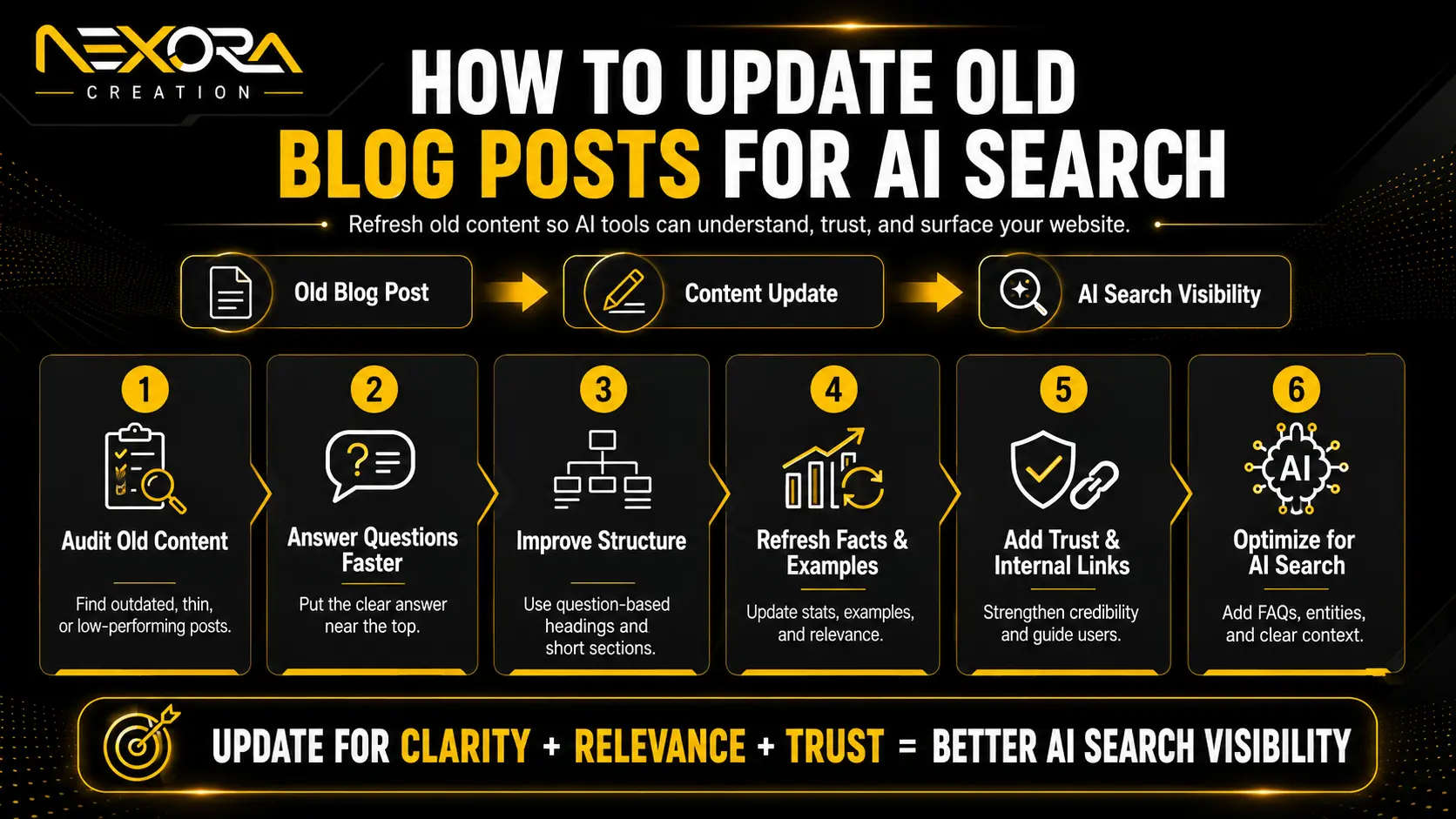
To update old blog posts for AI Search, you need to improve them for clarity, structure, search intent, direct answers, trust signals, internal links, and lead generation.
Old blog posts should not only be refreshed with new words.
They should be improved so users, search engines, and AI systems can understand them faster.
A strong AI Search-friendly blog should:
- Answer the main question early
- Use clear question-based headings
- Explain topics in simple language
- Add helpful examples
- Include updated information
- Add FAQs
- Improve internal linking
- Show trust and expertise
- Connect readers to relevant services
- Make the next step easy
Many small businesses already have old blogs on their websites, but those blogs are often not structured for modern search behaviour.
They may have:
- Weak introductions
- Outdated examples
- Generic headings
- No FAQs
- No internal links
- No clear CTA
- Poor formatting
- Thin explanations
- Missing service links
- No lead-generation path
That means the blog may get traffic but still fail to generate enquiries.
At Nexora Creation, we look at old blog updates as both a visibility opportunity and a conversion opportunity. The goal is not only to get more impressions. The goal is to make old content more useful, easier to understand, and more likely to move readers toward a service page, contact page, audit page, or enquiry.
In this guide, we will explain how to update old blog posts for AI Search and how to turn existing content into a stronger search and lead-generation asset.
What does it mean to update old blog posts for AI Search?
Updating old blog posts for AI Search means improving existing content so it works better for modern search experiences such as Google AI Overviews, AI Mode, ChatGPT-style browsing, Perplexity, Gemini, Copilot, featured snippets, and answer-based search.
It does not mean stuffing the article with AI keywords.
It means making the content more helpful, structured, accurate, and easy to understand.
AI Search-friendly updates usually include:
- Better search intent alignment
- Direct answers near the top
- Question-based headings
- Clear definitions
- Better examples
- Updated facts
- Stronger internal links
- FAQs
- Schema where relevant
- Trust signals
- Improved formatting
- Better CTAs
- Conversion tracking
AI systems rely on understandable content.
If your blog is unclear, outdated, thin, or badly structured, it becomes harder for both users and search systems to trust it.
Why should small businesses update old blog posts?
Small businesses should update old blog posts because old content can become a valuable source of traffic and leads if it is improved properly.
Publishing new blogs is important, but old content often has existing value.
An old blog may already have:
- Indexed URLs
- Search impressions
- Some backlinks
- Existing rankings
- Historical traffic
- Internal link value
- Brand relevance
- Topic relevance
- Search Console data
Instead of always starting from zero, you can improve what already exists.
Updating old blogs can help you:
- Improve rankings
- Recover lost traffic
- Target new search intent
- Improve AI Search visibility
- Add missing FAQs
- Strengthen internal links
- Improve user experience
- Build topical authority
- Generate more leads from existing content
For small businesses, this is often more efficient than publishing random new content.
If your blog already gets traffic but does not generate leads, the issue may not be traffic.
The issue may be structure, CTA placement, internal linking, or weak service connection.
Relevant Blog: Content Decay SEO: Why old pages lose rankings over time
How do you choose which old blog posts to update first?
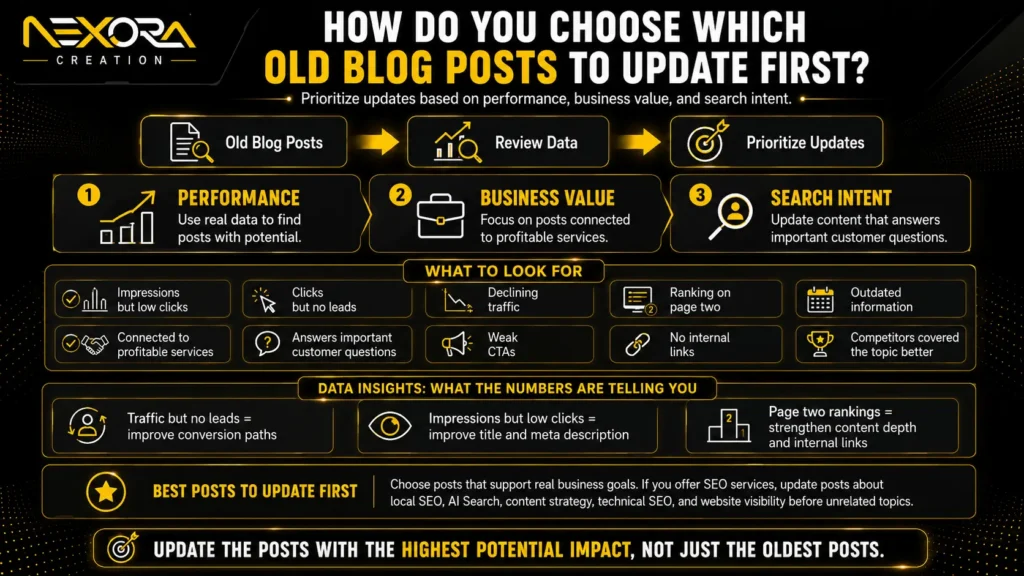
You should update old blog posts based on performance, business value, and search intent.
Do not update every blog randomly.
Start with posts that have potential.
Use Google Search Console, Google Analytics, and your CRM data to find:
- Blogs with impressions but low clicks
- Blogs with clicks but no leads
- Blogs with declining traffic
- Blogs ranking on page two
- Blogs with outdated information
- Blogs connected to profitable services
- Blogs that answer important customer questions
- Blogs with weak CTAs
- Blogs with no internal links
- Blogs that competitors have covered better
A blog with traffic but no leads may need better conversion paths.
A blog with impressions but low clicks may need a better title and meta description.
A blog ranking on page two may need stronger content depth and internal links.
A blog with outdated information may need a full refresh.
The best blogs to update first are the ones that connect to real business goals.
For example, if you offer SEO services, old blogs about local SEO, AI Search, content strategy, technical SEO, or website visibility should be updated before unrelated topics.
How should you audit an old blog before updating it?
Before updating an old blog, audit it from both search and conversion angles.
Ask these questions:
- What keyword or question is this blog targeting?
- Does the introduction answer the main question?
- Are the headings clear and question-based?
- Is the content still accurate?
- Are examples updated?
- Does the blog match current search intent?
- Does it include FAQs?
- Does it link to relevant service pages?
- Does it have a clear CTA?
- Does it show trust or expertise?
- Is the content easy to scan?
- Does it have outdated screenshots or stats?
- Does it need schema?
- Is the page fast and mobile-friendly?
- Does the blog generate leads?
This audit helps you decide whether the blog needs a light refresh or a full rewrite.
A light refresh may involve updating examples, adding FAQs, and improving internal links.
A full rewrite may be needed if the article is outdated, thin, poorly structured, or no longer matches search intent.
How can you update the introduction for AI Search?
You can update the introduction by answering the main question immediately.
Many old blogs start with generic introductions such as:
“In today’s digital world, businesses need to stay updated with the latest trends.”
That does not help the reader quickly.
A better AI Search-friendly introduction gives the answer first.
For example:
“To update old blog posts for AI Search, improve the content structure, answer the main question early, add question-based headings, update outdated information, include FAQs, and link the blog to relevant service pages.”
This gives value immediately.
A strong introduction should:
- Identify the problem
- Give the simple answer
- Explain why it matters
- Mention who the guide is for
- Preview what the article covers
AI Search and users both prefer clarity.
Do not hide the main answer too deep in the article.
How should headings be updated for AI Search?
Headings should be updated to match real user questions.
Old blog posts often use generic headings like:
- Benefits
- Tips
- Our Process
- Why It Matters
- Final Thoughts
These headings are not always bad, but they are often too vague for AI Search.
Question-based headings are usually better because they match how users search.
Better headings include:
- What does AI Search mean for small businesses?
- How do you update old blog posts for AI Search?
- Why should old blogs include FAQs?
- How can internal links turn blog traffic into leads?
- What trust signals should old blog posts include?
- How do you know if an old blog needs a full rewrite?
Question-based headings help:
- Users scan the article
- Search engines understand the topic
- AI systems extract answers
- Content match long-tail queries
- Blogs appear more useful
Each heading should answer a real customer question.
Do not add questions just for decoration.
How can you make old content more answer-focused?
You can make old content more answer-focused by giving a short direct answer at the start of each important section.
For example, under the heading:
“How can FAQs improve AI Search visibility?”
Start with:
“FAQs improve AI Search visibility by answering specific user questions in a clear, structured format that search engines and AI systems can understand.”
Then explain in more detail.
This structure works because it gives both users and AI systems the answer quickly.
Use this format:
- Question-based heading
- Direct answer
- Supporting explanation
- Example
- Helpful next step
This approach supports SEO, AEO, GEO, and AI Overviews-style search experiences.
It also improves readability.
People do not want to dig through long paragraphs to find the point.
How should you update outdated information?
You should update outdated information by checking facts, examples, tools, screenshots, statistics, links, and recommendations.
Old blog posts may include information that is no longer correct.
Examples include:
- Old platform features
- Outdated SEO advice
- Changed Google Ads policies
- Old screenshots
- Broken links
- Old pricing references
- Outdated plugin recommendations
- Dead tools
- Old statistics
- Old service descriptions
Updating content improves trust.
If a reader sees outdated advice, they may not trust the rest of the article.
To update outdated information:
- Remove incorrect claims
- Add current explanations
- Replace old examples
- Update screenshots
- Fix broken links
- Add newer context
- Check official sources
- Refresh the publication date if meaningful
- Keep the article aligned with current search behaviour
Do not update only the date without improving the content.
That can feel misleading.
The content should actually be refreshed.
How can you add FAQs to old blog posts?
You can add FAQs by identifying the questions users still have after reading the article.
FAQs are useful for AI Search because they give short, clear answers to specific questions.
Sources for FAQ ideas include:
- Google Search Console queries
- People Also Ask
- Customer emails
- Sales calls
- Support chats
- Competitor blogs
- Reddit or forum discussions
- Client objections
- Internal team knowledge
Good FAQs should be:
- Relevant to the topic
- Short and clear
- Based on real questions
- Written in simple language
- Helpful, not repetitive
- Connected to search intent
For example, for a blog about updating old posts, FAQs may include:
- How often should I update old blog posts?
- Should I change the URL when updating a blog?
- Does updating old content help SEO?
- Should I use AI to rewrite old blogs?
- How do I know which blogs to refresh first?
- Should I add FAQs to every blog post?
FAQs also create natural internal linking opportunities.
If an FAQ reveals a reader problem, link to a relevant service page where helpful.
How can internal links turn old blogs into lead sources?
Internal links can turn old blogs into lead sources by guiding readers from helpful content to relevant service pages.
This is important.
Internal links should not only be added for SEO.
They should also help the reader take the next step.
For example, if an old blog explains why a website is not generating leads, the reader may need help with:
- Website structure
- Service pages
- CTA placement
- UX design
- SEO
- Conversion tracking
That is the right place to link to website development or SEO services.
If a blog explains slow lead follow-up, link to CRM automation services.
If a blog explains AI customer support, link to AI chatbot services.
A good internal link should appear where the reader is already thinking:
“I may need help with this.”
That is how content becomes a lead-generation path.
If your old blogs get traffic but do not generate enquiries, Nexora Creation can review your blog structure, internal links, service page paths, and CTA placement through its SEO and website development services.
How should you update CTAs in old blog posts?
You should update CTAs so they match the reader’s problem and the blog topic.
Many old blogs end with a generic CTA like:
“Contact us today.”
That is too vague.
A better CTA connects the article to the reader’s situation.
For example:
If the blog is about AI Search:
“Need help making your website ready for AI Search? Our SEO team can review your content structure, internal links, and service pages.”
If the blog is about landing pages:
“If your Google Ads are getting clicks but not enough leads, our website development team can review your landing page structure and CTA flow.”
If the blog is about CRM:
“If your team is losing leads after form submissions, our CRM automation service can help capture, organize, and follow up with enquiries.”
A good CTA should be:
- Relevant
- Specific
- Low-friction
- Helpful
- Connected to the service
- Placed naturally
You can include CTAs in:
- Middle sections
- Problem-focused sections
- After practical checklists
- Before conclusion
- Final section
Do not wait until the end only.
If the reader identifies a problem midway, give them a relevant next step there.
How can trust signals improve old blog posts?
Trust signals help make old blog posts more credible.
AI Search and users both need confidence that the content is reliable.
Trust signals can include:
- Author expertise
- Business experience
- Real examples
- Case studies
- Client results
- Screenshots
- Testimonials
- Original insights
- Updated dates
- Sources
- Clear contact details
- Service experience
- Transparent recommendations
For example, instead of saying:
“Internal links are important.”
You can say:
“In our website audits, we often find that blogs get traffic but fail to generate leads because they do not connect readers to relevant service pages.”
This adds practical experience.
Old blogs often sound generic because they lack real perspective.
Add your expertise where possible.
That makes the content more useful and more trustworthy.
How can you improve formatting for AI Search and users?
You can improve formatting by making the blog easier to scan.
Old blogs often have long paragraphs and unclear sections.
Modern content should be easier to read.
Use:
- Short paragraphs
- Clear H2 headings
- H3 subheadings where needed
- Bullet points
- Numbered steps
- Simple language
- Bold important ideas where appropriate
- Tables if comparison is useful
- FAQs
- Summary sections
- Clear CTA blocks
Good formatting helps users stay longer and understand faster.
It also helps search systems identify the structure of the content.
Avoid large walls of text.
If the blog feels hard to read, users may leave even if the information is useful.
Should you use AI to update old blog posts?
You can use AI to help update old blog posts, but you should not rely on AI without review.
AI can help with:
- Creating outlines
- Finding missing questions
- Rewriting unclear sections
- Suggesting FAQs
- Improving headings
- Expanding thin content
- Summarizing old content
- Creating meta descriptions
- Finding internal link ideas
But AI can also create problems.
It may produce:
- Generic content
- Incorrect information
- Repetitive sections
- Unsupported claims
- Weak examples
- Robotic tone
- Content that does not match your services
The best approach is to use AI as a support tool, then add human expertise.
Before publishing, check:
- Is the content accurate?
- Does it match the business?
- Does it solve the reader’s problem?
- Does it include real examples?
- Does it link to relevant services?
- Does it sound natural?
- Does it support lead generation?
AI can speed up the update process.
Human strategy makes the update valuable.
Should you change the URL when updating old blogs?
In most cases, you should not change the URL unless there is a strong reason.
If the old blog already has rankings, backlinks, impressions, or traffic, changing the URL can create SEO risk.
Keep the URL if it is still relevant and clean.
You may consider changing the URL if:
- It is too long
- It has an old date
- It has irrelevant words
- It does not match the updated topic
- It targets the wrong keyword
- It creates confusion
If you change the URL, use a proper 301 redirect from the old URL to the new one.
Also update internal links pointing to the old URL.
For most blog refreshes, it is safer to keep the URL and improve the content.
How often should you update old blog posts?
You should review important old blog posts at least every 6 to 12 months.
However, some topics need updates more often.
Update more frequently if the topic involves:
- AI Search
- SEO
- Google Ads
- Software tools
- Laws or policies
- Pricing
- Platform features
- Technical tutorials
- Market trends
- Product comparisons
Stable evergreen topics may not need frequent updates, but they still need occasional review.
A good content refresh schedule can include:
- Monthly check for top-performing blogs
- Quarterly review of service-related blogs
- 6-month review of AI, SEO, and marketing topics
- Annual review of evergreen content
Do not update for the sake of changing words.
Update when the content can become more accurate, useful, structured, or conversion-focused.
How can you measure whether a blog update worked?
You can measure a blog update by tracking visibility, engagement, and lead-generation performance.
Do not only track traffic.
Track the full journey.
Useful metrics include:
- Organic impressions
- Organic clicks
- Average position
- Click-through rate
- Time on page
- Scroll depth
- Internal link clicks
- Service page visits
- Form submissions
- Phone calls
- Booking clicks
- CRM leads
- Assisted conversions
- Keyword growth
- Featured snippet visibility
- AI Overview visibility where visible
For lead-focused blogs, the most important question is:
Did the updated blog help generate business opportunities?
For example, if an old blog gets 500 monthly visits but sends no one to a service page, it needs better internal links and CTAs.
If another blog gets fewer visits but sends qualified readers to your contact page, it may be more valuable.
Measure content by business impact, not traffic alone.
What old blog update checklist should small businesses follow?
Use this checklist when updating old blog posts for AI Search:
1. Review search intent
Does the blog still match what users are searching for?
2. Update the introduction
Does it answer the main question early?
3. Improve headings
Are headings clear and question-based?
4. Add direct answers
Does each key section start with a clear answer?
5. Update outdated information
Are facts, examples, tools, and links current?
6. Add missing sections
Does the blog cover the topic completely?
7. Add FAQs
Are common questions answered clearly?
8. Improve internal links
Does the blog link to relevant service pages naturally?
9. Add trust signals
Does the content show expertise, proof, or real insight?
10. Improve formatting
Is the blog easy to scan?
11. Add a relevant CTA
Does the CTA match the reader’s problem?
12. Check page experience
Is the page fast, mobile-friendly, and easy to use?
13. Check tracking
Can you track service page clicks, forms, calls, and leads?
This checklist helps turn old content into a stronger visibility and lead-generation asset.
How can Nexora Creation help update old blog posts for AI Search?
Nexora Creation helps businesses improve old blog posts so they support modern SEO, AI Search visibility, and lead generation.
Updating old content is not just about changing text.
It involves:
- Search intent review
- SEO structure improvement
- AEO-friendly headings
- GEO-focused content depth
- AI Search formatting
- FAQ expansion
- Internal link planning
- Service page connections
- CTA improvement
- Technical SEO review
- Conversion tracking
- Lead-focused content strategy
If your old blogs get traffic but do not generate enquiries, the issue may be your content structure, internal links, CTA placement, or service page flow.
Our SEO and website development services can help turn old content into a stronger business asset.
What is the best way to update old blogs for AI Search?
The best way to update old blogs for AI Search is to improve them for both visibility and usefulness.
Start with the user’s question.
Then improve the article so it gives a better answer than before.
A strong update should:
- Match search intent
- Answer the main question early
- Use question-based headings
- Add clear direct answers
- Update outdated information
- Add examples
- Include FAQs
- Improve internal links
- Add trust signals
- Connect to relevant services
- Improve CTAs
- Track leads
Do not update old blogs only for search engines.
Update them so real users get better answers and better next steps.
That is what makes the content more useful for AI Search and more valuable for your business.
Conclusion
Old blog posts can become powerful assets for AI Search if they are updated properly.
Instead of only publishing new content, small businesses should review existing blogs and improve them for modern search behaviour.
To update old blog posts for AI Search, focus on:
- Better search intent
- Clear introductions
- Question-based headings
- Direct answers
- Updated information
- Stronger examples
- FAQs
- Internal links
- Trust signals
- Conversion-focused CTAs
- Page experience
- Lead tracking
AI Search rewards content that is useful, clear, structured, and trustworthy.
But visibility alone is not enough.
Your updated blogs should also help readers take the next step.
That means linking naturally to relevant service pages, audit pages, contact pages, or landing pages where the reader has a real problem.
When done properly, updating old blog posts can improve search visibility, support AI discovery, and turn existing content into a stronger lead-generation channel.
FAQs
Does updating old blog posts help SEO?
Yes, updating old blog posts can help SEO if the update improves search intent, content quality, accuracy, structure, internal links, FAQs, page experience, and user value.
How do I update old blogs for AI Search?
Update old blogs by answering the main question early, using question-based headings, adding direct answers, improving FAQs, updating outdated details, adding trust signals, and linking to relevant service pages.
Should I change the date when updating old content?
You can update the date if the content has been meaningfully refreshed. Do not change the date only to make old content look new.
Should I rewrite old blogs completely?
Rewrite old blogs completely if they are thin, outdated, poorly structured, or no longer match search intent. If the content is still strong, a focused refresh may be enough.
Should I add FAQs to every old blog post?
Add FAQs when they help answer real user questions. Do not add repetitive FAQs only for SEO. The FAQs should improve usefulness and clarity.
How often should I update old blog posts?
Review important blogs every 6 to 12 months. Topics related to SEO, AI Search, Google Ads, tools, platforms, and trends may need more frequent updates.
Should I use AI to update old blog posts?
You can use AI to assist with outlines, headings, FAQs, and content gaps, but the final content should be reviewed by a human for accuracy, expertise, examples, and brand voice.
How do internal links help old blogs generate leads?
Internal links guide readers from helpful blog content to relevant service pages, audit pages, contact pages, or landing pages. This helps turn blog traffic into potential enquiries.