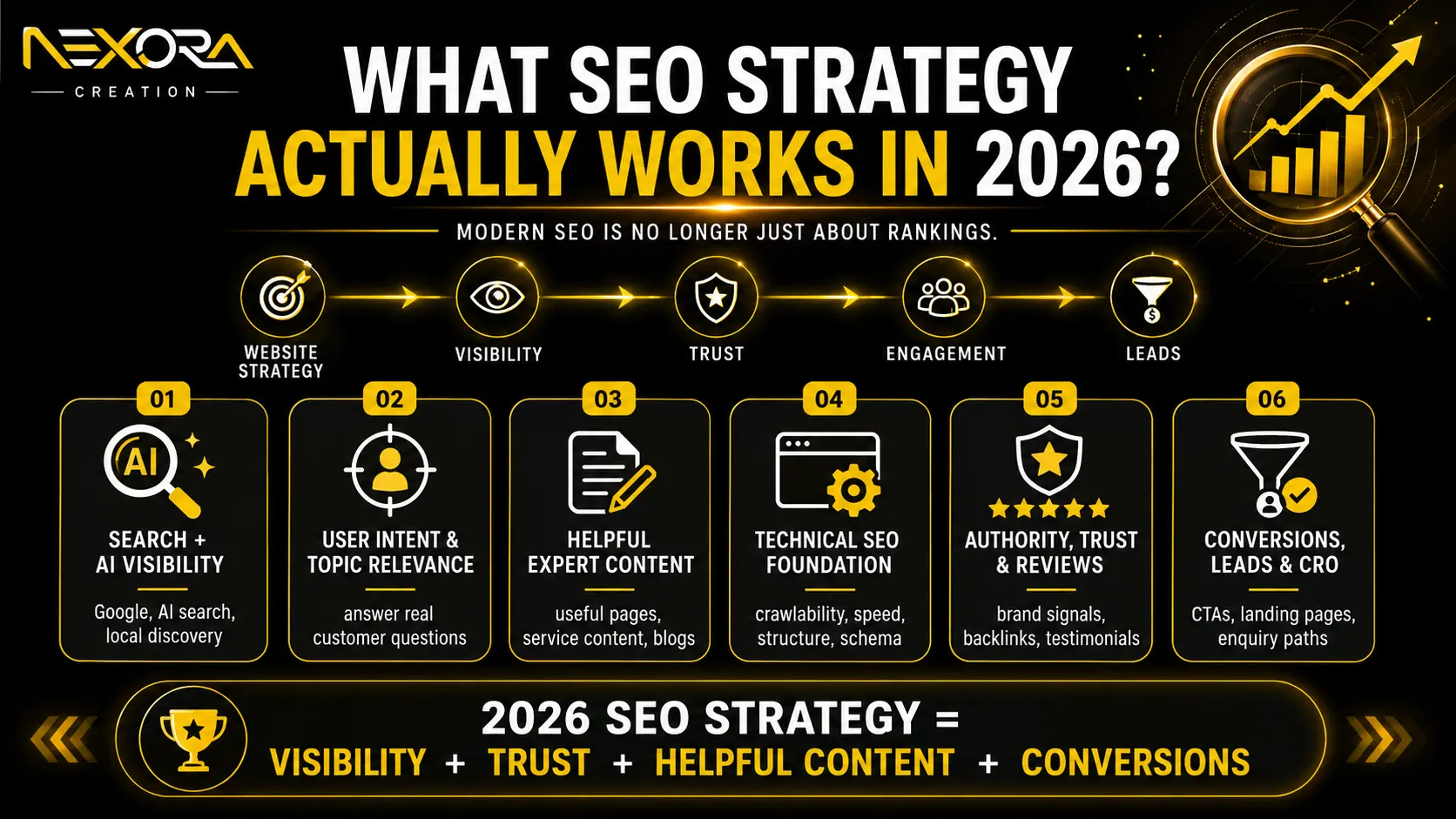
The SEO strategy that actually works in 2026 is not about chasing hacks, publishing random blogs, or stuffing keywords into pages.
It is about building a useful, technically strong, answer-focused, and conversion-ready website that helps the right people find, trust, and contact your business.
SEO still works in 2026, but weak SEO does not.
Generic content does not work.
Thin service pages do not work.
Random backlinks do not work.
Publishing AI-generated blogs without strategy does not work.
What works now is a complete SEO system that connects:
- Technical SEO
- Helpful content
- Clear service pages
- Local SEO
- AEO
- GEO
- AI Search readiness
- Internal linking
- User experience
- Trust signals
- Conversion tracking
- Lead follow-up
Search has changed because users now discover businesses through Google, AI Overviews, AI Mode, ChatGPT-style tools, Perplexity, Gemini, Google Maps, voice search, social search, and review platforms.
That does not mean SEO is dead.
It means SEO needs to be more useful, more structured, and more connected to business results.
At Nexora Creation, we see SEO in 2026 as a visibility and lead-generation system. The goal is not only to get more traffic. The goal is to attract the right people and turn them into calls, enquiries, bookings, and qualified leads.
In this guide, we will explain what SEO strategy actually works in 2026 and how small businesses can use it to grow.
What changed in SEO in 2026?
SEO changed because search behavior changed.
People no longer search only with short keywords and click the first blue link.
They now ask detailed questions, compare options, read AI summaries, check reviews, use Google Maps, watch videos, and ask AI tools for recommendations.
A customer may search:
“roof repair near me”
But they may also ask:
“What should I check before hiring a roofing company?”
or:
“Which website agency is good for local service businesses?”
or:
“Why is my website getting traffic but no leads?”
This means SEO has moved beyond basic keyword targeting.
In 2026, successful SEO needs to focus on:
- Search intent
- Helpful answers
- Topic authority
- Local trust
- Technical accessibility
- Page experience
- Service page quality
- Brand credibility
- AI Search visibility
- Conversion paths
The search landscape is broader.
Your strategy should be broader too.
Is traditional SEO still important in 2026?
Yes, traditional SEO is still important in 2026.
Traditional SEO is the foundation.
Search engines still need to crawl, index, understand, and rank web pages.
Your website still needs:
- Crawlable pages
- Indexable content
- Clean URL structure
- Logical headings
- Meta titles
- Meta descriptions
- Internal links
- XML sitemap
- Robots.txt setup
- Canonical tags
- Page speed
- Mobile-friendly design
- Structured data
- Helpful content
- Trust signals
AI Search does not remove these basics.
It depends on them.
If your website is technically weak, hard to crawl, slow, poorly structured, or full of thin content, it will be harder to succeed in both traditional search and AI-powered search.
Before chasing AEO, GEO, or AI visibility tools, fix the SEO foundation first.
What SEO strategy actually works now?
The SEO strategy that works now is built around one idea:
Create the best useful answer and the clearest path to action.
A working 2026 SEO strategy includes:
- Strong website foundation
- Service pages for real business offers
- Blog content based on real customer questions
- Local SEO for location-based searches
- AEO-friendly headings and FAQs
- GEO-friendly content depth and structure
- Internal links from blogs to services
- Trust signals across pages
- Fast mobile experience
- Conversion-focused CTAs
- Lead tracking and CRM follow-up
This strategy works because it focuses on both visibility and business outcome.
SEO should not only answer:
“How do we rank?”
It should also answer:
“How do we turn search visitors into leads?”
That is the difference between traffic-focused SEO and business-focused SEO.
Why do service pages matter more than random blogs?
Service pages matter because they connect search visibility to revenue.
A blog may attract attention.
A service page turns that attention into enquiries.
Many small businesses make the mistake of publishing blogs while their service pages are weak.
For example, a business may publish blogs about:
- Marketing tips
- SEO trends
- Website ideas
- AI tools
But their actual service pages may be thin, unclear, or missing.
That creates a problem.
People may visit the website, but they do not understand what the business offers or how to take the next step.
A strong service page should include:
- Clear service headline
- Who the service is for
- What problem it solves
- What is included
- Process steps
- Benefits
- FAQs
- Trust signals
- Internal links
- Clear CTA
- Contact options
For example, an SEO service page should explain SEO strategy, technical SEO, local SEO, content, internal links, reporting, and how the service helps generate leads.
If your website has blog traffic but weak service pages, Nexora Creation can review your website structure and service page flow through its website development services.
How should small businesses create SEO content in 2026?
Small businesses should create content around real customer problems, not random keywords.
A good SEO content topic should answer a question your audience actually cares about.
Examples:
- Why is my website not generating leads?
- How much does a business website cost?
- Is SEO dead in 2026?
- How can local businesses rank on Google Maps?
- What is the best landing page structure for Google Ads?
- Can AI tools do SEO for your website?
- How do I optimize my website for AI Search?
These topics work because they match real pain points.
A strong SEO blog should include:
- Clear title
- Direct answer in the introduction
- Question-based headings
- Simple explanations
- Practical examples
- FAQs
- Internal links
- Trust signals
- CTA
- Updated information
Do not write content only to fill a content calendar.
Write content that helps the reader make a decision.
How does AEO fit into SEO strategy?
AEO stands for Answer Engine Optimization.
AEO helps your content answer user questions clearly.
It matters because people search in question-based ways.
They ask:
- What is local SEO?
- How does AI Search affect SEO?
- Why is my website not converting?
- What is the difference between AEO and GEO?
- How do I improve Google Ads landing pages?
AEO-friendly content uses:
- Question-based headings
- Short direct answers
- FAQs
- Simple explanations
- Examples
- Bullet points
- Clear next steps
AEO does not replace SEO.
It improves SEO by making your content easier to understand and easier to use in answer-based search experiences.
For small businesses, AEO is useful because customers often ask questions before they contact you.
If your website answers those questions better than competitors, you build trust earlier.
How does GEO fit into SEO strategy?
GEO stands for Generative Engine Optimization.
GEO focuses on making your content useful for generative AI search experiences such as AI Overviews, AI Mode, ChatGPT-style browsing, Perplexity, Gemini, and Copilot.
GEO is not a magic trick.
It is mostly about making your content clear, helpful, structured, trustworthy, and easy to reference.
A GEO-friendly website should have:
- Helpful service pages
- Clear explanations
- Real examples
- FAQs
- Strong topical coverage
- Internal links
- Trust signals
- Updated content
- Technical SEO foundation
- Good page experience
- Accurate business information
The goal is not to manipulate AI systems.
The goal is to become a useful source.
If your content is vague, thin, or generic, it may not be strong enough for AI-powered discovery.
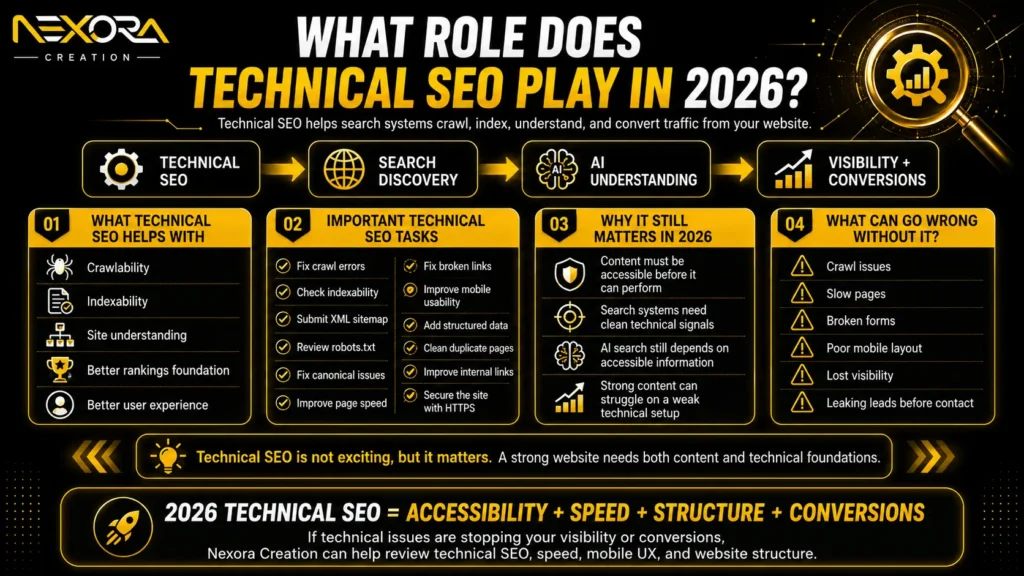
What role does technical SEO play in 2026?
Technical SEO plays a major role because your content must be accessible before it can perform.
Technical SEO helps search systems crawl, index, and understand your website.
Important technical SEO tasks include:
- Fixing crawl errors
- Checking indexability
- Submitting XML sitemap
- Reviewing robots.txt
- Fixing canonical issues
- Improving page speed
- Fixing broken links
- Improving mobile usability
- Adding structured data
- Cleaning duplicate pages
- Improving internal links
- Securing the website with HTTPS
Technical SEO is not exciting, but it matters.
A website with strong content but poor technical setup may still struggle.
If your website has crawl issues, slow pages, broken forms, or poor mobile layout, your SEO strategy may leak leads before users even contact you.
If technical issues are stopping your visibility or conversions, Nexora Creation can help review technical SEO, speed, mobile UX, and website structure through its SEO and website development services.
Why does local SEO still work in 2026?
Local SEO still works because people still search for nearby businesses and service providers.
Local searches often have strong buying intent.
Examples:
- Plumber near me
- Dentist in Multan
- Roof repair Tampa
- HVAC repair near me
- Local SEO agency
- Web design company near me
- Cleaning service in my area
Local SEO helps your business appear in:
- Google Maps
- Local Pack
- Google Business Profile
- Local organic results
- Location-based searches
- Review-based discovery
- Local AI answers
A strong local SEO strategy includes:
- Google Business Profile optimization
- Accurate business information
- Reviews
- Photos
- Service categories
- Service area content
- Local landing pages
- Local backlinks
- Local citations
- Location-specific FAQs
- Clear phone and contact details
- Mobile-friendly website
For local businesses, SEO is not only about ranking blogs.
It is about being visible when customers nearby are ready to act.
Why does internal linking matter more now?
Internal linking matters because it connects your content into a useful system.
Many websites have good blogs but poor internal linking.
That means readers learn something but do not know what to do next.
Internal links help:
- Users find relevant services
- Search engines understand topic relationships
- AI systems understand site structure
- Service pages gain more context
- Blog traffic move toward enquiries
- Content clusters become stronger
A good internal link appears where the reader has a problem.
For example:
A blog about AI Search should link to SEO services.
A blog about landing pages should link to website development or UI/UX services.
A blog about slow follow-up should link to CRM automation services.
A blog about AI chat support should link to AI chatbot services.
A blog about website conversion problems should link to website development and contact pages.
Internal links should not be added randomly.
They should guide the reader toward the next logical step.
If your blogs get traffic but do not generate leads, Nexora Creation can help build an internal linking strategy that connects content to service pages naturally.
Does blogging still work in 2026?
Yes, blogging still works when the content is useful, specific, and connected to business goals.
Random blogging does not work well.
A blog should not only target keywords.
It should answer real questions and support the buyer journey.
Good blog topics include:
- Problem-aware topics
- Comparison topics
- Cost topics
- Strategy topics
- Mistake topics
- Checklist topics
- Local service topics
- AI Search topics
- Conversion topics
For example:
- 15 Google Ads Landing Page Mistakes That Waste Ad Budget
- Best Landing Page Structure for Home Service Google Ads
- How to Update Old Blog Posts for AI Search
- What Technical GEO Actually Matters?
- Can AI Tools Like ChatGPT Do SEO?
These topics work because they answer problems your audience already has.
A blog should also link to relevant service pages.
That is how blog content becomes a lead-generation asset.
Does AI-generated content work for SEO?
AI-generated content can work if it is helpful, accurate, reviewed, and improved by humans.
AI can help with:
- Topic ideas
- Outlines
- Drafts
- FAQs
- Meta descriptions
- Internal link ideas
- Content refreshes
- Content briefs
But AI content can fail when it is:
- Generic
- Repetitive
- Thin
- Inaccurate
- Not based on real expertise
- Not connected to services
- Missing examples
- Written only to rank
- Published without review
The best approach is AI-assisted SEO, not AI-only SEO.
Use AI to speed up the process.
Use human strategy to make the content useful, accurate, and connected to business goals.
What role does website UX play in SEO strategy?
Website UX plays a major role because visibility is useless if visitors do not convert.
A website can rank and still fail.
Common UX problems include:
- Confusing navigation
- Slow loading speed
- Poor mobile design
- Weak CTA placement
- Long forms
- No trust signals
- Poor service page layout
- Hard-to-read text
- Broken buttons
- Hidden contact options
Modern SEO should include conversion optimization.
A strong SEO-friendly website should make it easy for visitors to:
- Understand the service
- Trust the business
- Compare options
- Read proof
- Ask questions
- Contact the team
- Book a call
- Submit a form
SEO should bring the visitor.
UX should help convert the visitor.
If your website gets organic traffic but no leads, the issue may be UX, CTA placement, service page structure, or form friction.
Why does lead tracking matter in SEO?
Lead tracking matters because traffic alone does not prove SEO success.
A blog may get traffic but no leads.
A service page may get visits but no calls.
A keyword may rank but attract the wrong audience.
You need to track business outcomes.
Important SEO metrics include:
- Organic impressions
- Organic clicks
- Ranking growth
- Service page visits
- Blog-to-service clicks
- Form submissions
- Phone calls
- Booking clicks
- Google Business Profile actions
- WhatsApp clicks
- CRM leads
- Lead quality
- Closed customers
- Assisted conversions
If you do not track leads, you may keep improving pages that do not generate business.
SEO strategy should connect to revenue, not only visibility.
How can CRM and automation support SEO results?
CRM and automation support SEO results by helping you handle leads faster and more consistently.
SEO can bring visitors to your website.
But if a lead submits a form and your team responds too late, you may lose the opportunity.
A CRM system can help:
- Capture leads instantly
- Store source data
- Notify your team
- Assign leads
- Send confirmations
- Track follow-up
- Measure lead quality
- Record closed deals
- Improve response time
This matters because SEO success does not stop at the form submission.
The full journey is:
- Search
- Page visit
- Trust
- CTA
- Form or call
- CRM capture
- Follow-up
- Sale
If your SEO generates leads but your team loses them after submission, Nexora Creation can help connect your website with CRM automation.
What SEO tactics do not work anymore?
Some SEO tactics are less effective or risky in 2026.
Avoid relying on:
- Keyword stuffing
- Thin AI-generated blogs
- Generic listicles
- Fake author profiles
- Low-quality backlinks
- Duplicate location pages
- Mass-produced content
- Hidden text
- Random internal links
- Clickbait titles
- Old blogs with outdated information
- Service pages with no depth
- Ignoring technical SEO
- Ignoring conversion tracking
- Chasing AEO/GEO hacks without fixing SEO basics
Search systems are better at identifying low-value content.
Users are also less patient.
If your content does not help them, they leave.
The safest SEO strategy is to create useful, clear, trustworthy content and support it with strong technical foundations.
What is the best SEO workflow for 2026?
A practical SEO workflow for 2026 should look like this:
1. Audit the website
Check technical SEO, content, service pages, local SEO, UX, speed, and conversion paths.
2. Fix technical issues
Make pages crawlable, indexable, fast, secure, and mobile-friendly.
3. Improve service pages
Build clear pages for important services.
4. Research search intent
Understand what customers actually search and ask.
5. Build content clusters
Create blogs and resources around connected topics.
6. Add AEO structure
Use question-based headings, direct answers, and FAQs.
7. Improve GEO readiness
Make content clear, useful, trustworthy, and easy for AI systems to understand.
8. Build internal links
Connect blogs to service pages naturally.
9. Improve CTAs
Make the next step clear.
10. Track leads
Measure calls, forms, bookings, and CRM leads.
11. Refresh old content
Update outdated blogs and pages regularly.
12. Review performance
Improve based on data, not guesses.
This workflow keeps SEO connected to real business outcomes.
How can Nexora Creation help with SEO strategy in 2026?
Nexora Creation helps small businesses build SEO strategies that support modern search visibility and lead generation.
A strong SEO strategy in 2026 should not only bring traffic.
It should help your business get discovered, trusted, and contacted.
Our SEO and website services can help with:
- Technical SEO audits
- Local SEO
- Website development
- Service page optimization
- Blog strategy
- AEO-friendly content structure
- GEO content planning
- Internal linking
- Landing page optimization
- UI/UX improvement
- Conversion-focused CTAs
- CRM automation
- AI chatbot integration
- Lead tracking
If your SEO is not producing leads, the issue may not be one page.
It may be your full website, content, and conversion system.
What is the final SEO strategy that works in 2026?
The final SEO strategy that works in 2026 is simple to understand but requires consistent execution.
Build a website that is:
- Technically strong
- Easy to crawl
- Fast
- Mobile-friendly
- Clear about services
- Helpful for users
- Structured around questions
- Strong in local search
- Trustworthy
- Internally linked
- Conversion-focused
- Updated regularly
- Connected to lead tracking
Then create content that:
- Answers real customer questions
- Matches search intent
- Builds topical authority
- Supports AEO and GEO
- Links to relevant services
- Helps users take action
That is the strategy that works.
Not hacks.
Not random blogs.
Not tool dashboards.
Not AI content without review.
A strong SEO strategy in 2026 is useful, structured, trustworthy, and business-focused.
Conclusion
The SEO strategy that actually works in 2026 is not about chasing every new trend.
It is about combining the fundamentals of SEO with the realities of AI Search, local visibility, answer-based content, and lead generation.
Small businesses should focus on:
- Technical SEO
- Clear service pages
- Helpful content
- Local SEO
- AEO structure
- GEO readiness
- Internal linking
- Trust signals
- UX
- Conversion tracking
- CRM follow-up
- Content refreshes
SEO is still valuable, but it has to be connected to business goals.
Traffic alone is not enough.
Rankings alone are not enough.
The winning strategy is the one that helps the right people find your business, trust your expertise, and take action.
That is what SEO should do in 2026.
FAQs
What SEO strategy works in 2026?
The SEO strategy that works in 2026 combines technical SEO, helpful content, clear service pages, local SEO, AEO, GEO, internal links, trust signals, UX, lead tracking, and content refreshes.
Is SEO still worth it in 2026?
Yes, SEO is still worth it in 2026. Search behaviour has changed, but people still use search engines and AI-powered tools to find services, answers, products, and businesses.
Does AI Search replace SEO?
No, AI Search does not replace SEO. AI Search builds on many SEO foundations, including helpful content, crawlability, page experience, structured content, and trust signals.
What should small businesses focus on first?
Small businesses should first fix technical SEO, service pages, website structure, local SEO, and conversion paths before investing heavily in advanced AEO or GEO tools.
Does blogging still help SEO?
Yes, blogging helps SEO when it answers real customer questions, matches search intent, links to relevant service pages, and supports topical authority and lead generation.
What is AEO in SEO strategy?
AEO means Answer Engine Optimization. It helps content answer user questions clearly through question-based headings, direct answers, FAQs, and structured explanations.
What is GEO in SEO strategy?
GEO means Generative Engine Optimization. It focuses on making content useful, structured, and trustworthy enough for AI-powered search systems to understand and potentially reference.
How do I know if my SEO strategy is working?
Track organic traffic, rankings, service page visits, internal link clicks, calls, forms, bookings, CRM leads, lead quality, and closed customers. SEO should be measured by business impact, not traffic alone.