
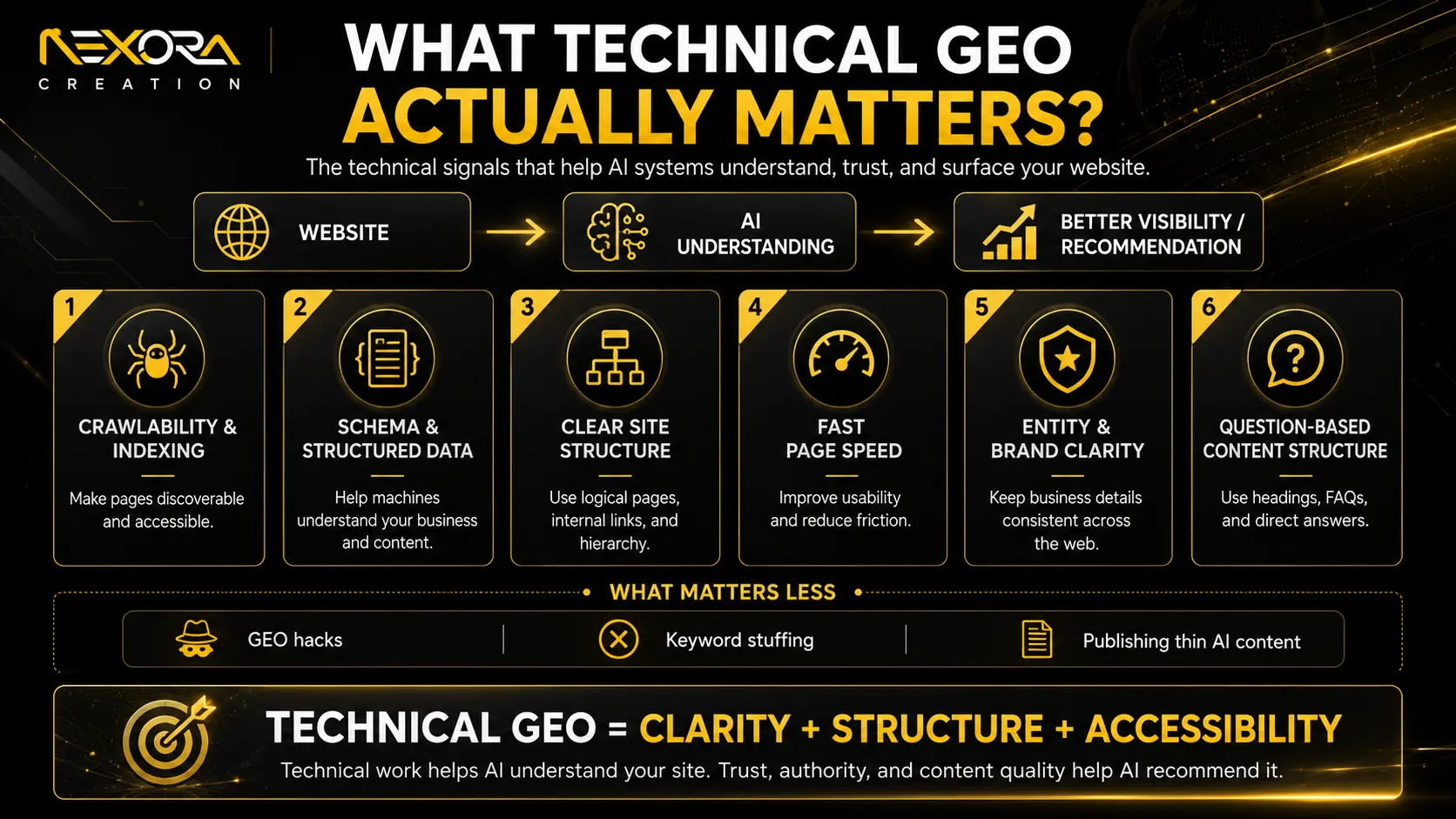
Technical GEO matters when it helps search engines and AI systems crawl, understand, access, and trust your website content.
But not every “technical GEO” tactic is worth your time.
The simple answer is this:
The technical GEO that actually matters is mostly strong technical SEO, clean website structure, crawlable content, indexable pages, fast performance, structured data, clear internal linking, snippet accessibility, and trustworthy content signals.
The technical GEO that does not matter much is usually hype: special AI-only tricks, hidden prompt text, keyword stuffing for AI, fake authority signals, or chasing tools without fixing your website foundation.
GEO stands for Generative Engine Optimization. It focuses on improving how your content appears in AI-generated answers from platforms like Google AI Overviews, AI Mode, ChatGPT, Perplexity, Gemini, and Copilot.
But for small businesses, the goal should not be to “hack AI.”
The goal should be to make your website easy for humans, search engines, and AI systems to understand.
At Nexora Creation, we treat technical GEO as a practical layer on top of SEO. If your website is slow, hard to crawl, missing service pages, blocked by robots rules, poorly structured, or full of thin content, no GEO tool or trick will fix the real problem.
In this guide, we will explain what technical GEO actually matters, what does not matter, and how small businesses can improve their website for AI Search without wasting time on hype.
What is technical GEO?
Technical GEO means improving the technical parts of your website so generative AI systems can discover, access, understand, and use your content more easily.
It is related to technical SEO, but the focus is slightly broader.
Technical SEO asks:
Can search engines crawl, index, understand, and rank this page?
Technical GEO asks:
Can search engines and AI-powered systems access, understand, summarize, and trust this content enough to use it in AI-generated answers?
A strong technical GEO foundation includes:
- Crawlable pages
- Indexable content
- Clear site architecture
- Fast loading speed
- Mobile-friendly design
- Clean HTML structure
- Descriptive headings
- Helpful structured data
- Internal links
- XML sitemap
- Robots.txt accuracy
- Snippet accessibility
- Canonical setup
- Secure HTTPS
- Clear business information
- Helpful content structure
- Trust and authority signals
In simple words, technical GEO is not about secret AI code.
It is about removing technical barriers that stop your content from being discovered and understood.
Why does technical GEO matter for small businesses?
Technical GEO matters for small businesses because AI Search still depends on accessible, understandable, and trustworthy web content.
If your website is technically weak, AI-powered search systems may struggle to understand your business.
For example, if your website has:
- Important pages blocked by robots.txt
- No clear service pages
- Slow mobile loading
- Broken internal links
- Duplicate pages
- Thin content
- Confusing headings
- Poor schema
- Missing contact details
- No local business information
- Broken forms
Then your content may be less useful for both search engines and AI systems.
This matters because customers now search in more conversational ways.
They may ask:
- Who provides website development for small businesses?
- What should a Google Ads landing page include?
- How can a local roofing company get more leads?
- Which business needs CRM automation?
- What is the best way to improve AI Search visibility?
If your website clearly answers these questions and your technical foundation is strong, you have a better chance of being discovered, understood, and trusted.
Does technical SEO still matter for GEO?
Yes, technical SEO still matters for GEO.
In fact, technical SEO is the foundation of technical GEO.
If search engines cannot crawl or index your content properly, your chances of appearing in AI-powered search experiences become weaker.
Important technical SEO basics include:
- Crawlability
- Indexability
- XML sitemap
- Robots.txt setup
- Canonical tags
- Mobile usability
- Page speed
- Clean URL structure
- Internal linking
- Structured data
- HTTPS
- Error-free pages
- Correct redirects
AI Search does not remove these basics.
It makes them more important because AI systems need clean, accessible, and well-structured information to work with.
Before worrying about advanced GEO tools, make sure your website can be properly crawled, indexed, and understood.
Why does crawlability matter for GEO?
Crawlability matters because AI-powered search systems often depend on search indexes and accessible web content.
If your content cannot be crawled, it may not be discovered.
Common crawlability issues include:
- Important pages blocked in robots.txt
- No internal links to key pages
- Broken links
- Orphan pages
- JavaScript-rendered content not accessible
- Redirect chains
- Server errors
- Slow server response
- Pages hidden behind forms or logins
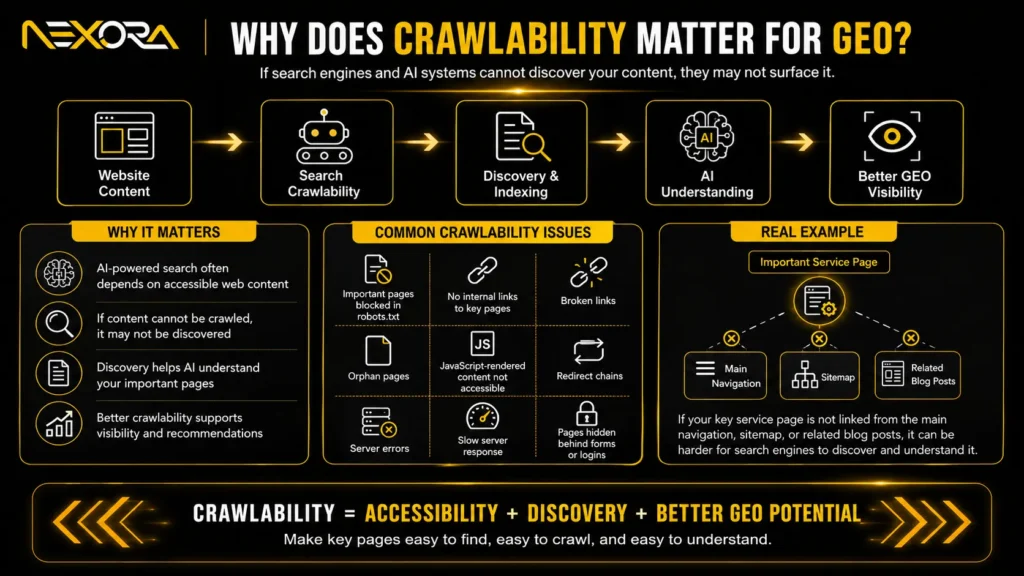
For example, if your most important service page is not linked from the main navigation, sitemap, or related blog posts, it may be harder for search engines to discover and understand it.
How can you improve crawlability?
You can improve crawlability by:
- Creating a clean site structure
- Linking important pages from your navigation
- Adding relevant internal links from blogs
- Submitting an XML sitemap
- Fixing broken links
- Removing unnecessary redirects
- Checking robots.txt rules
- Avoiding hidden important content
- Making sure key content is available in HTML
- Fixing server errors
Crawlability is one of the most basic technical GEO requirements.
If your content cannot be discovered, it cannot support AI visibility.
Why does indexability matter for AI Search?
Indexability matters because pages usually need to be eligible for search indexing before they can support visibility in search and AI-powered features.
A page may be crawlable but not indexable.
Common indexability issues include:
- Noindex tags
- Canonical tags pointing to the wrong page
- Duplicate content
- Thin content
- Soft 404 pages
- Poor page quality
- Redirected URLs
- Blocked resources
- Wrong robots meta settings
For small businesses, this can be a major issue.
Sometimes important pages such as service pages, landing pages, or blog posts are accidentally set to noindex.
That means search engines may crawl them but not include them in search results.
How can you improve indexability?
You can improve indexability by:
- Checking robots meta tags
- Removing accidental noindex tags
- Fixing incorrect canonical tags
- Improving thin pages
- Avoiding duplicate service pages
- Submitting important URLs in Google Search Console
- Ensuring pages return 200 status codes
- Making content useful and unique
- Keeping URLs clean and stable
If your key pages are not indexable, they cannot support SEO or GEO properly.
Do robots.txt and meta robots affect GEO?
Yes, robots.txt and meta robots can affect GEO because they control crawler access and indexing behaviour.
Robots.txt can block crawlers from accessing certain parts of your website.
Meta robots tags can tell search engines whether a page should be indexed, followed, or shown in snippets.
For Google Search, robots meta tags and X-Robots-Tag can control indexing and serving behaviour on a page-specific level.
This matters because AI Search features often depend on content that search systems can access and use.
If you accidentally block important content, you may reduce your visibility.
What should small businesses check?
Check:
- Is robots.txt blocking important pages?
- Are service pages set to index?
- Are blog posts indexable?
- Are important images or scripts blocked?
- Are noindex tags used correctly?
- Are canonical tags pointing to the right URL?
- Are snippet controls too restrictive?
Google also explains that site owners can use preview controls such as nosnippet, data-nosnippet, max-snippet, and noindex to manage how content appears in Google Search and AI features.
These controls are useful, but they should be used carefully.
If you restrict too much content, you may limit how your page can appear.
Does structured data matter for technical GEO?
Structured data matters because it helps search engines understand the meaning of your content more clearly.
Structured data does not guarantee AI visibility, rankings, or citations.
But it can support clarity.
For small businesses, useful structured data may include:
- Organization schema
- LocalBusiness schema
- Service schema
- Article schema
- FAQ schema
- Breadcrumb schema
- Product schema
- Review schema, where eligible
Structured data should match visible page content.
Do not add fake reviews, fake ratings, or misleading schema.
How can structured data help?
Structured data can help search systems understand:
- Who the business is
- What services are offered
- Where the business operates
- What the page is about
- Which article or blog is being published
- How pages connect through breadcrumbs
- What FAQs are answered
- What products or services are available
For GEO, structured data is not a magic ranking signal.
It is a clarity signal.
If your website content is already helpful, structured data can make the meaning easier to process.
Does page speed matter for GEO?
Page speed matters because users and search systems both prefer accessible, usable pages.
A slow website creates a poor experience.
For AI Search, page speed is not a “GEO hack,” but it is part of strong page experience and technical SEO.
Slow pages can hurt:
- User engagement
- Conversion rate
- Crawl efficiency
- Mobile experience
- Landing page performance
- Lead generation
Common speed issues include:
- Oversized images
- Heavy videos
- Too many plugins
- Poor hosting
- Bloated themes
- Too many scripts
- No caching
- Large fonts
- Render-blocking resources
- Unoptimized page builders
How can you improve speed?
Improve speed by:
- Compressing images
- Using WebP format
- Enabling caching
- Choosing better hosting
- Reducing scripts
- Removing unnecessary plugins
- Avoiding heavy animations
- Optimizing fonts
- Cleaning unused CSS
- Testing mobile performance
If your website loads slowly, visitors may leave before they even read your content.
That means even if your content gets visibility, it may not turn into leads.
If your website has strong content but poor speed, Nexora Creation can review your technical structure, page speed, mobile UX, and conversion flow through its website development services.
Does mobile experience matter for GEO?
Yes, mobile experience matters because many users search and interact with AI-powered results on mobile devices.
A website that is hard to use on mobile creates friction.
Mobile issues include:
- Tiny text
- Small buttons
- Slow loading
- Broken layouts
- Overlapping sections
- Difficult forms
- Hidden CTAs
- Intrusive popups
- Poor spacing
- Hard-to-read navigation
For small businesses, mobile experience directly affects leads.
A user may discover your business through search or AI recommendations, then visit your site from a phone.
If the mobile page is poor, they may leave.
How can you improve mobile GEO readiness?
Improve mobile experience by:
- Using responsive design
- Keeping text readable
- Making buttons easy to tap
- Adding click-to-call buttons
- Simplifying forms
- Keeping CTAs visible
- Reducing popups
- Testing on real devices
- Improving loading speed
- Keeping layouts clean
AI Search visibility is only useful if the user can actually use your website after discovering it.
Does internal linking matter for technical GEO?
Yes, internal linking matters because it helps users, search engines, and AI systems understand how your content connects.
Internal links create relationships between pages.
They help clarify:
- Which pages are important
- Which topics are connected
- Which services solve which problems
- Which blogs support which service pages
- How users should move through the website
For example:
A blog about AI Search should link to SEO services.
A blog about landing page mistakes should link to website development or UI/UX services.
A blog about slow lead follow-up should link to CRM automation services.
A blog about AI chat support should link to AI chatbot services.
This supports both visibility and lead generation.
How should internal links be added?
Add internal links where the reader has a clear problem.
Do not add links randomly.
A good internal link appears when the reader is thinking:
“I need help with this.”
For example:
If your blogs explain search visibility but readers are not moving toward enquiries, Nexora Creation can help plan internal links, service page paths, and CTAs through its SEO services.
Does HTML structure matter for GEO?
HTML structure matters because clean page structure helps search systems understand the hierarchy of your content.
Important HTML elements include:
- One clear H1
- Logical H2 and H3 headings
- Paragraphs that answer questions clearly
- Lists for steps and checklists
- Descriptive anchor text
- Alt text for meaningful images
- Proper title tags
- Meta descriptions
- Canonical tags
- Breadcrumbs
- Schema markup
Good structure helps both users and machines.
A poorly structured page may have:
- Multiple confusing H1s
- Headings used only for style
- Missing heading hierarchy
- Important text hidden in images
- Unclear navigation
- Weak anchor text
- Duplicate titles
- Missing meta descriptions
Technical GEO is not only about server settings.
It is also about making content structure clean and understandable.
Does JavaScript-rendered content affect GEO?
JavaScript-rendered content can affect GEO if important content is not easily accessible to crawlers.
Modern search engines can process many JavaScript websites, but problems still happen when important content depends heavily on scripts.
Issues may include:
- Content not visible in initial HTML
- Slow rendering
- Broken hydration
- Internal links hidden behind scripts
- Forms not working properly
- Dynamic content not indexed
- Lazy-loaded sections failing
- Poor mobile performance
For small businesses, important content should not be hidden in complex scripts.
Key content should be easy to access.
This includes:
- Service descriptions
- FAQs
- Contact information
- Reviews
- Pricing guidance
- Internal links
- CTAs
- Business details
How can you fix JavaScript issues?
You can improve accessibility by:
- Keeping important content in HTML where possible
- Testing pages with Google Search Console
- Checking rendered HTML
- Making internal links crawlable
- Avoiding hidden text behind scripts
- Reducing heavy JavaScript
- Testing forms and CTAs
- Improving load performance
If AI and search systems cannot easily access your content, your GEO foundation becomes weaker.
Do snippets and preview controls matter for GEO?
Yes, snippets and preview controls can matter because they influence how much content search systems can show or use in search experiences.
Google supports controls such as:
- nosnippet
- max-snippet
- data-nosnippet
- noindex
These can control how content appears in Google Search results and AI features.
For most small businesses, you should not restrict snippets unless you have a clear reason.
If you use restrictive preview controls too aggressively, your content may have less opportunity to appear in rich or AI-powered search experiences.
What should you check?
Check:
- Are important pages using nosnippet?
- Is max-snippet too restrictive?
- Are key paragraphs blocked with data-nosnippet?
- Are pages accidentally noindexed?
- Are preview controls applied sitewide by mistake?
Snippet controls are useful for privacy and content control.
But they should not be applied blindly.
Does schema for FAQ still matter?
FAQ schema can still be useful when it accurately represents visible FAQ content, but it should not be treated as a shortcut.
The real value is not only the schema.
The real value is answering important questions clearly.
For AI Search and AEO, FAQs help because they:
- Answer specific questions
- Improve content structure
- Support long-tail searches
- Make pages easier to scan
- Help users make decisions
- Create natural internal linking opportunities
For example, a service page can include FAQs like:
- How much does this service cost?
- How long does the process take?
- Do you serve my area?
- What happens after I submit the form?
- Can I book a consultation?
These questions help users.
They may also help search systems understand the page better.
Use FAQ schema only when the FAQs are visible and accurate.
Does llms.txt matter for GEO?
For Google Search’s generative AI features, Google’s official guidance says some widely discussed tactics can be ignored, including llms.txt as an optimization requirement for Google Search generative AI features.
That does not mean llms.txt can never have use in any context.
It means small businesses should not treat it as a priority over core technical SEO.
If your website has crawl issues, thin service pages, poor internal links, weak mobile UX, and no lead tracking, llms.txt will not solve those problems.
What should you focus on instead?
Focus on:
- Crawlability
- Indexability
- Helpful content
- Structured pages
- Internal links
- Page speed
- Mobile UX
- Trust signals
- Conversion tracking
- Clear service pages
Do not chase experimental files before fixing fundamentals.
What technical GEO tactics are mostly hype?
Some technical GEO tactics are mostly hype when they distract from real fundamentals.
Be careful with tactics like:
- Hidden AI prompts on pages
- Keyword stuffing for AI tools
- Fake citations
- Fake author signals
- Fake reviews
- Doorway pages for AI prompts
- Publishing thin AI-generated content at scale
- Adding schema that does not match visible content
- Treating llms.txt as a magic visibility switch
- Creating pages only to manipulate AI answers
- Over-optimizing for one tool’s prompt output
These tactics can reduce trust and may create long-term risk.
Google’s spam policies also focus on manipulative practices that try to deceive users or manipulate search results, including generative AI-powered search experiences.
A safer approach is to build genuinely useful, accessible, and trustworthy content.
What technical GEO checklist should small businesses follow?
Small businesses can follow this technical GEO checklist:
1. Check crawlability
Make sure important pages are not blocked.
2. Check indexability
Remove accidental noindex tags from key pages.
3. Review robots.txt
Confirm that important content is accessible.
4. Review sitemap
Submit updated XML sitemap.
5. Fix broken links
Remove or redirect broken internal links.
6. Improve page speed
Compress images, reduce scripts, and improve hosting.
7. Improve mobile UX
Make buttons, text, forms, and CTAs easy to use.
8. Clean heading structure
Use one H1 and logical H2/H3 sections.
9. Add structured data
Use accurate schema where relevant.
10. Improve internal links
Connect blogs to service pages naturally.
11. Check snippets controls
Avoid unnecessary nosnippet or max-snippet restrictions.
12. Improve service pages
Make services clear, helpful, and conversion-focused.
13. Add FAQs
Answer real customer questions.
14. Add trust signals
Use reviews, case studies, testimonials, and clear business info.
15. Track conversions
Track calls, forms, bookings, and CRM leads.
This checklist covers the technical GEO that actually matters for most small businesses.
How can technical GEO support lead generation?
Technical GEO supports lead generation by making your content easier to discover, understand, and act on.
But visibility alone is not enough.
A technically strong page should also guide users toward conversion.
That means your website should have:
- Clear CTAs
- Service page links
- Fast mobile experience
- Working forms
- Click-to-call buttons
- Internal links from blogs
- Trust signals
- Contact options
- CRM lead capture
- Conversion tracking
For example:
If a blog explains why technical GEO matters, it should naturally guide readers to SEO or website development services when they realize their own site has technical issues.
If a page explains CRM problems, it should link to CRM automation.
If a page explains AI chat support, it should link to AI chatbot services.
Technical GEO should not only help AI systems understand the site.
It should help real users take the next step.
How can Nexora Creation help with technical GEO?
Nexora Creation helps businesses improve the technical, content, and conversion foundations needed for SEO, AEO, GEO, and AI Search visibility.
Technical GEO is not only about adding schema or testing AI tools.
It includes:
- Technical SEO audits
- Crawlability checks
- Indexability checks
- Website speed improvement
- Mobile UX improvement
- Service page structure
- Internal linking strategy
- Schema planning
- Blog content optimization
- AI Search content formatting
- CTA placement
- Conversion tracking
- CRM integration
- AI chatbot integration
If your website is not easy to crawl, understand, trust, or convert from, technical GEO should start with your website foundation.
What is the best technical GEO strategy?
The best technical GEO strategy is to fix the fundamentals first.
Do not start with hype.
Start with the basics that help both users and search systems.
A practical technical GEO strategy includes:
- Make pages crawlable.
- Make important pages indexable.
- Keep robots.txt clean.
- Use accurate canonical tags.
- Improve page speed.
- Improve mobile usability.
- Add structured data where useful.
- Build clear internal links.
- Use clean heading structure.
- Make important content accessible in HTML.
- Avoid unnecessary snippet restrictions.
- Add clear service pages.
- Include FAQs.
- Show trust signals.
- Track leads and conversions.
Technical GEO should support a simple goal:
Make your website easier to find, easier to understand, easier to trust, and easier to convert from.
Conclusion
The technical GEO that actually matters is not a secret trick.
It is the technical foundation that helps search engines, AI systems, and users access and understand your website.
For small businesses, the most important technical GEO factors are:
- Crawlability
- Indexability
- Robots.txt accuracy
- Meta robots setup
- Structured data
- Page speed
- Mobile experience
- Clean HTML structure
- Internal linking
- Snippet accessibility
- Service page clarity
- FAQs
- Trust signals
- Conversion tracking
The least useful technical GEO tactics are usually the ones that promise shortcuts.
AI Search is changing how people discover information, but the foundation still matters.
If your website is crawlable, useful, structured, fast, trustworthy, and conversion-focused, it is better prepared for both traditional SEO and AI-powered search experiences.
Do not chase GEO hype before fixing your website.
Fix the foundation first.
FAQs
What is technical GEO?
Technical GEO means improving your website’s technical structure so search engines and AI systems can crawl, access, understand, and use your content more easily in AI-powered search experiences.
Is technical GEO different from technical SEO?
Technical GEO is closely related to technical SEO. Technical SEO focuses on search engine crawling, indexing, and ranking. Technical GEO extends that thinking to AI-powered answer and generative search experiences.
Does structured data help GEO?
Structured data can help search systems understand your content, business, services, articles, FAQs, and breadcrumbs. It does not guarantee AI visibility, but it supports clarity.
Does llms.txt matter for GEO?
For Google Search generative AI features, Google’s official guidance says llms.txt is not a required optimization tactic. Small businesses should focus on technical SEO foundations first.
Can robots.txt affect AI Search visibility?
Yes. If robots.txt blocks important pages or resources, search systems may not access them properly. This can reduce your visibility in traditional and AI-powered search experiences.
Should I use nosnippet on important pages?
Use nosnippet only when you have a clear reason. Restrictive snippet controls can limit how content appears in Google Search and AI features.
What is the most important technical GEO factor?
The most important factor is accessibility. Your important content should be crawlable, indexable, well-structured, useful, and easy for both users and search systems to understand.
How can technical GEO generate leads?
Technical GEO can support lead generation by improving visibility, page experience, internal links, service page clarity, CTAs, forms, and tracking so users can move from content to enquiry.