
Over the last few years, SEO has been the primary way businesses improve their online visibility.
If you wanted more traffic, you optimised your website for Google.
If you wanted more leads, you improved your rankings.
But search is changing.
Today, millions of people are asking questions directly to AI tools such as:
- ChatGPT
- Gemini
- Perplexity
- Google AI Overviews
Instead of searching through multiple websites, users increasingly expect AI to provide direct answers and recommendations.
This shift has introduced a new concept:
Generative Engine Optimisation (GEO).
If you’ve been hearing about GEO but aren’t sure what it actually means, this guide will explain everything you need to know.
What Is GEO?
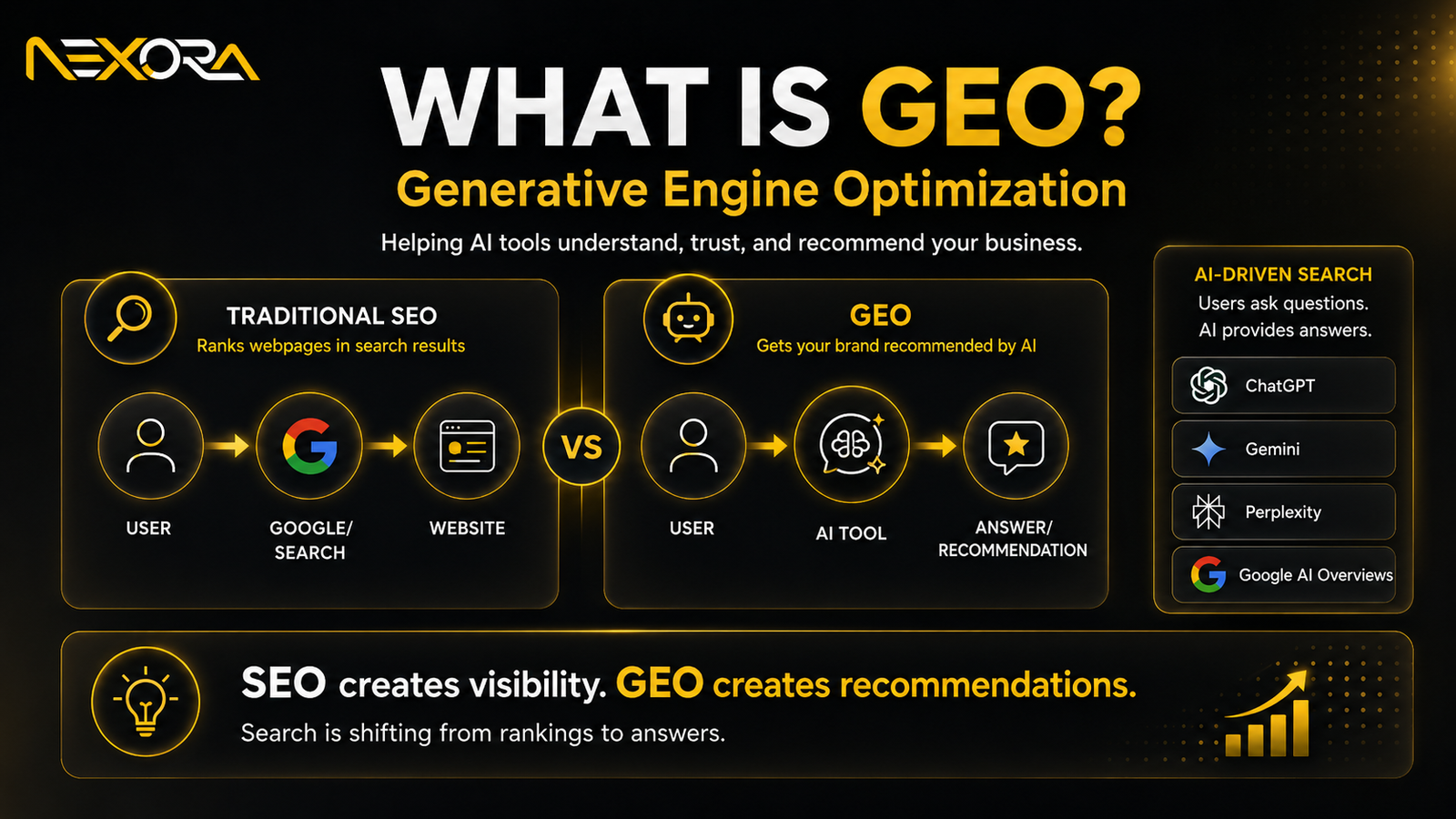
Generative Engine Optimisation (GEO) is the process of helping AI search tools understand, trust, and recommend your business.
Traditional SEO focuses on helping your website rank in search results.
GEO focuses on helping your business become part of the answer.
Think about the difference.
Traditional SEO
Goal:
Rank your webpage.
Example:
Your kitchen design page ranks on page one for “Kitchen Company Manchester.”
GEO
Goal:
Get your brand recommended.
Example:
Someone asks ChatGPT:
“Who are the best kitchen companies in Manchester?”
Your business gets mentioned as one of the recommended options.
That’s GEO in its simplest form.
Why GEO Has Become So Popular
The rise of GEO is directly connected to changes in search behaviour.
For years, the process looked like this:
User → Google → Website
Now it increasingly looks like this:
User → AI Tool → Answer
People are asking questions such as:
- Best SEO agency for small business?
- Best kitchen company near me?
- Which IV therapy clinic should I trust?
- What is the best roofing company in my city?
Instead of clicking through multiple websites, users often receive recommendations immediately.
As platforms like ChatGPT, Gemini, Perplexity, and Google’s AI Overviews become more common, businesses are starting to realise that visibility is no longer limited to Google rankings.
GEO vs SEO: What’s the Difference?
Many people assume GEO is simply a new name for SEO.
It isn’t.
While they are closely connected, they have different goals.
SEO Focuses on Rankings
SEO asks:
“How do I get more clicks?”
The goal is visibility in traditional search results.
GEO Focuses on Recommendations
GEO asks:
“How do I become a trusted answer?”
The goal is being mentioned, cited, or recommended by AI systems.
A page can rank well without becoming a recommended brand.
GEO focuses on building the trust signals that make recommendations possible.
Will GEO Replace SEO?
No.
In my opinion, GEO will not replace SEO.
Instead, they will work together.
This is important because many businesses are making the mistake of treating GEO as a replacement.
Without SEO:
- Pages aren’t discovered
- Content isn’t indexed
- Authority isn’t built
- Search visibility becomes limited
SEO remains the foundation.
GEO builds on top of that foundation.
A simple way to think about it is:
SEO creates visibility.
GEO creates recommendations.
Both are needed.
What Signals Do AI Systems Appear to Value?
While no AI company publishes a complete ranking formula, there are clear patterns emerging.
Based on industry observations and what I see when reviewing websites, AI systems appear to value:
Strong Website Content
Clear, helpful, accurate content.
Reviews
External proof from real customers.
Brand Mentions
References across trusted websites.
Third-Party Citations
Industry directories, publications, and recognised sources.
Expert Content
Demonstrated experience and expertise.
Case Studies
Real-world proof of success.
Consistent Business Information
Clear and accurate brand details across the web.
Media Mentions
Recognition from external sources.
The common theme behind all of these signals is trust.
The Biggest GEO Mistakes Businesses Are Making
Many businesses are approaching GEO incorrectly.
Some of the most common mistakes include:
Publishing Mass AI Content
More content doesn’t automatically create authority.
Ignoring Reviews
Reputation plays a major role in trust.
Weak Brand Building
Many businesses focus only on rankings.
No Third-Party Presence
Authority is built both on and off your website.
No Expertise Signals
No case studies.
No project examples.
No proof of experience.
Searching for GEO Hacks
There is no secret GEO trick.
Trust remains the core principle.
Why Digital Reputation Matters More Than Ever
One of the biggest differences between SEO and GEO is that GEO extends beyond your website.
Traditional SEO often focuses heavily on:
- Keywords
- Content
- Technical optimisation
GEO introduces a wider question:
“What does the internet say about your business?”
AI systems appear increasingly interested in reputation signals.
This includes:
- Reviews
- Directories
- Reddit discussions
- Industry mentions
- Social proof
- Expert content
The stronger your reputation, the easier it becomes for AI systems to recommend you confidently.
A Real Example of GEO in Action
Imagine a kitchen company operating in Manchester.
A homeowner asks:
“Who are the best kitchen companies in Manchester?”
If ChatGPT includes that company in its answer, the business immediately gains visibility before the user ever visits Google.
That visibility can lead to:
- Website visits
- Quote requests
- Brand awareness
- Customer enquiries
without spending money on ads.
The key point is that the company must earn the right to be recommended.
What Content Performs Best in GEO?
Not all content is equally useful for AI systems.
The content most likely to be referenced often includes:
Comprehensive Guides
Detailed resources that answer questions thoroughly.
FAQs
Clear question-and-answer content.
Comparison Articles
Helpful evaluations of options.
Case Studies
Evidence-based success stories.
Original Research
Unique insights and findings.
Industry Statistics
Useful supporting information.
Cost Guides
Common purchasing questions.
Expert Opinion Articles
First-hand experience and practical insights.
The strongest content is usually content that helps users make decisions.
A 12-Month GEO Strategy for a New Business
If I were building a brand from scratch today, my GEO strategy would look something like this.
Months 1–3: Build the Foundation
Create:
- Website
- Service pages
- About page
- FAQ pages
- Google Business Profile
Focus on clarity and trust.
Months 4–6: Publish Helpful Content
Create:
- Guides
- Local content
- Case studies
- Comparison articles
Answer real customer questions.
Months 7–9: Build Authority
Focus on:
- Industry mentions
- Guest contributions
- Partnerships
- Podcast appearances
Expand visibility beyond your website.
Months 10–12: Strengthen Reputation
Invest in:
- Reviews
- Customer feedback
- PR opportunities
- Brand recognition
Build signals that support trust.
Why Service Pages Matter for GEO
One of the first things I review during audits is service page quality.
Many businesses treat service pages as simple information pages.
That’s a mistake.
Strong service pages should include:
- Service explanations
- FAQs
- Reviews
- Case studies
- Internal links
- Trust signals
- Clear calls-to-action
These improvements support:
- SEO
- GEO
- Conversions
at the same time.
How GEO Will Evolve Over the Next 3–5 Years
I believe GEO will become increasingly important.
Not because SEO is disappearing.
Because search is expanding.
The future will likely include:
- Traditional rankings
- AI Overviews
- AI recommendations
- AI-generated summaries
- Conversational search experiences
Businesses relying entirely on rankings may struggle.
Businesses investing in authority and trust are likely to benefit the most.
The Biggest Myth About GEO
The biggest myth is:
“There is a secret GEO optimisation trick.”
There isn’t.
Most GEO success still comes from fundamentals:
- Better content
- Better authority
- Better reviews
- Better trust signals
- Better reputation
The businesses that deserve to be recommended are usually the businesses that get recommended.
Frequently Asked Questions
Is GEO the same as SEO?
No.
SEO focuses on rankings.
GEO focuses on recommendations.
Do I still need SEO?
Absolutely, SEO remains the foundation that helps search engines discover and understand content.
Are reviews important for GEO?
Yes, Reviews are one of the strongest trust signals available online.
D,es AI-generated content help GEO?
Only if it is genuinely helpful, accurate, and supported by real expertise.
What is the most important GEO factor?
Trust, Almost every important GEO signal ultimately contributes to trust.
Final Thoughts
Generative Engine Optimisation is not about manipulating AI systems.
It’s about helping AI systems understand that your business deserves to be recommended.
The businesses that succeed in GEO will usually be the same businesses that succeed in SEO:
- Helpful businesses
- Trusted businesses
- Visible businesses
- Authoritative businesses
The difference is that GEO shifts the focus from rankings to recommendations.
And as AI-powered search continues to grow, recommendations may become one of the most valuable forms of visibility available.
Remember:
GEO is not about convincing AI to trust your business. It’s about becoming the kind of business AI can confidently recommend.