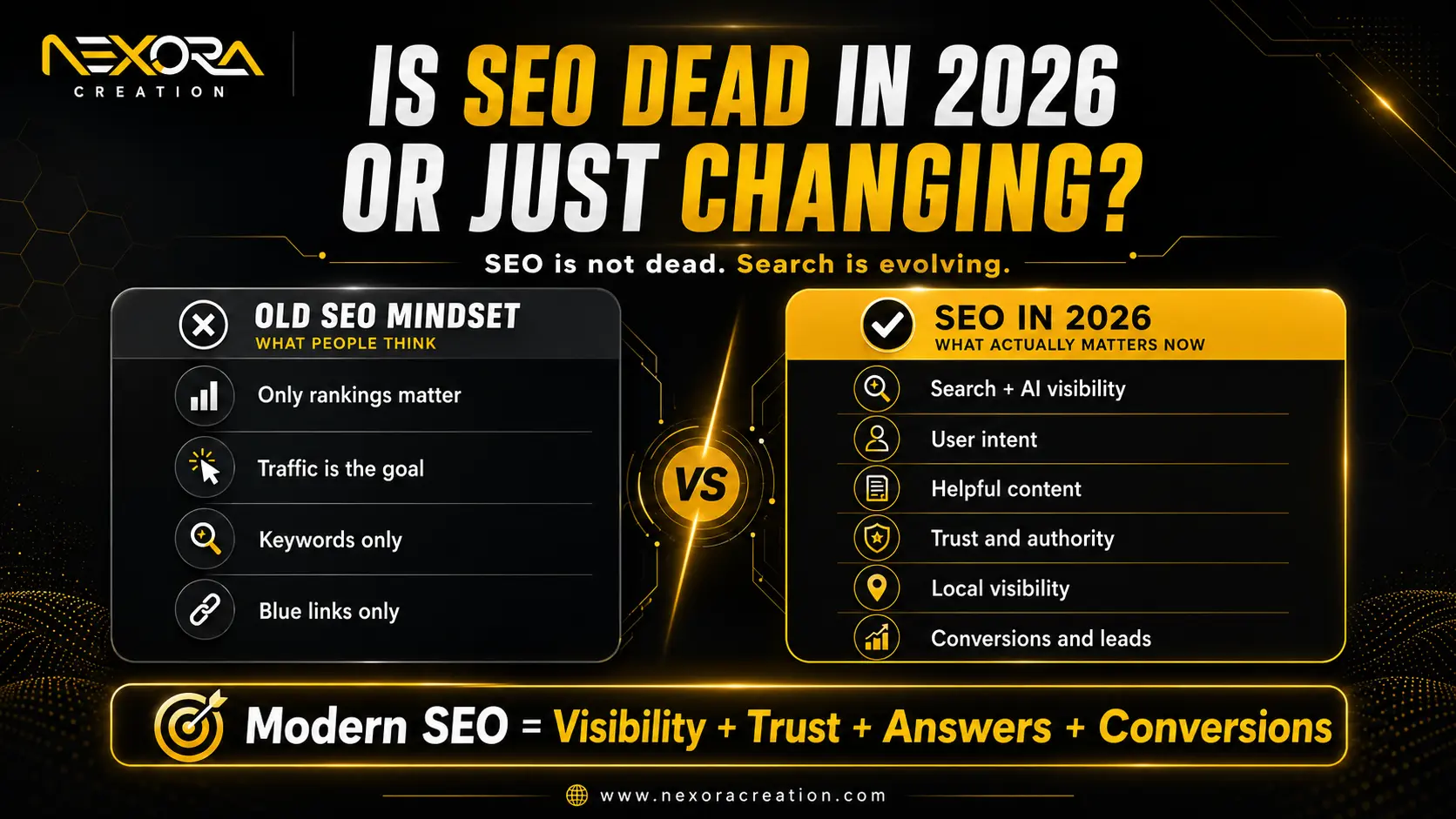
SEO is not dead in 2026.
SEO is changing.
The way people search has changed because users now use Google, AI Overviews, AI Mode, ChatGPT, Perplexity, Gemini, voice search, social platforms, and direct answer experiences to find information.
But the main goal of SEO is still the same:
Help the right people find your business when they are looking for answers, services, products, or solutions.
What has changed is how visibility happens.
In the past, SEO was mostly about ranking higher on Google search result pages.
In 2026, SEO is broader.
Your business may need to appear in:
- Traditional Google search results
- Local search results
- Google Maps
- Featured snippets
- People Also Ask
- AI Overviews
- AI Mode
- ChatGPT-style answers
- Perplexity answers
- Voice search results
- Social search
- Review-based discovery
That does not mean SEO is finished.
It means SEO now includes stronger content structure, better user experience, clearer answers, local trust signals, technical SEO, AEO, GEO, and conversion-focused pages.
At Nexora Creation, we see SEO in 2026 as a visibility and lead-generation system. It is not only about traffic. It is about helping small businesses get discovered, trusted, and contacted.
In this guide, we will explain why SEO is not dead, what has changed, and what small businesses should do to keep getting visibility and leads in 2026.
Why do people say SEO is dead?
People say SEO is dead because search results look different now.
Users do not always click traditional blue links the way they used to.
They may get answers from:
- AI Overviews
- Featured snippets
- Google Business Profile
- Maps results
- Reddit threads
- YouTube videos
- TikTok search
- ChatGPT
- Perplexity
- Gemini
- Voice assistants
This makes some business owners feel like traditional SEO is losing value.
They may think:
- AI answers will take all clicks.
- Google rankings do not matter anymore.
- Blog content is useless.
- People only use AI tools now.
- SEO tools and keywords are outdated.
- Paid ads are the only way to get leads.
But this is not the full picture.
Search has changed before.
Mobile changed SEO.
Voice search changed SEO.
Local search changed SEO.
Featured snippets changed SEO.
Now AI Search is changing SEO again.
Every time search changes, weak SEO tactics become less useful.
But strong SEO becomes more important.
Is SEO actually dead in 2026?
No, SEO is not dead in 2026.
SEO is still important because people still search for businesses, services, products, answers, and local solutions.
A homeowner still searches for:
- Plumber near me
- Roof repair in Tampa
- AC repair service
- Emergency electrician
- Pest control company
A business owner still searches for:
- Website development agency
- Local SEO services
- Google Ads landing page design
- CRM automation for small business
- AI chatbot for website
A customer still needs help finding the right provider.
SEO helps your business appear when that search happens.
What has changed is that search is no longer limited to one page of blue links.
SEO now needs to support:
- Search rankings
- Answer-based visibility
- AI-generated results
- Local visibility
- Brand trust
- Content authority
- Website conversions
So SEO is not dead.
Old SEO is dying.
Modern SEO is expanding.
What changed in SEO in 2026?
SEO in 2026 has changed because search engines and AI systems now try to understand intent, context, trust, and usefulness more deeply.
The biggest changes include:
- AI-generated answers
- Lower clicks for some informational searches
- More importance of brand authority
- More importance of helpful content
- More need for direct answers
- More visibility across multiple platforms
- More importance of local trust signals
- More focus on page experience
- More importance of conversion optimization
- More need for content refreshes
- More value in topical authority
In the past, many businesses could publish basic keyword-focused blogs and still get traffic.
That is harder now.
Generic content is easier to replace with AI summaries.
Thin service pages do not build enough trust.
Weak internal linking wastes content value.
Outdated blogs lose relevance quickly.
In 2026, SEO needs to be more strategic.
It should connect website structure, content, local SEO, AI Search visibility, and lead generation.
How is AI Search changing SEO?
AI Search is changing SEO by giving users direct answers and summaries.
Instead of only showing links, AI-powered search experiences may summarize information from multiple sources.
This changes how content should be created.
Your content should be:
- Clear
- Helpful
- Accurate
- Structured
- Easy to crawl
- Easy to understand
- Trustworthy
- Specific
- Updated
- Useful for real users
AI Search does not remove the need for SEO.
It increases the need for better SEO.
If your content is vague, thin, outdated, or hard to understand, it may be ignored by both users and AI systems.
AI Search prefers content that answers real questions clearly.
For example, instead of writing a generic blog like:
“Digital Marketing Tips”
write something specific like:
“Why Is My Website Getting Traffic But No Leads?”
or:
“How to Build a High-Converting Google Ads Landing Page for Local Service Businesses”
Specific content answers real problems.
That is more useful for search and AI discovery.
What is the difference between old SEO and modern SEO?
Old SEO was often focused on keywords and rankings.
Modern SEO focuses on search intent, trust, authority, user experience, and conversions.
Old SEO often looked like this:
- Add keywords to pages
- Write generic blogs
- Build backlinks
- Track rankings
- Wait for traffic
Modern SEO looks like this:
- Understand customer problems
- Build clear service pages
- Answer questions directly
- Improve technical SEO
- Optimize for local search
- Structure content for AEO and AI Search
- Add trust signals
- Build internal links
- Improve CTAs
- Track leads
- Update old content
- Improve conversion paths
Old SEO asked:
“How do we get traffic?”
Modern SEO asks:
“How do we get qualified visibility that turns into leads?”
That is the real shift.
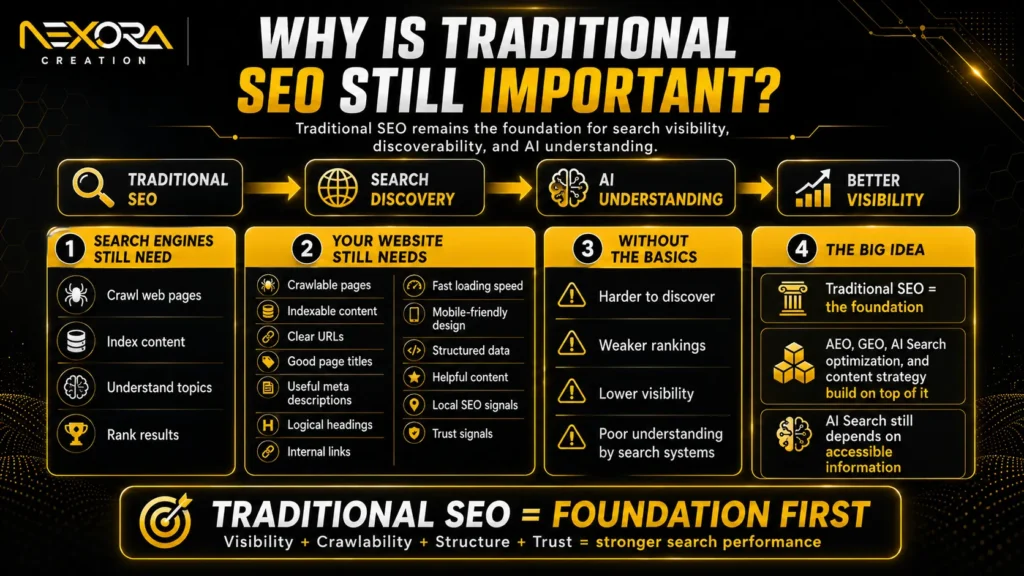
Why is traditional SEO still important?
Traditional SEO is still important because search engines still need to crawl, index, understand, and rank web pages.
A website still needs:
- Crawlable pages
- Indexable content
- Clear URLs
- Good page titles
- Useful meta descriptions
- Logical headings
- Internal links
- Fast loading speed
- Mobile-friendly design
- Structured data
- Helpful content
- Local SEO signals
- Trust signals
Without these basics, your website becomes harder to discover.
AI Search still depends on accessible information.
If your website is technically weak, search systems may not understand it properly.
Traditional SEO is the foundation.
AEO, GEO, AI Search optimization, and content strategy build on top of that foundation.
What is AEO and why does it matter now?
AEO stands for Answer Engine Optimization.
AEO means creating content that answers user questions clearly and directly.
It matters because users now search in question-based ways.
They ask:
- What is SEO?
- Is SEO dead?
- How does AI Search affect small businesses?
- How can I improve my website visibility?
- Why is my website not generating leads?
- What is the difference between SEO and GEO?
AEO-friendly content uses:
- Question-based headings
- Direct answers
- Short paragraphs
- Examples
- FAQs
- Clear explanations
- Helpful next steps
AEO helps your content perform better in answer-based search experiences such as:
- Featured snippets
- People Also Ask
- Voice search
- AI assistants
- AI-generated answers
For small businesses, AEO is useful because customers usually have questions before they contact you.
If your website answers those questions clearly, you build trust earlier.
What is GEO and how does it connect to SEO?
GEO stands for Generative Engine Optimization.
GEO focuses on improving how your business, website, or content appears in AI-generated answers.
Generative engines may include:
- Google AI Overviews
- Google AI Mode
- ChatGPT browsing
- Perplexity
- Gemini
- Copilot
GEO is not a replacement for SEO.
It is an extension of SEO.
To improve GEO, your website needs:
- Helpful content
- Clear service pages
- Strong topical authority
- Trust signals
- Accurate business information
- Good internal links
- Technical SEO
- Structured content
- Updated pages
- Real examples and expertise
GEO is not about tricking AI tools.
It is about making your content useful enough to be understood and potentially referenced.
What should small businesses focus on instead of asking if SEO is dead?
Small businesses should stop asking only “Is SEO dead?” and start asking:
“Is our website useful, visible, trustworthy, and built to generate leads?”
That question is more practical.
A small business should focus on:
- Strong website structure
- Clear service pages
- Local SEO
- Google Business Profile
- Helpful blog content
- Question-based content
- Technical SEO
- Internal linking
- Trust signals
- Case studies
- Reviews
- Page speed
- Mobile experience
- Clear CTAs
- Lead tracking
- CRM follow-up
SEO in 2026 is not only about ranking.
It is about building a complete visibility system.
How should small businesses update their SEO strategy in 2026?
Small businesses should update their SEO strategy by combining traditional SEO with AI Search optimization and lead generation.
Here is a practical approach.
1. Fix technical SEO
Make sure your website is crawlable, indexable, fast, secure, and mobile-friendly.
2. Build clear service pages
Each important service should have its own page.
A service page should explain:
- What the service is
- Who it is for
- What problem it solves
- How the process works
- Why the business is trustworthy
- What action the visitor should take
3. Answer real customer questions
Use blog posts and FAQs to answer questions your customers actually ask.
4. Improve internal links
Link blogs to relevant service pages where readers need help.
5. Add trust signals
Use reviews, testimonials, case studies, portfolio examples, and clear business details.
6. Optimize for local search
Improve Google Business Profile, local pages, service areas, and local reviews.
7. Track leads, not only traffic
Measure calls, forms, bookings, service page clicks, and CRM leads.
If your website gets traffic but visitors are not turning into enquiries, Nexora Creation can review your SEO structure, service pages, internal links, and conversion flow through its SEO services.
Is blogging still worth it in 2026?
Yes, blogging is still worth it if the blog answers real questions and connects to business goals.
Random blogging is not enough anymore.
A blog should not exist only to publish keywords.
A good blog should:
- Answer a real question
- Match search intent
- Give a direct answer early
- Use clear headings
- Include examples
- Add FAQs
- Link to relevant services
- Build topical authority
- Support lead generation
For example, a digital agency should not only write generic posts like:
“Why Digital Marketing Matters”
Better topics include:
- Why Is My Website Not Generating Leads?
- Landing Page vs Website for Google Ads
- How to Optimize Your Website for AI Search
- SEO vs AEO vs GEO vs AIO
- How to Update Old Blog Posts for AI Search
These topics solve real problems.
That is what makes blogging useful.
Are keywords still important?
Yes, keywords are still important, but they should not control the entire strategy.
Keywords help you understand what people search for.
But modern SEO also needs to understand:
- Search intent
- Customer pain points
- Topic clusters
- Questions
- Buyer journey
- Local intent
- Content depth
- Conversion path
For example, the keyword “SEO services” is useful.
But the intent behind it may vary.
One person may want pricing.
Another may want a local agency.
Another may want to understand what SEO includes.
Another may be comparing SEO with paid ads.
Your content should address the real intent behind the keyword.
In 2026, keywords are starting points.
Intent is the strategy.
Are backlinks still important?
Backlinks can still matter, but low-quality link building is less useful than before.
A good backlink can show that your website is trusted or referenced by others.
But spammy backlinks, fake guest posts, link farms, and irrelevant links can create risk.
Small businesses should focus on earning trust naturally.
Good link opportunities may come from:
- Local directories
- Business associations
- Partner websites
- Industry mentions
- Helpful resources
- Case studies
- PR mentions
- Guest insights on relevant sites
- Local sponsorships
- High-quality content worth referencing
Backlinks should support credibility.
They should not be the only SEO strategy.
A website with poor content and weak service pages will not become strong just because it has links.
Is local SEO more important in 2026?
Yes, local SEO is very important for small businesses in 2026.
Many customers still search with local intent.
Examples:
- Dentist near me
- Roofing company in Tampa
- Best HVAC repair near me
- Local SEO agency
- Web design company near me
- Emergency plumber in Dallas
Local SEO helps your business appear in:
- Google Maps
- Local Pack
- Local organic results
- Google Business Profile
- Location-based searches
- Local AI answers
- Review-based discovery
A strong local SEO strategy includes:
- Google Business Profile optimization
- Accurate business information
- Reviews
- Local service pages
- Service area content
- Local schema
- Local backlinks
- Photos
- FAQs
- Clear contact details
- Mobile-friendly website
For local businesses, SEO is not dead.
Local SEO may be more competitive than ever.
How does website design affect SEO now?
Website design affects SEO because user experience and conversion paths matter.
A website may get traffic, but if users do not trust it or cannot take action, SEO does not create business value.
A strong SEO-friendly website should have:
- Clear navigation
- Fast loading speed
- Mobile-friendly layout
- Strong service pages
- Clear CTAs
- Trust signals
- Easy contact options
- Helpful blog structure
- Internal links
- Working forms
- Readable design
- Conversion tracking
SEO should not stop at traffic.
The website should convert that traffic into calls, enquiries, bookings, or leads.
If your website ranks but does not generate leads, the issue may be web design, UX, CTA placement, or service page structure.
What role does content quality play in 2026 SEO?
Content quality is more important than ever.
Generic content is easy to ignore.
AI tools can produce basic explanations quickly, so businesses need content that adds real value.
High-quality content should be:
- Helpful
- Specific
- Accurate
- Easy to read
- Based on real customer problems
- Updated
- Structured clearly
- Supported by examples
- Connected to services
- Written for humans first
- Strong enough to build trust
Avoid content that is:
- Thin
- Repetitive
- Generic
- Keyword-stuffed
- Written only for ranking
- Not connected to business goals
- Missing examples
- Missing next steps
SEO in 2026 rewards usefulness.
If your content does not help the reader make a decision, it needs improvement.
Can AI-generated content help SEO?
AI-generated content can help SEO if it is used carefully and reviewed by humans.
AI can help with:
- Outlines
- Topic ideas
- FAQs
- Content structure
- Drafting
- Summaries
- Internal link ideas
- Meta descriptions
But AI content can also create problems if it is published without review.
Weak AI content may be:
- Generic
- Repetitive
- Inaccurate
- Thin
- Not based on real expertise
- Not connected to your services
- Missing examples
- Written only to fill a blog
The better approach is to use AI as an assistant, not the final expert.
Before publishing AI-assisted content, ask:
- Is it accurate?
- Does it solve a real problem?
- Does it include business expertise?
- Does it match our services?
- Does it link to the right pages?
- Does it help users take the next step?
AI can speed up content creation.
Strategy makes it valuable.
What SEO metrics should small businesses track in 2026?
Small businesses should track business-focused SEO metrics, not only rankings.
Important metrics include:
- Organic impressions
- Organic clicks
- Keyword growth
- Service page visits
- Blog traffic
- Internal link clicks
- Form submissions
- Phone calls
- Booking clicks
- Google Business Profile actions
- Local rankings
- Conversion rate
- Cost per lead from SEO
- CRM leads
- Closed deals
- Assisted conversions
Traffic is useful.
But traffic without leads is not enough.
If a blog gets visitors but no one moves to a service page, it may need better internal links and CTAs.
If a service page gets visitors but no enquiries, it may need better trust signals, copy, or form placement.
SEO should be measured by visibility and business impact.
How can internal linking help modern SEO?
Internal linking helps users, search engines, and AI systems understand how your content connects.
It also helps turn blog readers into leads.
For example:
A blog about AI Search should link to SEO services.
A blog about landing pages should link to website development services.
A blog about poor website conversions should link to UI/UX or website development.
A blog about slow lead follow-up should link to CRM automation.
A good internal link appears where the reader has a problem and needs a next step.
For example:
If your content is getting traffic but not producing enquiries, Nexora Creation can review your internal linking, service page structure, and CTA strategy through its SEO services.
Internal links should not be random.
They should guide the user journey.
How can Nexora Creation help with modern SEO?
Nexora Creation helps small businesses build SEO systems that support visibility, trust, and lead generation.
Modern SEO is not only about keywords.
It includes:
- Technical SEO
- Local SEO
- Service page structure
- Blog strategy
- AEO-friendly content
- GEO content structure
- Internal linking
- Website development
- Landing page optimization
- Conversion-focused CTAs
- AI Search readiness
- CRM and automation support
- Lead tracking
If your website is not ranking, not appearing for the right queries, or not converting traffic into leads, the issue may not be one thing.
It may be your full SEO and website system.
What is the best SEO strategy for 2026?
The best SEO strategy for 2026 is to build a useful, technically strong, answer-focused, and conversion-ready website.
A practical SEO strategy should include:
- Technical SEO foundation
- Clear service pages
- Helpful blog content
- Local SEO
- Google Business Profile optimization
- Question-based headings
- FAQs
- Strong internal links
- Trust signals
- Case studies
- Updated content
- AI Search readiness
- Fast mobile experience
- Clear CTAs
- Lead tracking
- CRM follow-up
Small businesses should not chase every trend randomly.
They should build a system that helps customers discover, understand, trust, and contact them.
That is what modern SEO is really about.
Conclusion
SEO is not dead in 2026.
SEO is changing.
Traditional rankings still matter, but search visibility now includes AI Overviews, AI Mode, answer engines, local search, voice search, social search, and brand discovery across multiple platforms.
Old SEO tactics are becoming weaker.
Modern SEO is stronger, broader, and more connected to user experience and lead generation.
Small businesses should focus on:
- Helpful content
- Technical SEO
- Local SEO
- Clear service pages
- Question-based answers
- Trust signals
- Internal links
- Conversion paths
- AI Search readiness
- Lead tracking
The businesses that win in 2026 will not be the ones asking whether SEO is dead.
They will be the ones adapting their SEO strategy to how people actually search now.
SEO is not gone.
It has evolved.
FAQs
Is SEO dead in 2026?
No, SEO is not dead in 2026. SEO is changing because of AI Search, AI Overviews, answer engines, local search, and new user behaviour, but search visibility is still important.
Why do people say SEO is dead?
People say SEO is dead because AI answers, zero-click searches, social search, and changing search results have reduced some traditional clicks. But SEO has adapted to every major search change.
Is SEO still worth it for small businesses?
Yes, SEO is still worth it for small businesses because customers still search for services, products, local providers, and solutions. SEO helps your business get found and trusted.
How is AI changing SEO?
AI is changing SEO by increasing the importance of clear answers, helpful content, topical authority, trust signals, technical accessibility, and structured content.
What is replacing SEO?
SEO is not being replaced. It is expanding into AEO, GEO, AI Search optimization, local SEO, content strategy, and conversion-focused website optimization.
Are keywords still important in 2026?
Yes, keywords are still useful, but search intent matters more. Businesses should use keywords to understand user needs, then create helpful content that answers those needs clearly.
Should small businesses focus on SEO or AI Search?
Small businesses should focus on both. Strong SEO is the foundation, and AI Search optimization builds on that foundation through structured, helpful, answer-focused content.
How can I make my SEO strategy future-ready?
Make your SEO future-ready by improving technical SEO, service pages, local SEO, helpful content, question-based headings, internal links, trust signals, AI Search structure, and lead tracking.