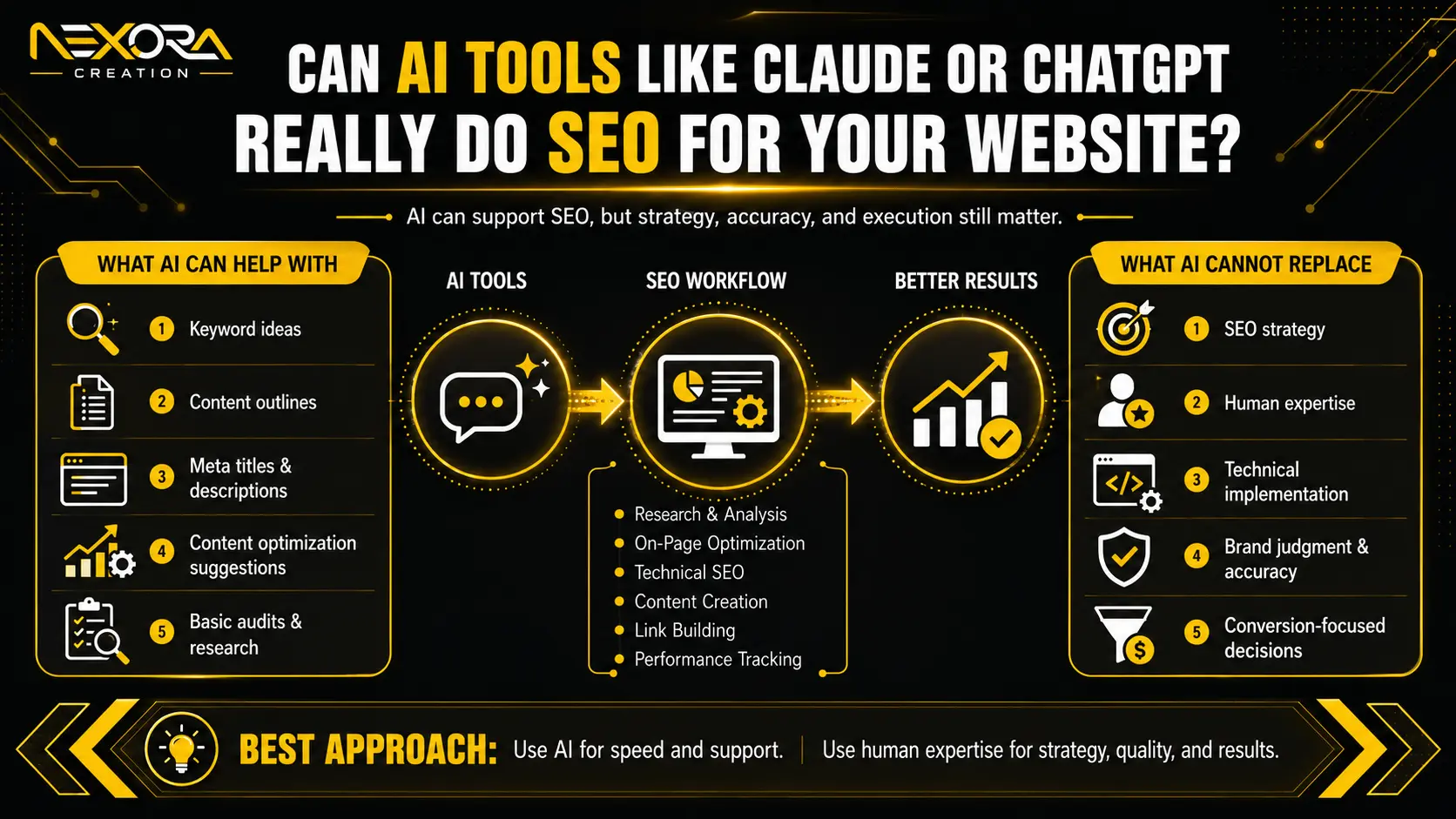
AI tools like Claude and ChatGPT can help with SEO, but they cannot fully do SEO for your website without human strategy, technical review, business understanding, and proper implementation.
The simple answer is this:
AI tools can support SEO tasks such as keyword ideas, content outlines, blog drafts, FAQs, meta descriptions, internal link suggestions, competitor research, content refreshes, and basic audits.
But AI tools cannot replace a full SEO strategy.
They cannot fully understand your business goals, customer quality, local market, technical website issues, conversion problems, brand positioning, sales process, or whether the SEO work is actually generating leads.
SEO is not only about writing content.
SEO includes:
- Technical website health
- Search intent
- Service page structure
- Local SEO
- Content quality
- Internal linking
- Website speed
- Mobile experience
- Conversion optimization
- Trust signals
- Analytics
- Lead tracking
- CRM follow-up
- Ongoing improvement
AI tools can help speed up parts of this work.
But they still need direction.
At Nexora Creation, we use AI as an assistant, not as a replacement for SEO thinking. AI can make research and content planning faster, but a strong SEO strategy still needs human judgment, real business experience, technical execution, and lead-generation planning.
In this guide, we will explain what AI tools like Claude and ChatGPT can do for SEO, what they cannot do, where they can be risky, and how small businesses should use them properly.
Can ChatGPT or Claude do SEO for your website?
ChatGPT and Claude can help with SEO, but they cannot fully handle SEO from start to finish without guidance.
They can assist with many SEO tasks.
For example, they can help you:
- Brainstorm keyword ideas
- Create blog outlines
- Rewrite meta descriptions
- Generate FAQ ideas
- Improve headings
- Summarize competitor pages
- Suggest internal links
- Create content briefs
- Explain technical SEO issues
- Rewrite outdated content
- Draft local service page copy
- Create schema ideas
- Build SEO checklists
But there is a difference between helping with SEO and owning SEO results.
AI tools can produce suggestions.
They cannot guarantee rankings, traffic, leads, or revenue.
They also cannot automatically fix your website unless someone implements the work.
For example, an AI tool may suggest:
“Improve page speed.”
But someone still needs to:
- Compress images
- Reduce scripts
- Fix hosting issues
- Optimize caching
- Test Core Web Vitals
- Review plugins
- Improve mobile layout
AI can identify or explain the task.
Execution still matters.
What SEO tasks can AI tools help with?
AI tools can help with many SEO tasks when used properly.
The most useful tasks include:
1. Keyword research ideas
AI can suggest topic ideas and keyword angles based on your services.
For example, if you offer website development, AI can suggest topics like:
- Website design for small businesses
- Why your website is not generating leads
- Landing page vs website for Google Ads
- How much does a business website cost?
- Best website structure for local service businesses
However, AI keyword ideas should still be checked with SEO tools, Search Console, and real search data.
2. Content outlines
AI can create structured outlines for blog posts, service pages, landing pages, and guides.
This saves time.
But the outline still needs human review to make sure it matches business goals and search intent.
3. Blog drafts
AI can draft blog content quickly.
But AI drafts often need editing for accuracy, originality, examples, brand voice, internal links, and conversion flow.
4. FAQs
AI is useful for generating FAQ ideas.
FAQs help with AEO, AI Search, and user experience.
But FAQs should be based on real customer questions, not random filler.
5. Meta titles and descriptions
AI can create multiple meta title and meta description options.
These should still be checked for length, clarity, keyword use, and click appeal.
6. Internal link ideas
AI can suggest where to link between blogs and service pages.
This is useful for SEO and lead generation.
7. Content refreshes
AI can help update old blog posts by finding missing sections, rewriting unclear parts, and suggesting new FAQs.
8. Competitor content review
AI can summarize competitor pages and identify content gaps.
But you should not copy competitor content.
Use the insight to create something better.
Can AI write SEO content for your website?
AI can write SEO content, but the content should not be published without human review.
AI can create a draft.
That draft may be useful.
But it may also be:
- Generic
- Repetitive
- Too broad
- Inaccurate
- Missing examples
- Missing business context
- Missing local relevance
- Missing trust signals
- Not aligned with search intent
- Not connected to your services
- Not conversion-focused
Good SEO content should not only sound correct.
It should help the reader solve a problem and take the next step.
For example, if AI writes a blog about “why your website is not generating leads,” the blog should naturally connect to website development, UI/UX, SEO, or conversion audit services.
If it only explains the problem and does not guide the reader toward a solution, it may get traffic but fail to generate leads.
AI content should be edited by someone who understands:
- SEO
- The business
- Customer pain points
- The service offer
- Brand voice
- Conversion goals
- Internal linking
- Search intent
- Technical accuracy
AI can draft.
Human strategy should publish.
What SEO tasks should not be left fully to AI?
Some SEO tasks should not be left fully to AI because they require real data, technical access, business judgment, or implementation.
These include:
1. Technical SEO audits
AI can explain technical SEO, but it cannot fully audit your website without access to crawl data, Search Console, analytics, server responses, and actual page performance.
Technical SEO needs checks for:
- Crawl errors
- Indexing issues
- Canonical tags
- Redirect chains
- Sitemap problems
- Robots.txt rules
- Core Web Vitals
- Broken links
- Duplicate pages
- Schema errors
- Mobile usability
2. Final keyword decisions
AI can suggest keywords, but keyword strategy should be based on real data.
You still need to check:
- Search volume
- Competition
- Search intent
- Ranking difficulty
- Business value
- Local relevance
- Conversion potential
3. Local SEO
AI can suggest local SEO improvements, but local SEO needs real business details, Google Business Profile optimization, reviews, citations, service areas, and local signals.
4. Conversion strategy
AI may suggest CTAs, but it cannot fully know which leads are qualified, which services are profitable, or where customers drop off.
5. Content accuracy
AI can make mistakes.
Someone must verify claims, examples, pricing, services, and recommendations.
6. Analytics interpretation
AI can help explain data, but it needs accurate data first.
SEO decisions should use Search Console, analytics, CRM, call tracking, and lead quality data.
7. Implementation
AI can recommend changes, but someone still needs to apply them on the website.
That may involve WordPress, Shopify, Webflow, custom code, SEO plugins, schema setup, speed optimization, or CRM integration.
Can AI tools replace an SEO expert?
AI tools can replace some repetitive SEO tasks, but they cannot fully replace an SEO expert.
An SEO expert does more than generate content.
A good SEO expert connects:
- Business goals
- Search intent
- Website structure
- Technical SEO
- Content strategy
- Competitor analysis
- Local SEO
- Internal linking
- Conversion optimization
- Analytics
- Lead quality
- Ongoing testing
AI can help with execution speed.
But SEO experts decide what should be done and why.
For example, AI may suggest writing 20 blog posts.
An SEO expert may say:
“No, first we need to fix the service pages because the website is getting traffic but not converting.”
That decision comes from strategy.
AI can produce output.
Human SEO decides priority.
Can AI tools help with local SEO?
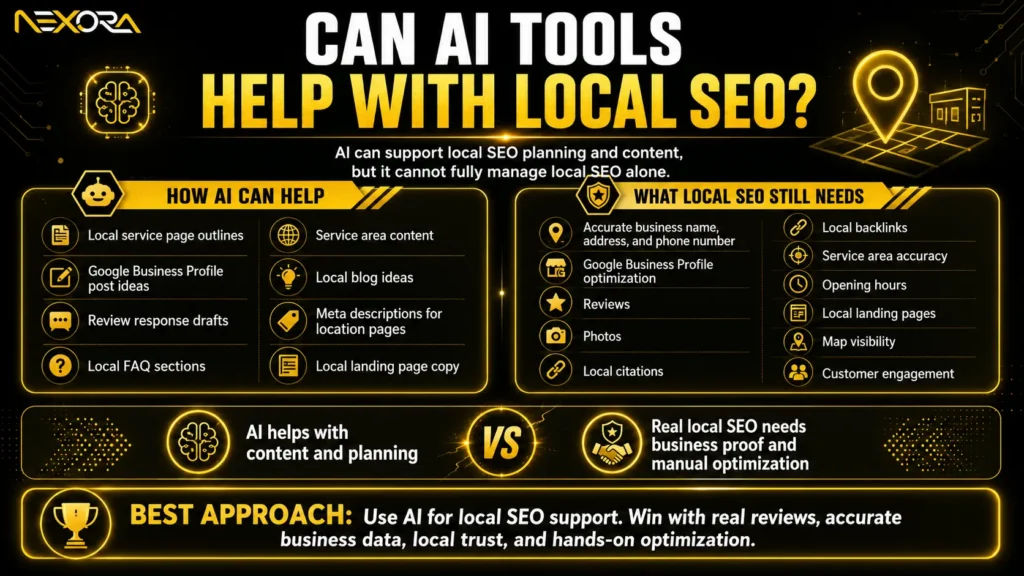
AI tools can help with local SEO planning, but they cannot fully manage local SEO alone.
AI can help you create:
- Local service page outlines
- Google Business Profile post ideas
- Review response drafts
- Local FAQ sections
- Service area content
- Local blog ideas
- Meta descriptions for location pages
- Local landing page copy
But local SEO also needs real-world signals.
These include:
- Accurate business name, address, and phone number
- Google Business Profile optimization
- Reviews
- Photos
- Local citations
- Local backlinks
- Service area accuracy
- Opening hours
- Local landing pages
- Map visibility
- Customer engagement
AI cannot create real reviews.
AI cannot replace real local reputation.
AI cannot verify every local citation unless connected to the right tools and data.
For local businesses, AI can support content and planning, but local SEO still needs real business proof and manual optimization.
Can AI tools help with AEO and GEO?
Yes, AI tools can help with AEO and GEO because they are good at organizing questions, answers, and topic structures.
AEO stands for Answer Engine Optimization.
It focuses on answering user questions clearly.
GEO stands for Generative Engine Optimization.
It focuses on improving how your content may appear in AI-generated answers.
AI tools can help with:
- Question-based headings
- FAQ ideas
- Direct answer formatting
- Topic cluster planning
- Content gap discovery
- AI Search content structure
- Blog outlines
- Summary sections
- Comparison tables
- Service page explanations
For example, AI can help turn a generic heading like:
“Benefits”
into a better AEO-style heading like:
“How can SEO help a small business get more leads?”
This makes content easier for users and answer engines to understand.
But AEO and GEO still need strong SEO foundations.
If your website is not crawlable, useful, trustworthy, or properly structured, AI-generated content alone will not solve the problem.
Can AI tools improve technical SEO?
AI tools can explain technical SEO and help create checklists, but they cannot fully improve technical SEO without data and implementation.
AI can help you understand issues like:
- Crawlability
- Indexability
- Robots.txt
- Sitemap
- Canonical tags
- Structured data
- Page speed
- Mobile usability
- Internal links
- Broken links
- Redirects
- Duplicate content
But technical SEO requires real testing.
You need tools and access such as:
- Google Search Console
- Google Analytics
- Screaming Frog or site crawlers
- PageSpeed Insights
- WordPress or CMS access
- Hosting access
- SEO plugin settings
- Schema testing tools
- Server response checks
AI can say what to check.
An SEO professional or developer needs to check it, fix it, and validate it.
If your website has technical SEO issues, Nexora Creation can review crawlability, indexing, speed, mobile UX, service page structure, and conversion paths through its SEO and website development services.
Can AI tools help with internal linking?
Yes, AI tools can help with internal linking, but the links still need strategy.
AI can suggest links between:
- Blogs
- Service pages
- Landing pages
- Contact pages
- Case studies
- FAQ pages
- Location pages
For example:
A blog about AI Search should link to SEO services.
A blog about landing page mistakes should link to website development services.
A blog about slow follow-up should link to CRM automation services.
A blog about AI chat support should link to AI chatbot services.
But internal links should not be added randomly.
A good internal link appears when the reader has a problem and needs the next step.
For example:
If a reader is learning why their website content is not generating leads, that is a natural place to link to website development, SEO, or UI/UX services.
Internal links should support both:
- SEO structure
- Lead generation
If your blog content is getting traffic but not enquiries, Nexora Creation can help improve internal linking, service page paths, and CTA placement so readers move toward relevant services.
What are the risks of using AI tools for SEO?
AI tools can create SEO risks when they are used without strategy or review.
Common risks include:
- Publishing generic content
- Creating inaccurate information
- Repeating competitor-style content
- Writing for search engines instead of users
- Producing thin pages at scale
- Missing real expertise
- Ignoring technical SEO
- Ignoring local SEO
- Missing conversion paths
- Adding weak internal links
- Using fake claims
- Overusing keywords
- Creating duplicate-style content
- Not verifying facts
- Not tracking results
The biggest risk is thinking AI output equals SEO strategy.
It does not.
AI can produce content quickly, but speed without strategy can create more low-quality pages.
Google’s guidance warns that using generative AI to create many pages without adding user value may violate spam policies.
So the safest approach is:
Use AI to assist.
Use human expertise to decide, verify, edit, and publish.
How should small businesses use AI tools for SEO safely?
Small businesses should use AI tools as SEO assistants, not SEO replacements.
A safe workflow looks like this:
1. Start with business goals
Define what you want SEO to achieve.
Examples:
- More local leads
- More service page traffic
- More calls
- More quote requests
- Better Google Maps visibility
- More AI Search visibility
2. Use AI for research and ideas
Ask AI to help with topics, questions, content gaps, and outlines.
3. Check real search data
Use Search Console, SEO tools, keyword tools, analytics, and customer questions.
4. Build a content plan
Choose topics based on business value, not only keyword volume.
5. Draft with AI
Use AI to create the first draft or structure.
6. Add human expertise
Add examples, experience, service details, proof, and brand voice.
7. Add internal links
Connect the content to relevant service pages where the reader needs help.
8. Optimize and publish
Check headings, meta title, meta description, formatting, FAQs, and CTAs.
9. Track results
Measure traffic, service page clicks, calls, forms, bookings, and leads.
10. Improve over time
Update content based on performance and search changes.
This process gives you the speed of AI and the judgment of real SEO strategy.
What is the best way to use ChatGPT or Claude for SEO content?
The best way to use ChatGPT or Claude for SEO content is to give them strong direction.
Do not ask:
“Write an SEO blog.”
That usually creates generic content.
Give a detailed brief.
Include:
- Target audience
- Main keyword
- Search intent
- Business service
- Brand voice
- Page goal
- Internal links
- FAQs
- CTA
- Examples
- Word count
- Structure
- What to avoid
For example:
“Write a blog for small business owners about why their website gets traffic but no leads. Use question-based headings, explain conversion issues, include internal links to website development and SEO services, and end with a soft CTA.”
This gives AI more useful direction.
The better the brief, the better the output.
But even then, review the content before publishing.
What should an AI-assisted SEO checklist include?
An AI-assisted SEO checklist should include both content and business checks.
Before publishing AI-assisted content, review:
Content quality
- Does it answer the main question?
- Is it helpful?
- Is it specific?
- Is it accurate?
- Does it include examples?
- Does it avoid fluff?
SEO structure
- Does it have a clear H1?
- Are H2s question-based?
- Does it include FAQs?
- Is the meta title optimized?
- Is the meta description clear?
- Are keywords used naturally?
AEO/GEO readiness
- Does it answer questions directly?
- Is it easy to summarize?
- Does it use clear sections?
- Does it build topical authority?
- Does it avoid vague claims?
Conversion value
- Does it link to relevant services?
- Is the CTA clear?
- Does the content guide the reader to the next step?
- Is there a lead-generation path?
Trust
- Does it show expertise?
- Does it avoid false claims?
- Does it mention real services?
- Is it aligned with the business?
AI-assisted content should pass all these checks before going live.
Can AI tools build a complete SEO strategy?
AI tools can help create parts of an SEO strategy, but they should not be trusted to build the full strategy without human input.
A complete SEO strategy needs:
- Website audit
- Competitor analysis
- Business positioning
- Keyword research
- Content mapping
- Technical SEO plan
- Local SEO plan
- Service page strategy
- Internal linking plan
- Conversion strategy
- Analytics setup
- Lead tracking
- Ongoing reporting
- Content refresh plan
AI can help organize these areas.
But it needs accurate information.
If you give AI weak inputs, it will produce weak strategy.
For example, AI cannot automatically know:
- Which service has the highest profit margin
- Which leads are low quality
- Which pages already rank
- Which form fields are causing drop-offs
- Which local competitors are strongest
- Which blog topics convert best
- Which calls turn into booked jobs
That data comes from the business.
So AI can support strategy.
It cannot replace business intelligence.
How can Nexora Creation help with AI-assisted SEO?
Nexora Creation helps businesses use AI tools properly inside a real SEO and lead-generation strategy.
AI tools like Claude and ChatGPT can speed up content planning, but your website still needs the right structure, technical setup, internal links, and conversion flow.
Our SEO and website development services can help with:
- SEO strategy
- Technical SEO audits
- AI-assisted content planning
- Blog structure
- Service page optimization
- AEO-friendly headings
- GEO content structure
- Internal linking
- Local SEO
- Landing page optimization
- CTA placement
- Conversion tracking
- CRM automation
- AI chatbot integration
If you are using AI tools to create content but your website is not getting leads, the issue may be your SEO strategy, service page structure, internal linking, or conversion path.
What is the final answer: can AI tools really do SEO?
AI tools can help with SEO, but they cannot fully do SEO for your website by themselves.
They are useful for:
- Ideas
- Outlines
- Drafts
- FAQs
- Meta descriptions
- Internal link suggestions
- Content refreshes
- Basic SEO explanations
- Research support
But they cannot fully replace:
- SEO strategy
- Technical audits
- Business understanding
- Local SEO execution
- Content accuracy review
- Conversion optimization
- Lead tracking
- Human expertise
- Real implementation
The best approach is not AI vs SEO expert.
The best approach is AI plus SEO strategy.
Use AI to move faster.
Use human expertise to make the work accurate, useful, and connected to business results.
Conclusion
AI tools like Claude and ChatGPT can be very useful for SEO, but they are not complete SEO solutions.
They can help you research, plan, draft, organize, and improve content faster.
But SEO still requires technical execution, real data, search intent understanding, business strategy, content quality, trust signals, internal linking, local SEO, and conversion tracking.
Small businesses should not ask:
“Can AI do SEO for me?”
A better question is:
“How can I use AI to support a smarter SEO strategy?”
If you use AI without strategy, you may create generic content that does not rank, convert, or build trust.
But if you use AI with the right SEO process, it can save time, improve content structure, and support long-term visibility.
AI can help.
Strategy decides whether it works.
FAQs
Can ChatGPT do SEO for my website?
ChatGPT can help with SEO tasks such as topic ideas, outlines, FAQs, meta descriptions, content drafts, and internal link suggestions. But it cannot fully replace SEO strategy, technical audits, implementation, or lead tracking.
Can Claude write SEO content?
Yes, Claude can help write SEO content, but the content should be reviewed for accuracy, search intent, examples, brand voice, internal links, and conversion value before publishing.
Can AI tools replace an SEO expert?
AI tools can replace some repetitive tasks, but they cannot fully replace an SEO expert. SEO still requires strategy, technical review, business understanding, local SEO, and performance analysis.
Is AI-generated content bad for SEO?
AI-generated content is not automatically bad. It becomes risky when it is generic, inaccurate, low-value, mass-produced, or created only to manipulate search rankings.
What SEO tasks are best for AI tools?
AI tools are useful for content outlines, blog drafts, FAQs, meta descriptions, topic ideas, content refreshes, internal link suggestions, and basic SEO explanations.
What SEO tasks should humans handle?
Humans should handle final strategy, technical SEO audits, keyword decisions, content accuracy, local SEO, conversion optimization, analytics interpretation, and implementation.
Can AI help with local SEO?
AI can help with local page copy, FAQs, review responses, Google Business Profile post ideas, and local content outlines. But real local SEO still needs reviews, citations, local signals, and accurate business information.
Should small businesses use AI for SEO?
Yes, small businesses can use AI for SEO if they treat it as an assistant, not a replacement. AI should support research, drafting, and optimization, while human strategy controls the final direction.