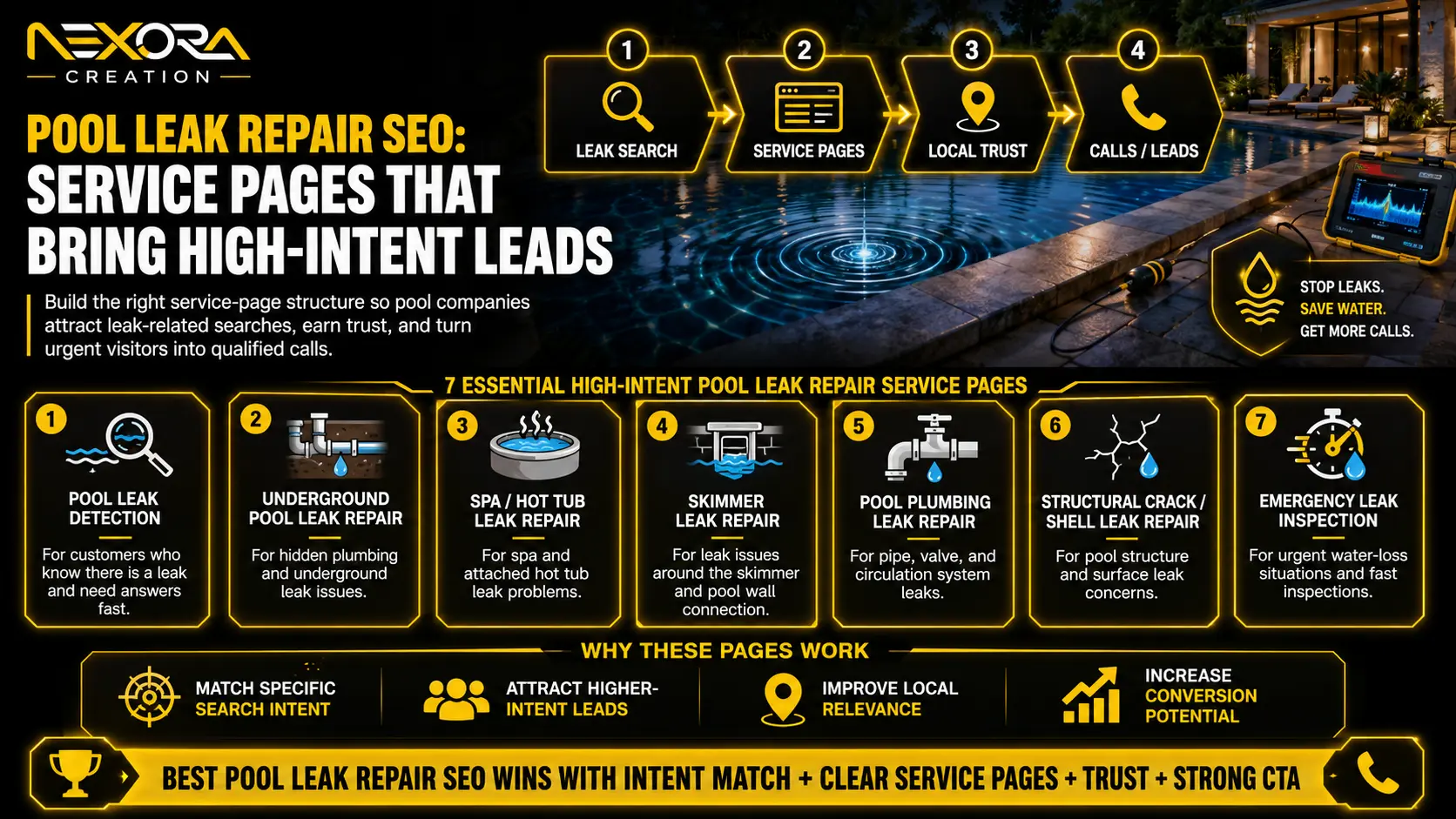
Pool leak repair SEO helps pool companies attract high-intent leads by creating service pages for homeowners who already suspect a serious pool problem.
A person searching for pool leak repair is usually not casually browsing.
They may be dealing with:
- Water level dropping too fast
- Higher water bills
- Wet spots around the pool
- Cracks in the pool surface
- Air bubbles in return lines
- Pool equipment losing prime
- Loose tiles
- Soggy ground near the pool
- Constant need to refill the pool
- Concern about structural damage
That makes pool leak searches valuable.
A homeowner searching for “pool leak repair near me” or “pool leak detection in [city]” is often closer to calling than someone searching for general pool tips.
But many pool companies do not build strong pages for this intent.
They may only have one general pool service page.
That can miss high-value searches.
At Nexora Creation, we see pool leak repair SEO as a service-page and lead-generation strategy. The goal is not only to rank. The goal is to turn leak-related searches into calls, inspection requests, repair estimates, and booked jobs.
In this guide, we will explain which pool leak repair service pages can bring high-intent leads and how to structure them for local SEO.
Why is pool leak repair SEO important?
Pool leak repair SEO is important because leak-related searches usually show strong problem awareness.
A homeowner may search:
- Pool leak repair near me
- Pool leak detection near me
- Pool leak repair in Phoenix
- Pool losing water fast
- How to find a pool leak
- Pool leak detection service
- Pool skimmer leak repair
- Pool plumbing leak repair
- Pool crack repair
- Pool equipment leak repair
These searches show that the homeowner is already concerned.
They may need professional help.
That makes pool leak repair different from broad searches like:
- Pool care tips
- Pool cleaning schedule
- Pool maintenance ideas
Educational searches can bring traffic.
But leak repair searches can bring leads.
A strong SEO strategy should target high-intent searches that connect directly to service requests.
Why are pool leak repair leads high intent?
Pool leak repair leads are high intent because leaks can create urgency.
A pool leak may increase water use, damage surrounding areas, affect equipment performance, or create bigger repair problems if ignored.
Homeowners searching for leak repair often want answers quickly.
They want to know:
- Do I have a leak?
- Where could the leak be?
- Can someone inspect it?
- Do you repair pool leaks?
- Do you serve my area?
- How soon can I get help?
- Can I request a quote?
- What happens after I contact you?
A good service page answers these questions clearly.
It should not only say:
“We offer pool leak repair.”
It should explain the signs, process, service area, trust proof, and next step.
That is what turns high-intent visitors into leads.
What is a pool leak repair service page?
A pool leak repair service page is a dedicated page that explains how your company helps homeowners find and repair pool leaks.
It can target searches like:
- Pool leak repair near me
- Pool leak repair in [city]
- Swimming pool leak repair
- Pool leak detection and repair
- Pool plumbing leak repair
- Pool skimmer leak repair
A strong page should include:
- Clear service headline
- Location or service area
- Signs of a pool leak
- Common leak sources
- Inspection or detection process
- Repair options
- Reviews
- Trust proof
- Photos, if available
- Click-to-call CTA
- Short form
- FAQs
- Final CTA
- Internal links
The page should make the homeowner feel:
“This company understands my problem and can help me take the next step.”
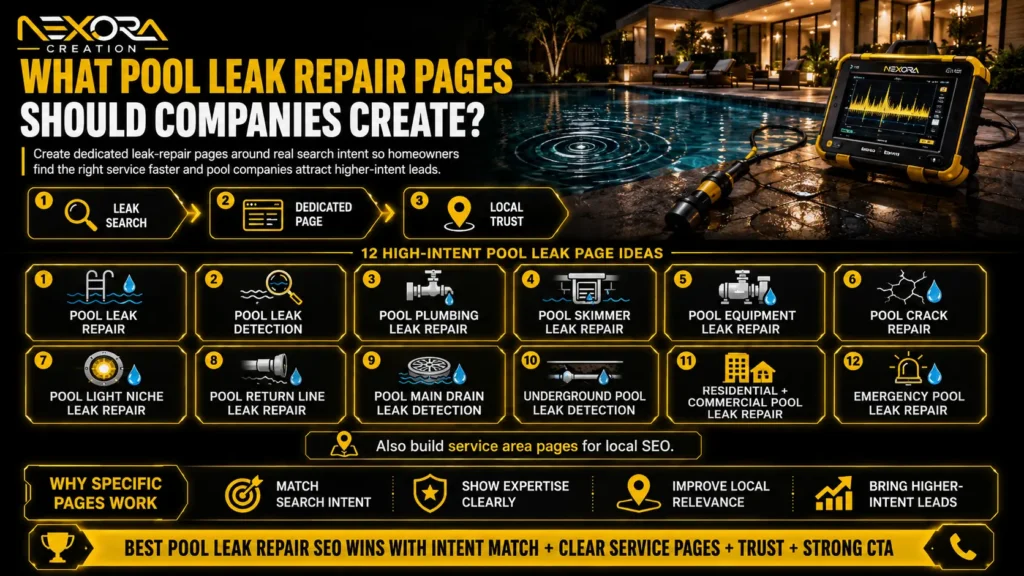
What pool leak repair pages should companies create?
Pool companies should create service pages based on real search intent.
Useful pages include:
- Pool Leak Repair
- Pool Leak Detection
- Pool Plumbing Leak Repair
- Pool Skimmer Leak Repair
- Pool Equipment Leak Repair
- Pool Crack Repair
- Pool Light Niche Leak Repair, if offered
- Pool Return Line Leak Repair
- Pool Main Drain Leak Detection
- Underground Pool Leak Detection
- Residential Pool Leak Repair
- Commercial Pool Leak Repair
- Emergency Pool Leak Repair, if offered
- Pool Leak Repair Service Area Pages
Each page should have a clear purpose.
Do not put every leak service into one small paragraph on a general pool service page.
Specific pages help Google understand your expertise and help homeowners find the right service.
Page 1: Pool Leak Repair
The main pool leak repair page should act as the parent service page.
It can target searches like:
- Pool leak repair near me
- Pool leak repair in [city]
- Swimming pool leak repair
- Pool leak repair company
- Pool leak repair service
This page should explain:
- What pool leak repair includes
- Signs of a leak
- Common leak sources
- Why leaks should be inspected
- How your process works
- What homeowners should do next
- Which areas you serve
Common signs to mention:
- Water level dropping quickly
- Constant refilling
- Wet spots near pool
- Cracks in pool shell
- Higher water bills
- Air in pool lines
- Equipment losing prime
- Loose tiles
- Unusual soil movement
- Algae growth from water imbalance
CTA examples:
- Request Pool Leak Repair
- Schedule Leak Inspection
- Call for Pool Leak Help
- Get Pool Leak Repair Quote
This page should link to leak detection, plumbing leak repair, skimmer leak repair, and crack repair pages.
Page 2: Pool Leak Detection
Pool leak detection deserves its own page because many homeowners are not sure if they need repair yet.
They may search:
- Pool leak detection near me
- Pool leak detection in [city]
- Pool losing water fast
- How to tell if pool is leaking
- Swimming pool leak detection service
- Pool pressure test near me
This page should explain:
- Signs that suggest a leak
- Difference between evaporation and leaking
- How professionals inspect leaks
- What areas may be checked
- When homeowners should call
- Why early detection matters
Possible detection areas include:
- Pool shell
- Skimmer
- Return lines
- Main drain
- Pool plumbing
- Equipment pad
- Lights
- Tile line
- Cracks
- Fittings
Avoid making the page too technical.
Explain enough to build trust without overwhelming the homeowner.
CTA examples:
- Schedule Pool Leak Detection
- Request Leak Inspection
- Call for Leak Detection Service
This page can bring leads from homeowners who are early in the decision process but still highly concerned.
Page 3: Pool Plumbing Leak Repair
Pool plumbing leak repair is a strong page if your company handles plumbing-related leaks.
Searches may include:
- Pool plumbing leak repair
- Pool pipe leak repair near me
- Underground pool pipe leak
- Pool return line leak repair
- Pool suction line leak repair
- Pool plumbing leak detection
This page should explain:
- What pool plumbing leaks are
- Signs of plumbing leaks
- Why pressure testing may be needed
- Possible leak locations
- Repair process
- Why professional help matters
Signs can include:
- Air bubbles in return jets
- Pump losing prime
- Wet ground near plumbing lines
- Water level drop
- Equipment pressure changes
- Poor circulation
- Unusual noises from pump
This page can attract more advanced service intent.
A homeowner searching for plumbing leak repair may already understand that the problem is not just surface-level.
Page 4: Pool Skimmer Leak Repair
Skimmer leaks are common enough to deserve a dedicated page if the company provides this service.
Target searches may include:
- Pool skimmer leak repair
- Skimmer leak detection
- Pool leaking around skimmer
- Pool skimmer repair near me
- Skimmer crack repair
This page should explain:
- What the skimmer does
- Why skimmers may leak
- Signs of a skimmer leak
- Inspection process
- Repair options
- When replacement may be needed
Signs may include:
- Water loss near skimmer level
- Cracks around skimmer mouth
- Loose skimmer faceplate
- Wet soil near skimmer area
- Air entering system
- Pool level stopping near skimmer
CTA examples:
- Request Skimmer Leak Repair
- Schedule Pool Skimmer Inspection
- Call for Skimmer Leak Help
This page helps capture very specific problem searches.
Specific pages often bring better-qualified leads.
Page 5: Pool Equipment Leak Repair
Some pool leaks happen around equipment, not inside the pool shell.
A pool equipment leak repair page can target:
- Pool equipment leak repair
- Pool pump leaking
- Pool filter leaking
- Pool heater leaking
- Pool equipment pad leak
- Pool pump seal leak
This page should explain:
- Equipment pad leaks
- Pump leaks
- Filter leaks
- Valve leaks
- Heater leaks
- Pipe fitting leaks
- When repair is needed
- When replacement may be better
Signs may include:
- Water around equipment pad
- Dripping from pump
- Filter tank leak
- Valve leaks
- Pump losing pressure
- Air in system
- Unusual equipment noises
This page can also internally link to pool maintenance, filter cleaning, and equipment inspection pages.
Page 6: Pool Crack Repair
Pool crack repair can attract high-intent leads because visible cracks worry homeowners.
Target searches may include:
- Pool crack repair near me
- Pool shell crack repair
- Concrete pool crack repair
- Gunite pool crack repair
- Pool plaster crack repair
- Pool leaking through crack
This page should explain:
- Types of visible cracks
- Why cracks should be inspected
- Cosmetic vs leak-related cracks
- When professional evaluation is needed
- Repair process
- Why ignoring cracks may create bigger issues
Use careful wording.
Do not diagnose structural issues from a webpage.
Instead, say:
“Visible cracks should be inspected to understand whether they are cosmetic, surface-level, or connected to water loss.”
CTA examples:
- Request Pool Crack Inspection
- Schedule Pool Crack Repair Estimate
- Call for Pool Leak Help
This page can attract serious leads.
Page 7: Underground Pool Leak Detection
Underground pool leak detection is a specialized page if the company provides this service.
Target searches may include:
- Underground pool leak detection
- Underground pool pipe leak
- Pool losing water underground
- Underground pool plumbing leak
- Pool line leak detection near me
This page should explain:
- Why underground leaks are hard to see
- Signs of underground leaks
- Why testing may be needed
- Possible repair steps
- When homeowners should call
Signs may include:
- Soggy ground
- Sunken areas
- Water level dropping
- Poor circulation
- Pump issues
- Unexplained water bills
- Wet spots away from pool
This page can attract high-value leads because underground leaks usually require professional service.
Page 8: Emergency Pool Leak Repair
If your company offers urgent leak help, create an emergency pool leak repair page.
Target searches may include:
- Emergency pool leak repair
- Pool leak emergency
- Pool losing water fast
- Urgent pool leak repair
- Pool leak repair near me today
This page should focus on fast contact.
It should include:
- Emergency headline
- Click-to-call CTA
- Short form
- Signs of urgent leaks
- Service area
- Trust proof
- Process
- FAQs
- Final CTA
Possible urgent signs:
- Water level dropping very fast
- Equipment running dry
- Large wet area
- Structural concern
- Pool cannot hold water
- Significant crack
- Leak near equipment
CTA examples:
- Call Now for Pool Leak Help
- Request Urgent Leak Inspection
- Get Emergency Pool Leak Support
If emergency service is not offered, do not create this page.
Accuracy matters.
Page 9: Pool Leak Repair Location Pages
Location pages can help pool leak repair companies rank in different service areas.
Examples:
- Pool Leak Repair in Phoenix
- Pool Leak Detection in Las Vegas
- Pool Leak Repair in Tampa
- Pool Leak Detection in Orlando
- Pool Leak Repair in Scottsdale
- Pool Leak Detection in Henderson
Each location page should be unique and useful.
Do not duplicate the same content and only change the city name.
A strong location page should include:
- Local service area details
- Leak repair services offered
- Common pool leak signs
- Local pool care concerns
- Reviews from nearby customers, if available
- Photos, if available
- Short form
- Click-to-call CTA
- FAQs
- Internal links
Only create pages for areas you actually serve.
How should a pool leak repair page be structured?
A high-converting pool leak repair page should follow a clear structure.
Use this layout:
1. Hero section
Include service, location, problem, and CTA.
Example:
“Pool Leak Repair in Phoenix”
“Losing water faster than normal? Request pool leak detection and repair support from a local pool service team.”
2. Click-to-call CTA
Make phone contact easy above the fold.
3. Signs of a pool leak
List common symptoms homeowners recognize.
4. Common leak sources
Explain where leaks may happen.
5. Detection or inspection process
Explain what happens after contact.
6. Repair options
Explain that the right repair depends on the leak source.
7. Reviews and trust proof
Show proof near CTA sections.
8. Service area
Clearly list real service areas.
9. Short form
Ask for essential details.
10. FAQs
Answer common leak questions.
11. Final CTA
Repeat the call or inspection request.
This structure helps users move from concern to action.
What should the hero section say?
The hero section should be specific.
Weak headline:
“Professional Pool Services”
Better headline:
“Pool Leak Repair Near You”
Stronger local headline:
“Pool Leak Detection and Repair in Phoenix”
The hero should include:
- Main service
- Location or service area
- Problem
- CTA
- Trust signal
- Phone number
- Short form or button
Example hero copy:
“Pool Leak Detection and Repair in Phoenix”
“Is your pool losing water faster than normal? Call now or request leak inspection support from a local pool service team.”
CTA buttons:
“Request Leak Inspection”
“Call Now”
Trust line:
“Helping local homeowners identify and repair pool leak problems.”
A clear hero improves both user experience and conversion.
What signs of a pool leak should the page mention?
The page should mention signs homeowners may notice.
Useful signs include:
- Pool water level drops quickly
- Pool needs frequent refilling
- Wet spots near the pool
- Soggy ground
- Cracks in pool shell
- Loose tiles
- Air bubbles in return lines
- Pump losing prime
- Equipment pad leaks
- Higher water bills
- Algae problems from water imbalance
- Uneven deck movement
- Water loss beyond normal evaporation
Example copy:
“Call for pool leak help if your water level drops faster than usual, you notice wet spots near the pool, the pump loses prime, or you need to refill the pool more often than normal.”
This helps visitors recognize their problem.
It also supports search relevance.
How should the page explain evaporation vs leak?
Many homeowners wonder whether their pool is leaking or just losing water from evaporation.
Your page can answer this in a simple way.
Example:
“All pools lose some water from evaporation, splash-out, and normal use. But if your pool is losing water faster than expected, needs frequent refilling, or shows wet spots around the pool or equipment, it may be time to schedule a leak inspection.”
Avoid giving exact diagnosis.
Do not say every water loss issue is a leak.
This builds trust by being honest.
You can suggest:
“If you are unsure, a professional inspection can help identify whether water loss is normal or connected to a leak.”
What trust signals should pool leak repair pages include?
Pool leak repair pages need trust because homeowners may worry about cost and damage.
Trust signals include:
- Reviews
- Testimonials
- Before and after photos
- Technician photos
- Service vehicle photos
- Leak detection process
- Years in business
- Licensed or insured message, if applicable
- Service area proof
- Clear contact details
- Warranty or workmanship information, if offered
- Equipment or method explanation
- Project examples
Place trust proof near CTAs.
Do not hide it only at the bottom.
Specific reviews are helpful.
Example:
“Our pool was losing water every few days. The team inspected the issue, explained the leak source, and helped us understand the repair options.”
This type of review speaks directly to the problem.
What should the form ask for?
A pool leak repair form should be short and specific.
Useful fields include:
- Name
- Phone number
- ZIP code
- Pool type
- Water loss issue
- Visible signs
- Preferred contact time
- Short message
Optional dropdown for issue:
- Pool losing water
- Wet spots near pool
- Equipment leak
- Skimmer leak
- Cracked pool surface
- Plumbing leak concern
- Not sure
Button text:
- Request Leak Inspection
- Get Pool Leak Repair Quote
- Schedule Pool Leak Detection
- Call Me About My Pool Leak
Avoid using only “Submit.”
The CTA should explain the next step.
Make sure the form:
- Works on mobile
- Sends alerts instantly
- Connects to CRM
- Tracks conversions
- Shows confirmation message
- Avoids unnecessary fields
How can Google Business Profile support pool leak repair SEO?
Google Business Profile can support pool leak repair SEO by making your services clear.
Add accurate services such as:
- Pool leak detection
- Pool leak repair
- Pool plumbing leak repair
- Pool skimmer repair
- Pool maintenance
- Pool equipment repair, if offered
- Pool cleaning
- Pool inspection
Keep your profile updated with:
- Photos
- Reviews
- Business hours
- Service areas
- Phone number
- Website link
- Booking link
- Posts or updates
Reviews can also support relevance when customers mention leak detection or leak repair naturally.
Your website and profile should match.
If your profile says pool leak detection, your website should have a pool leak detection page.
How should internal links support pool leak repair pages?
Internal links help users and search engines understand your services.
Pool leak repair pages should link to related services such as:
- Pool Leak Detection
- Pool Maintenance
- Pool Cleaning
- Pool Filter Cleaning
- Pool Equipment Repair
- Green Pool Cleanup
- Service Area Pages
- Contact Page
Blogs should also link to leak pages.
For example:
A blog about “Why Is My Pool Losing Water?” should link to pool leak detection.
A blog about “Evaporation vs Pool Leak” should link to pool leak inspection.
A blog about “Signs of Pool Plumbing Leaks” should link to plumbing leak repair.
Internal links should guide visitors toward service.
If your pool service blogs bring traffic but not leads, Nexora Creation can help improve internal linking and service-page flow through its SEO services.
What blog topics support pool leak repair SEO?
Helpful blog content can support pool leak repair pages.
Useful topics include:
- Why Is My Pool Losing Water?
- Pool Leak vs Evaporation: How to Tell the Difference
- Signs Your Pool Has a Leak
- What Causes Pool Plumbing Leaks?
- Why Is There Water Around My Pool Equipment?
- Pool Skimmer Leak Signs Homeowners Should Know
- What to Do If Your Pool Water Level Keeps Dropping
- Can a Pool Leak Damage the Surrounding Area?
- How Pool Leak Detection Works
- When Should You Call a Pool Leak Repair Company?
Each blog should link to a relevant service page.
Do not write blogs only for traffic.
Write blogs that create a path toward inspection or repair.
How can local photos improve pool leak repair pages?
Photos can build trust.
Useful photo ideas include:
- Technician inspecting pool
- Equipment pad leak
- Pool plumbing area
- Skimmer inspection
- Crack inspection
- Before and after repair
- Service vehicle
- Team photo
- Water loss test setup, if appropriate
Avoid showing unsafe or misleading visuals.
Use real photos when possible.
Optimize images for speed.
Use descriptive alt text.
Example:
“Pool leak detection technician inspecting skimmer area for possible water loss.”
Photos should support the service, not slow the page.
How does mobile UX affect pool leak repair leads?
Many pool leak searches happen on mobile.
A homeowner may search from the backyard while checking the pool water level.
Your website should make action easy.
Important mobile features include:
- Fast loading
- Click-to-call button
- Sticky mobile CTA
- Short form
- Clear headline
- Service area section
- Reviews near CTA
- Easy navigation
- No blocking popups
- Readable text
A simple test:
Can a visitor request leak inspection in less than 30 seconds?
If not, the mobile experience may need improvement.
High-intent leads can still be lost if the page is hard to use.
How can online booking help pool leak repair leads?
Online booking can help capture visitors who prefer forms over phone calls.
A good booking flow can ask:
- What leak issue are you seeing?
- How fast is the water level dropping?
- Do you see wet spots?
- Is there water around the equipment?
- What ZIP code is the pool in?
- What is the best phone number?
- When should the team contact you?
This helps the company qualify the lead before the first call.
Online booking should connect to CRM when possible.
That way, every leak request is tracked and followed up.
How can CRM automation improve pool leak repair leads?
CRM automation helps pool companies respond faster to high-intent leak leads.
A CRM can:
- Capture form submissions instantly
- Store lead source
- Tag leak repair interest
- Tag service area
- Notify the team
- Assign follow-up
- Send confirmation messages
- Track inspection requests
- Track quote status
- Track booked repairs
- Follow up with old leads
Pool leak leads can be urgent.
If your team responds late, the homeowner may choose another company.
If your pool leak repair pages generate enquiries but follow-up is slow, Nexora Creation can help connect forms, calls, and booking requests with CRM automation.
Can AI chatbots help pool leak repair pages?
AI chatbots can help capture pool leak leads by asking useful questions.
A chatbot can answer:
- Do you provide pool leak detection?
- Do you repair pool leaks?
- Do you serve my area?
- What should I do if my pool is losing water?
- Can I request an inspection?
- What happens after I submit the form?
It can collect:
- Name
- Phone number
- ZIP code
- Pool issue
- Water loss details
- Visible signs
- Preferred contact time
This can improve lead capture from visitors who are not ready to call.
But if the leak is urgent, the phone CTA should still be visible.
AI Voice Agent & Chatbot Services
What mistakes should pool leak repair pages avoid?
Common mistakes include:
- No dedicated leak repair page
- No leak detection page
- Thin service content
- Generic pool service copy
- No signs of leak section
- No service area section
- Hidden phone number
- No click-to-call button
- Long form
- No reviews near CTA
- No photos
- No internal links
- No Google Business Profile service alignment
- No tracking
- No CRM follow-up
- Overpromising diagnosis online
- No explanation of evaporation vs leak
- No mobile optimization
Each mistake can reduce rankings and leads.
A pool leak page should be specific, useful, local, and conversion-focused.
How can Nexora Creation help pool service companies?
Nexora Creation helps pool service companies build SEO-friendly websites and service pages that turn high-intent searches into leads.
For pool leak repair SEO, we can help with:
- Pool leak repair service pages
- Pool leak detection pages
- Local SEO strategy
- Google Business Profile support
- Website development
- Internal linking
- Blog content strategy
- Service area pages
- Mobile call flow
- Online booking forms
- Quote form optimization
- CRM automation
- AI chatbot integration
- Conversion tracking
If your pool company offers leak detection or leak repair but your website does not bring enough high-intent leads, the issue may be service-page structure, local SEO, CTA flow, or follow-up.
What is the best SEO strategy for pool leak repair leads?
The best pool leak repair SEO strategy is to build a focused service-page cluster around leak intent.
That cluster can include:
- Pool Leak Repair
- Pool Leak Detection
- Pool Plumbing Leak Repair
- Pool Skimmer Leak Repair
- Pool Equipment Leak Repair
- Pool Crack Repair
- Underground Pool Leak Detection
- Emergency Pool Leak Repair, if offered
- Pool Leak Repair Location Pages
Then support those pages with:
- Google Business Profile optimization
- Reviews
- Real photos
- Local content
- Internal links
- Service area pages
- Fast mobile website
- Online booking
- CRM follow-up
- Lead tracking
This creates a stronger local SEO system.
It helps Google understand your services.
It helps homeowners find the right page.
It helps your team capture better leads.
Conclusion
Pool leak repair SEO can bring high-intent leads because leak searches usually come from homeowners who already suspect a serious problem.
These visitors are often closer to booking an inspection or requesting repair.
A strong pool leak repair SEO strategy should include:
- Dedicated pool leak repair page
- Pool leak detection page
- Specific leak-related service pages
- Clear signs of a leak section
- Service area content
- Reviews and trust proof
- Real photos
- Google Business Profile alignment
- Internal links
- Local blog content
- Mobile-friendly design
- Short quote form
- Online booking
- CRM follow-up
- Conversion tracking
The goal is not only to rank.
The goal is to turn leak-related searches into calls, inspections, quotes, and booked repairs.
If your pool company offers leak repair but only has a general services page, you may be missing some of the highest-intent leads in the pool service market.
FAQs
Why is pool leak repair SEO important?
Pool leak repair SEO is important because leak-related searches often show high intent. Homeowners searching for leak repair or detection may be ready to call, request inspection, or book service.
What pages should a pool leak repair company have?
A pool leak repair company should consider pages for pool leak repair, pool leak detection, plumbing leak repair, skimmer leak repair, equipment leak repair, crack repair, and service area pages.
Should pool leak detection have its own page?
Yes. Pool leak detection should have its own page because many homeowners are unsure whether they have a leak and search for detection before repair.
What should a pool leak repair page include?
A pool leak repair page should include signs of a leak, common leak sources, inspection process, repair options, reviews, service areas, FAQs, phone CTA, short form, and final CTA.
Do reviews help pool leak repair SEO?
Yes. Reviews help build trust and local prominence. Reviews that mention leak detection, leak repair, water loss, or service area can be especially useful.
Should pool leak pages explain evaporation?
Yes. Explaining evaporation vs leak helps build trust and answers a common homeowner question before they contact the company.
Can online booking help pool leak repair leads?
Yes. Online booking helps capture visitors who prefer forms, after-hours visitors, and homeowners who want to request leak inspection without calling first.
What is the biggest mistake pool companies make with leak repair SEO?
The biggest mistake is using one generic pool service page instead of creating specific leak repair, leak detection, and related service pages that match high-intent searches.