A small business should publish SEO content in this order: homepage, core service pages, location pages if needed, high-intent problem blogs, supporting educational blogs, FAQs, case studies, and conversion-focused content that guides visitors toward contact, booking, or quote requests.
The biggest mistake small businesses make is publishing random blog posts before building the pages that actually generate leads.
A blog can bring traffic.
But a service page converts that traffic into enquiries.
That is why your SEO content plan should not start with “What blog should we write?”
It should start with:
- What services do we want to rank for?
- Which pages can generate leads?
- What problems do our customers search before contacting us?
- Which pages should Google understand first?
- Which pages should blogs support?
- Which pages should users visit before they contact us?
- How will we track leads from this content?
A strong SEO content plan helps small businesses avoid wasted effort.
It gives every page a job.
Some pages build trust.
Some pages explain services.
Some pages answer questions.
Some pages support local SEO.
Some pages attract problem-aware visitors.
Some pages convert visitors into leads.
As an SEO expert and website developer, I build content plans around business outcomes, not only keywords.
At Nexora Creation, I treat SEO content planning as a full website system. The goal is to help Google understand your business, help users trust your offer, and guide visitors toward a clear next step.
In this guide, I will explain what small businesses should publish first, how to prioritize content, and how to build an SEO content plan that supports rankings, leads, and long-term growth.
What is an SEO content plan for small businesses?
An SEO content plan is a structured publishing roadmap that tells a small business which pages and blog posts to create first.
It includes:
- Core website pages
- Service pages
- Location pages
- Blog topics
- Topic clusters
- FAQs
- Case studies
- Internal links
- CTAs
- Search intent
- Publishing order
- Content refresh plan
- Lead tracking
A good SEO content plan answers:
- What should we publish first?
- Which pages support leads?
- Which topics support services?
- Which keywords match buyer intent?
- Which questions do customers ask?
- Which pages should link together?
- Which pages need CTAs?
- Which pages should be updated later?
- How will we measure results?
A weak content plan usually looks like this:
- Publish random blogs.
- Chase keywords with volume.
- Ignore service pages.
- Ignore local intent.
- Add no internal links.
- Add weak CTAs.
- Track traffic only.
- Forget lead quality.
A strong content plan connects content to revenue.
Why should small businesses not publish random blogs first?
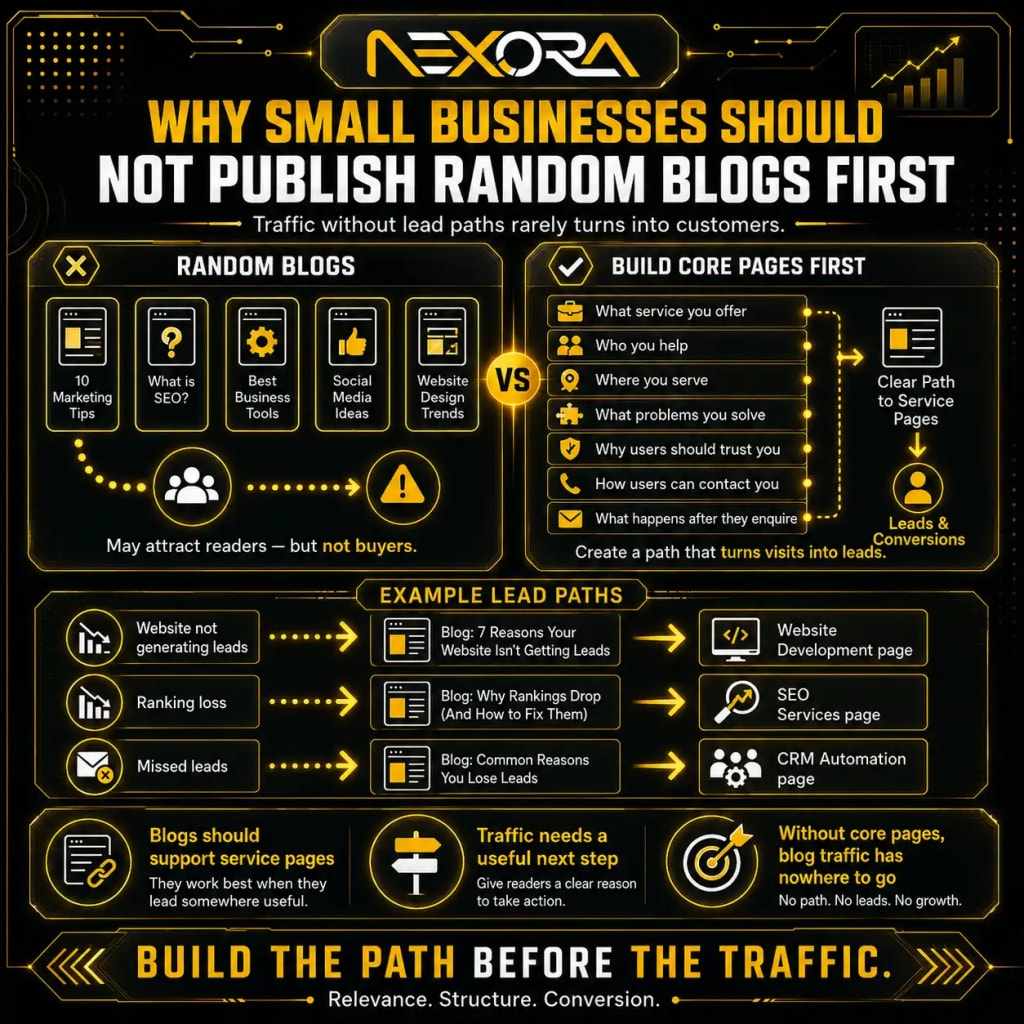
Small businesses should not publish random blogs first because random blogs often bring traffic without leads.
For example, a local service business may publish topics like:
- 10 marketing tips
- What is SEO?
- Best business tools
- Social media ideas
- Website design trends
These topics may attract readers.
But they may not attract buyers.
Before publishing blogs, a small business should build the pages that explain:
- What service you offer
- Who you help
- Where you serve
- What problems you solve
- Why users should trust you
- How users can contact you
- What happens after they enquire
Without these pages, blog traffic has nowhere useful to go.
A blog about “website not generating leads” should link to a Website Development page.
A blog about “ranking loss” should link to an SEO Services page.
A blog about “missed leads” should link to a CRM Automation page.
If those service pages do not exist, your blog cannot support a strong lead path.
What should small businesses publish first for SEO?
Small businesses should publish foundation pages before publishing large amounts of blog content.
The best publishing order is:
- Homepage
- Core service pages
- Contact page
- About page
- Location pages, if local
- Main service FAQs
- High-intent problem blogs
- Supporting educational blogs
- Case studies or portfolio
- Comparison pages
- Content refreshes
- Lead magnets, if useful
This order works because it builds a strong base first.
Your website needs pages that can rank, explain services, and convert visitors.
Then blogs can support those pages.
A small business does not need hundreds of pages to start.
It needs the right pages in the right order.
Why should the homepage come first?
The homepage should come first because it explains the business at the highest level.
A strong homepage tells users and search engines:
- Who you are
- What you do
- Who you help
- What services you offer
- What makes you different
- What problems you solve
- Which pages matter most
- What action visitors should take next
A good homepage should include:
- Clear headline
- Short value proposition
- Main services
- Trust signals
- Process overview
- Reviews or proof
- Internal links to service pages
- CTA buttons
- Contact path
- Blog or resource links, if useful
The homepage should not try to explain every service in detail.
It should guide users to the right service page.
For example, a digital agency homepage should link clearly to:
- Website Development
- SEO Services
- CRM Automation
- AI Voice Agents and Chatbots
- Contact Us
The homepage acts as the hub.
Service pages do the deeper selling.
Why should service pages be published before blogs?
Service pages should be published before blogs because they are usually the main lead-generation pages.
A service page targets commercial intent.
A blog often targets informational or problem-aware intent.
For example:
A user searching “SEO services for small businesses” may be closer to hiring.
A user searching “what is SEO” may only be learning.
Both can be useful.
But the service page is more important for leads.
Each core service should have its own page.
Examples:
- SEO Services
- Website Development Services
- CRM Automation Services
- AI Voice Agent and Chatbot Services
- UI/UX Design Services
- Local SEO Services
A strong service page should include:
- Clear H1
- Problem statement
- Service explanation
- Benefits
- Process
- Deliverables
- Trust signals
- FAQs
- CTA
- Internal links
- Contact path
If your service pages are weak, blog traffic may not convert.
How should small businesses choose which service pages to publish first?
Small businesses should publish service pages based on business value, customer demand, and lead potential.
Start with services that:
- Generate the most revenue
- Have strong buyer intent
- Solve urgent problems
- Have clear search demand
- Are easy to explain
- Have proof or experience
- Support long-term growth
- Connect to many blog topics
- Have clear CTAs
For example, an agency may prioritize:
- Website Development Services
- SEO Services
- CRM Automation Services
- AI Voice Agent and Chatbot Services
A contractor may prioritize:
- Roof Repair
- Roof Replacement
- Storm Damage Repair
- Emergency Roofing
- Roof Inspection
A clinic may prioritize:
- Main treatment services
- Insurance or appointment pages
- Location pages
- Patient FAQs
Do not publish service pages only because they sound good.
Publish the services that can bring qualified leads.
What should a small business service page include?
A service page should answer the questions a buyer asks before contacting you.
Include:
- What the service is
- Who the service is for
- What problem it solves
- What is included
- How the process works
- What benefits the customer gets
- Why your business is trustworthy
- What makes your approach different
- What results users can expect
- What the next step is
A strong service page structure can look like this:
- Hero section
- Clear H1
- Short intro
- Problem section
- Service details
- Benefits
- Process
- Deliverables
- Proof
- FAQs
- CTA
- Related blogs
- Contact section
Do not make service pages too thin.
A thin service page may say:
“We offer SEO services. Contact us today.”
That is not enough.
A strong service page explains the service clearly and gives users confidence to enquire.
Should small businesses publish location pages early?
Yes, local small businesses should publish location pages early if they serve specific cities, areas, or regions.
Location pages help users and Google understand where the business operates.
A local service business may need pages for:
- Main city
- Service area
- Nearby cities
- High-value neighborhoods
- Main office location
- Important local markets
A strong location page should include:
- Service and location in the heading
- Local service explanation
- Areas served
- Local pain points
- Trust proof
- Reviews
- Local FAQs
- Contact CTA
- Internal links to service pages
- Internal links to nearby pages
- Map or service area details, if useful
Avoid duplicate location pages.
Do not copy the same content and only change the city name.
Each location page should be useful and specific.
What should small businesses publish after service pages?
After service pages, small businesses should publish high-intent problem blogs.
These blogs attract users who already know they have a problem.
Examples:
- Why is my website not generating leads?
- Why is my business not showing up on Google?
- Why did my rankings drop?
- Why are Google Ads clicks not converting?
- Why are leads not showing in my CRM?
- Why are customers leaving my booking page?
- Why is my website slow on mobile?
- Why is my contact form not getting submissions?
These topics work because they connect directly to business pain.
They attract people who may need help soon.
A problem blog should:
- Explain the cause
- Give practical fixes
- Link to relevant service pages
- Include a CTA
- Include FAQs
- Build trust
- Guide users to the next step
Problem-aware content often converts better than broad educational content.
Why should problem-aware content come before broad educational content?
Problem-aware content should come before broad educational content because it is closer to buyer intent.
Broad educational content may target people who are just learning.
Problem-aware content targets people who need a solution.
For example:
Broad educational topic:
- What is SEO?
Problem-aware topic:
- Why is my website not ranking on Google?
Broad educational topic:
- What is a landing page?
Problem-aware topic:
- Why are my Google Ads clicks not converting?
Broad educational topic:
- What is CRM?
Problem-aware topic:
- Why are my website leads getting lost?
Problem-aware content is more useful for lead generation.
It shows users that you understand their situation.
It also gives you a natural reason to link to your services.
What blog topics should small businesses publish first?
Small businesses should publish blogs that answer urgent customer questions and connect to services.
Good first blog topics include:
- Why is my website not generating leads?
- Why is my website not ranking on Google?
- How much does a small business website cost?
- Do small businesses need SEO?
- How long does SEO take for a small business?
- Local SEO checklist for small businesses
- Google Ads landing page mistakes
- Website redesign SEO checklist
- What pages should a service business website have?
- How to track website leads
- Why contact forms do not convert
- How CRM automation helps small businesses
- Can AI chatbots generate leads?
Each blog should support a service.
For example:
- SEO blog → SEO Services
- Website blog → Website Development
- Lead tracking blog → CRM Automation
- Chatbot blog → AI Chatbot Services
- Landing page blog → Website Development or UI/UX
Do not publish a blog without a next step.
How should small businesses build a topic cluster?
A topic cluster connects related content around one main service or topic.
For example, an SEO topic cluster may include:
- SEO Services
- Local SEO for Small Businesses
- Technical SEO Issues That Cause Ranking Loss
- Lost Keywords in Google Search Console
- Content Decay SEO
- SEO Recovery Checklist
- Internal Linking Strategy
- SEO Website Structure
- How to Compare GSC Data During an SEO Drop
A Website Development cluster may include:
- Website Development Services
- Website Not Generating Leads
- SEO Website Structure
- Landing Page vs Website
- Google Ads Landing Page Experience
- Website Redesign SEO Checklist
- Service Page Structure
- Mobile Website Conversion
A CRM Automation cluster may include:
- CRM Automation Services
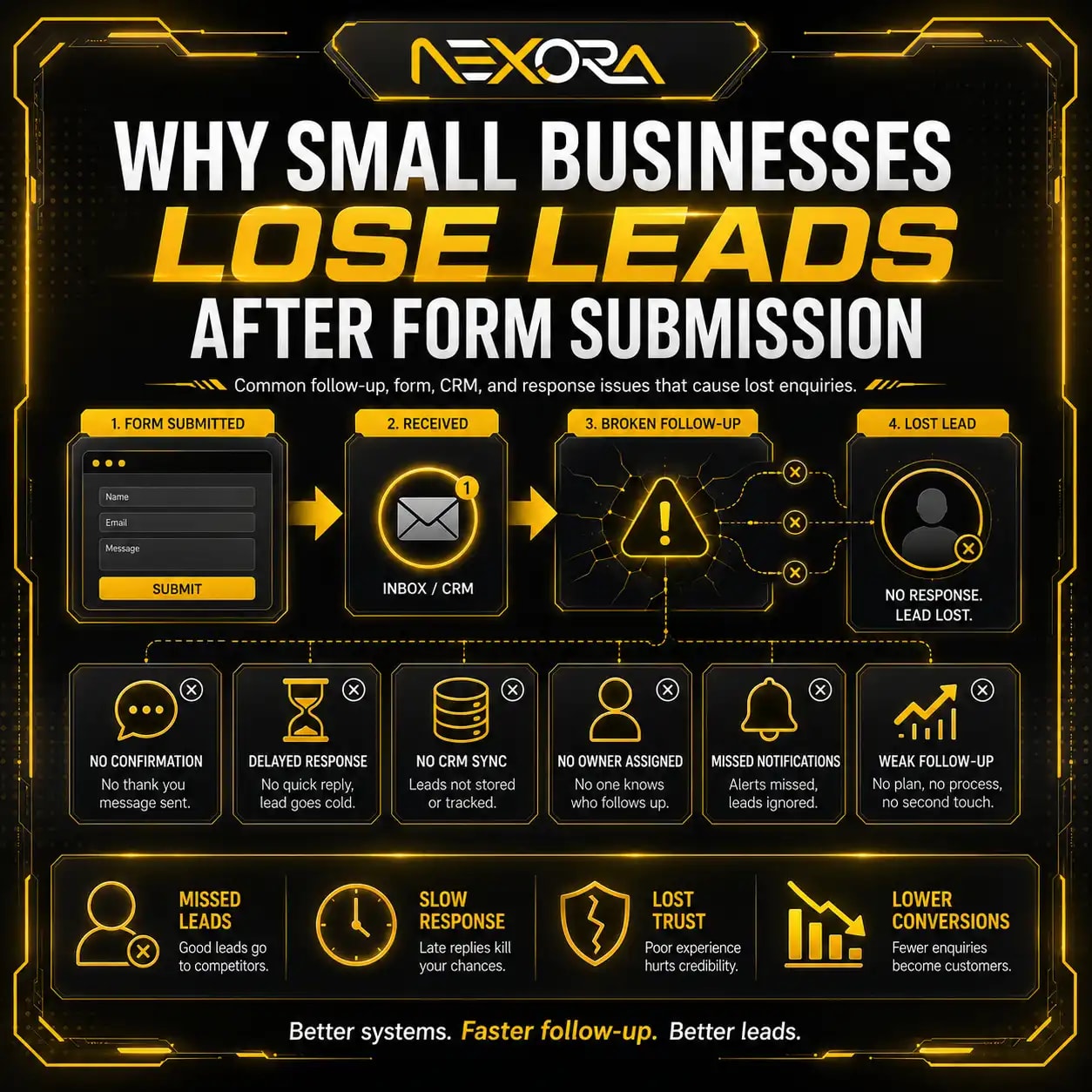
- Why Leads Get Lost After Form Submission
- How to Track Website Leads
- Online Booking for Service Businesses
- Follow-Up Automation for Small Businesses
Topic clusters help Google understand depth.
They also help users move from question to solution.
How many blog posts should a small business publish first?
A small business should start with 8 to 12 strategic blog posts around its most important service.
That is usually better than publishing 30 random posts.
A good first SEO content batch can include:
- 1 main service page
- 4 problem-aware blogs
- 4 supporting educational blogs
- 2 comparison or checklist blogs
- 1 case study or proof page
- 1 FAQ section
For example, a small business SEO cluster can start with:
- SEO Services
- Why Your Website Is Not Ranking on Google
- Local SEO for Small Businesses
- Technical SEO Issues That Cause Ranking Loss
- SEO Recovery Checklist
- Content Decay SEO
- Internal Linking Strategy
- SEO Website Structure
- Google Search Console Data Comparison
This gives the website enough depth to build topical relevance.
How should small businesses plan content by search intent?
Search intent means what the user wants when they search.
A strong content plan includes different intent levels.
What is commercial intent?
Commercial intent means the user may be ready to hire or compare providers.
Examples:
- SEO services for small business
- Website development company
- CRM automation agency
- Local SEO services
- AI chatbot service
These usually need service pages.
What is problem-aware intent?
Problem-aware intent means the user knows something is wrong.
Examples:
- Website not generating leads
- Rankings dropped suddenly
- Content not generating leads
- Google Ads clicks not converting
- Leads getting lost
These usually need blog posts or guides.
What is informational intent?
Informational intent means the user wants to learn.
Examples:
- What is SEO?
- What is CRM automation?
- What is topical authority?
- What is technical SEO?
These can support awareness, but they may not convert immediately.
What is local intent?
Local intent means the user wants a provider or solution in a specific area.
Examples:
- SEO agency near me
- Website designer in Tampa
- Local SEO services in Phoenix
- CRM automation consultant near me
These need local service pages or location pages.
A good content plan covers all intent levels, but it starts with pages closest to leads.
How should content connect to lead generation?
Every important content piece should guide visitors toward a lead path.
Lead paths may include:
- Service page
- Contact page
- Booking form
- Quote request
- Phone call
- Chatbot conversation
- Consultation page
- Downloadable checklist
- CRM-tracked form
A blog should not end with nothing.
It should include:
- Relevant internal links
- CTA
- Contact option
- Service connection
- FAQ section
- Trust signal
- Next step
For example:
A blog about website leads should link to:
- Website Development Services
- CRM Automation Services
- AI Chatbot Services
- Contact Us
A blog about rankings should link to:
- SEO Services
- Website Development Services
- Contact Us
A blog about missed calls should link to:
- AI Voice Agent and Chatbot Services
- CRM Automation Services
- Contact Us
Content should not only inform.
It should guide action.
How should small businesses use FAQs in SEO content?
FAQs help small businesses answer real customer questions and improve page completeness.
Use FAQs on:
- Service pages
- Blog posts
- Location pages
- Landing pages
- Contact page, if useful
Good FAQ topics include:
- Cost
- Timeline
- Process
- Results
- What is included
- Who the service is for
- How to get started
- Common problems
- Comparison questions
- Local service questions
Example FAQs for an SEO service page:
- How long does SEO take?
- Do small businesses need SEO?
- What is included in SEO services?
- Can SEO generate leads?
- How do you track SEO results?
FAQs should not be filler.
They should answer questions that help users make decisions.
How should internal links support the content plan?
Internal links connect your content plan into one system.
Use internal links to connect:
- Homepage to service pages
- Service pages to blogs
- Blogs to service pages
- Related blogs to each other
- Location pages to services
- Case studies to services
- Contact page from CTA sections
A blog about “SEO Recovery Checklist” should link to:
- SEO Services
- Technical SEO Issues
- Content Decay SEO
- Contact Us
A blog about “Website Not Generating Leads” should link to:
- Website Development Services
- CRM Automation Services
- AI Chatbot Services
- Contact Us
A content plan without internal links is incomplete.
Internal links help Google understand relationships.
They also help users find the next page.
How should small businesses choose CTAs for SEO content?
CTAs should match the user’s problem and the page intent.
Do not use the same generic CTA everywhere.
Weak CTAs include:
- Contact us
- Learn more
- Click here
- Submit
Better CTAs include:
- Request an SEO Audit
- Get a Website Review
- Fix Your Lead Tracking
- Book a Strategy Call
- Improve Your Landing Page
- Automate Your Follow-Up
- Add AI Chatbot Lead Capture
A blog about rankings should use an SEO CTA.
A blog about website leads should use a website development CTA.
A blog about missed leads should use a CRM CTA.
A blog about after-hours questions should use an AI chatbot CTA.
The CTA should feel like the next logical step.
How should small businesses track SEO content results?
Small businesses should track both visibility and leads.
Track SEO metrics:
- Impressions
- Clicks
- CTR
- Average position
- Ranking queries
- Indexed pages
- Service-page visits
- Blog traffic
- Internal link clicks
Track conversion metrics:
- Form submissions
- Phone calls
- Quote requests
- Booking requests
- Chatbot leads
- Contact page visits
- CRM leads
- Consultation requests
- Assisted conversions
- Lead quality
Traffic alone is not enough.
A blog with 1,000 visits and no leads may be less valuable than a blog with 100 visits and 5 qualified enquiries.
This is why content should connect to CRM and conversion tracking.
If your content gets traffic but you cannot track which pages generate leads, Nexora Creation can help connect forms, calls, chatbot leads, and CRM automation.
How should small businesses use case studies in a content plan?
Case studies help turn trust into action.
Small businesses should publish case studies after they have service pages and some supporting content.
A case study can show:
- Client problem
- Starting situation
- Strategy used
- Work completed
- Results achieved
- Timeline
- Screenshots or visuals
- Lessons learned
- Service link
- CTA
Case studies are useful because they show real experience.
They can support:
- SEO Services
- Website Development
- CRM Automation
- AI Chatbot Services
- Local SEO
- Landing page design
A case study does not need to be long.
It needs to be specific and honest.
It should help users think:
“This business has solved a problem like mine.”
How should small businesses use comparison content?
Comparison content helps users make decisions.
Good comparison topics include:
- SEO vs Google Ads
- Landing page vs website
- WordPress.com vs WordPress.org
- Website redesign vs website refresh
- CRM vs spreadsheet
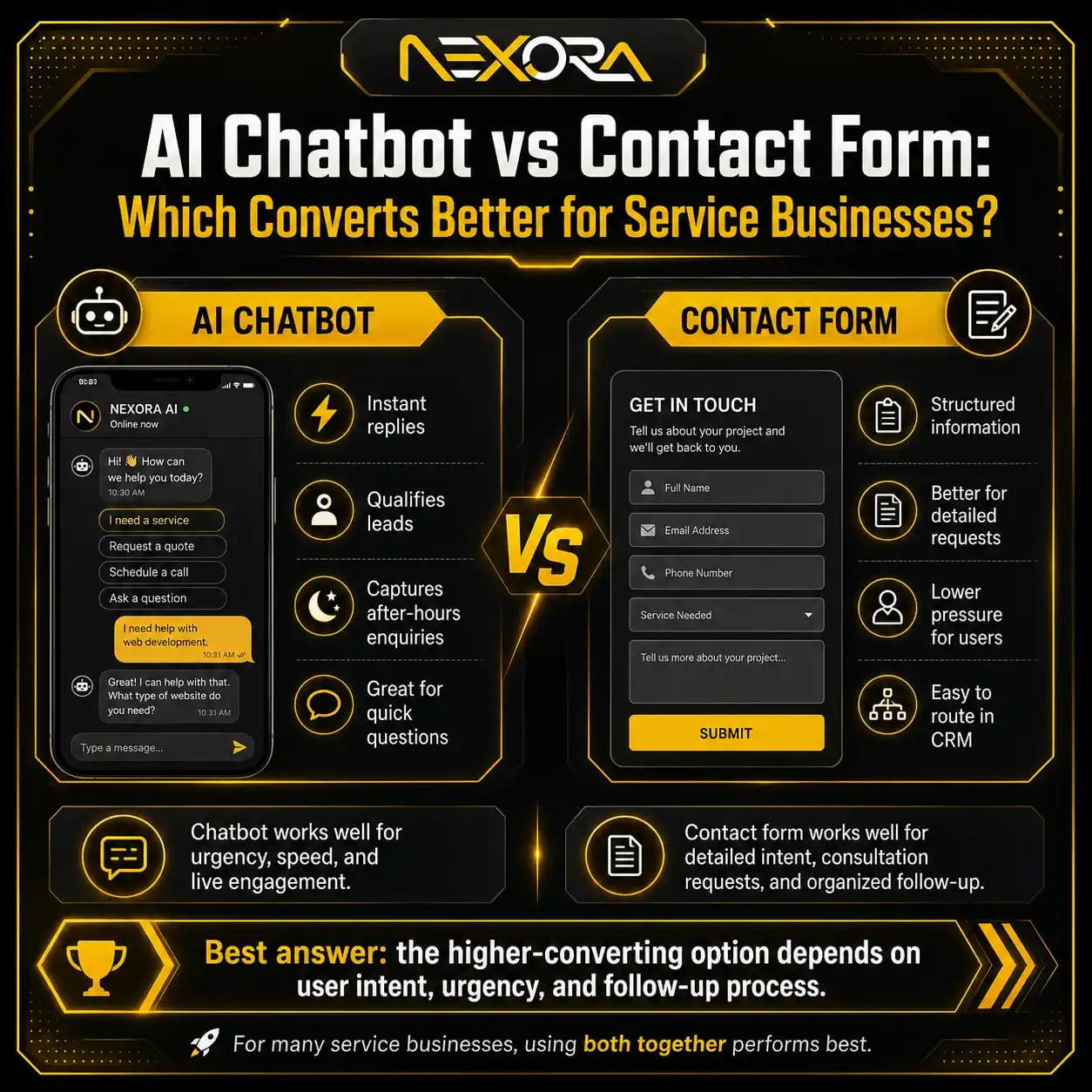
- AI chatbot vs live chat
- Local SEO vs traditional SEO
- Template website vs custom website
Comparison content is valuable because the user is often closer to a decision.
A comparison page should include:
- Clear comparison
- Pros and cons
- Best use cases
- Cost considerations
- Business impact
- Recommendation
- CTA
- Relevant service links
Comparison blogs can support lead generation when they help users choose the right solution.
How should small businesses use local content?
Local content helps businesses rank for area-specific searches.
A local content plan may include:
- Main location pages
- City service pages
- Local FAQs
- Local case studies
- Local problem blogs
- Service area pages
- Google Business Profile support content
Examples:
- Local SEO for Small Businesses in Tampa
- Website Design for Contractors in Phoenix
- HVAC SEO in Houston
- Roofing Website Design in Austin
- Pool Service SEO in Las Vegas
Local content should be useful.
Avoid thin pages that only swap city names.
Local pages should include:
- Real service details
- Local problems
- Service area information
- Reviews
- FAQs
- Contact CTA
- Internal links
Local SEO content should support real business areas.
What should small businesses publish in the first 30 days?
In the first 30 days, focus on the foundation.
Publish or improve:
- Homepage
- Contact page
- About page
- Main services page
- 2 to 4 core service pages
- Basic service FAQs
- XML sitemap
- Clear navigation
- Footer links
- First 2 high-intent blogs
- Internal links between core pages
- Lead tracking setup
The goal of the first month is clarity.
Google should understand what the business does.
Users should understand how to contact you.
Do not overload the site with random content.
Build the foundation first.
What should small businesses publish in the first 60 days?
In the first 60 days, start building topic depth.
Publish:
- 4 to 6 supporting blogs
- 1 to 2 problem-aware guides
- 1 comparison post
- 1 checklist post
- Updated FAQs
- Internal links from blogs to service pages
- Internal links between related blogs
- First case study, if available
- Location page, if local
- CTA improvements
The goal of the second month is topical relevance.
You want your website to show depth around your main service.
What should small businesses publish in the first 90 days?
In the first 90 days, strengthen the content cluster and start measuring performance.
Publish:
- 8 to 12 total supporting blogs
- 1 case study
- 1 comparison guide
- 1 checklist guide
- 1 local service page, if needed
- Updated service pages
- Stronger internal links
- Better CTAs
- FAQ improvements
- Content refreshes based on early data
- Lead tracking review
Review:
- Which pages are indexed?
- Which pages get impressions?
- Which pages get clicks?
- Which queries appear?
- Which blogs send users to service pages?
- Which pages generate leads?
- Which CTAs work?
The first 90 days should create the base for long-term SEO growth.
What should small businesses avoid in their first SEO content plan?
Avoid these mistakes:
- Publishing blogs before service pages
- Targeting only high-volume keywords
- Ignoring buyer intent
- Ignoring local intent
- Writing generic content
- No internal links
- No CTA
- No contact path
- Thin service pages
- Duplicate location pages
- No Google Search Console setup
- No lead tracking
- No CRM connection
- No content clusters
- Publishing too many unrelated topics
- Changing URLs often
- Ignoring website structure
- Ignoring mobile UX
- Ignoring page speed
- Not updating old content
A good SEO content plan is focused.
It does not try to do everything at once.
How can AI chatbots support a small business content plan?
AI chatbots can help small businesses turn content visitors into leads.
A visitor may read a blog but still have questions.
An AI chatbot can ask:
- What service are you looking for?
- What problem are you trying to solve?
- Do you need SEO, website, CRM, or chatbot help?
- What is your website URL?
- What is your preferred contact method?
- Do you want to request a consultation?
It can help users find:
- SEO Services
- Website Development Services
- CRM Automation Services
- AI Chatbot Services
- Contact page
It can also capture leads after hours.
This is useful for small businesses that cannot respond instantly all the time.
AI Voice Agent & Chatbot Services
How can Nexora Creation help build an SEO content plan?
Nexora Creation helps small businesses plan, structure, publish, and improve SEO content that supports rankings and leads.
For SEO content planning, we can help with:
- Website structure planning
- Service-page strategy
- Keyword intent research
- Topic cluster planning
- Blog content roadmap
- Local SEO content
- Internal linking strategy
- CTA planning
- Technical SEO setup
- Google Search Console review
- Content refresh planning
- Landing page planning
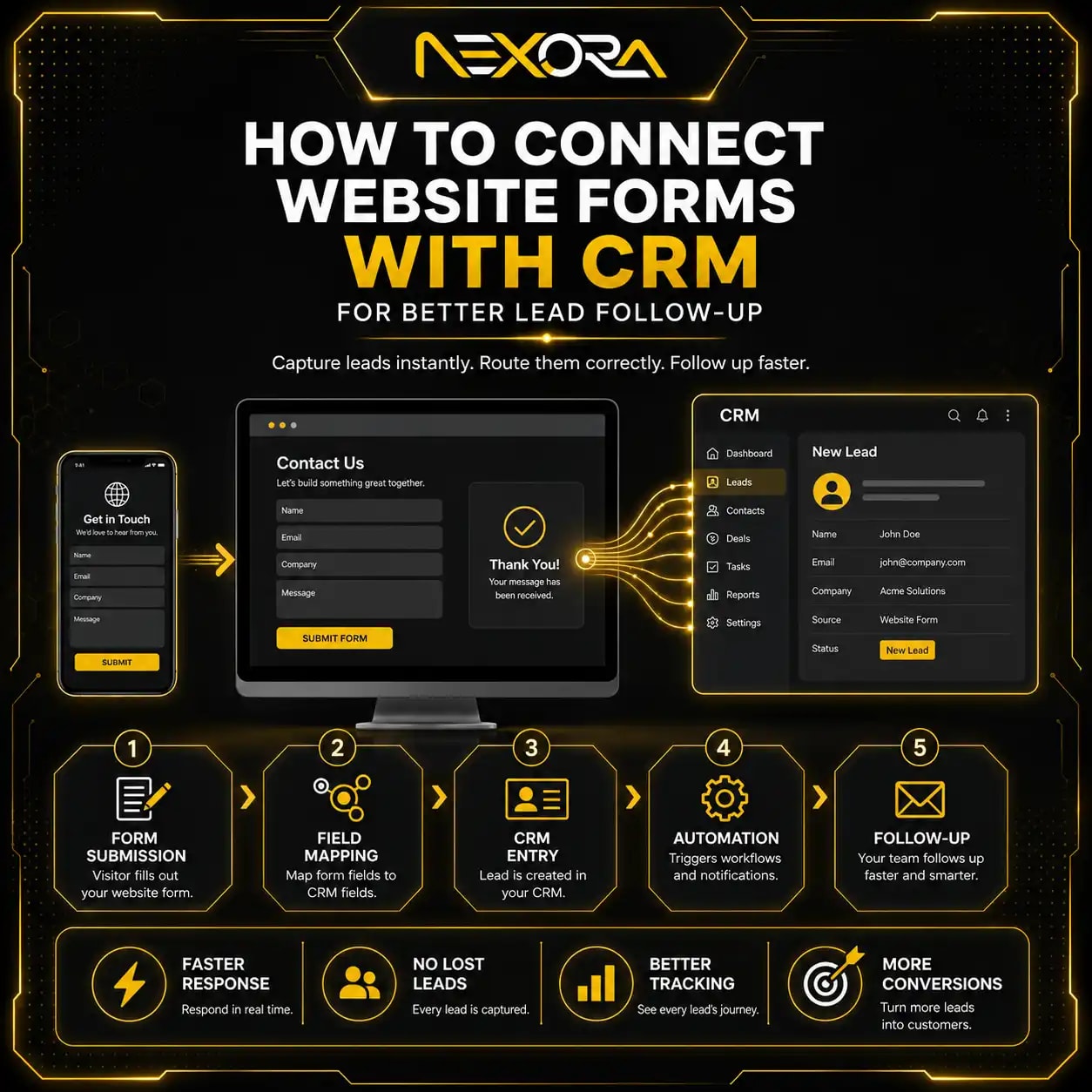
- CRM lead tracking
- AI chatbot lead capture
- SEO reporting
The goal is not to publish more content for the sake of content.
The goal is to publish the right pages first, connect them properly, and guide visitors toward action.
If your small business is starting SEO from scratch, the safest next step is a clear content plan before writing dozens of blogs.
What is the best SEO content plan for small businesses?
The best SEO content plan for small businesses starts with lead-generating pages and then builds supporting content around them.
Use this order:
What should you publish first?
Publish:
- Homepage
- Contact page
- About page
- Core service pages
- Main location page, if local
- Service FAQs
What should you publish second?
Publish:
- Problem-aware blogs
- High-intent guides
- Service-supporting content
- Local service content
- Comparison posts
- Checklists
What should you publish third?
Publish:
- Case studies
- Portfolio pages
- Deeper educational blogs
- Supporting topic clusters
- Lead magnets
- Content refreshes
What should you improve continuously?
Improve:
- Internal links
- CTAs
- Service pages
- FAQs
- Page speed
- Mobile UX
- Content freshness
- Lead tracking
- CRM data
- Search Console performance
This creates a practical and measurable SEO content system.
Conclusion
Small businesses should not start SEO by publishing random blogs.
They should start with pages that explain services, build trust, and generate leads.
The best publishing order is:
- Homepage
- Contact page
- About page
- Core service pages
- Location pages, if needed
- Service FAQs
- High-intent problem blogs
- Supporting educational blogs
- Comparison content
- Case studies
- Content refreshes
A strong SEO content plan connects every page to a business purpose.
Service pages target commercial intent.
Blogs support service pages.
Internal links connect the journey.
CTAs guide action.
CRM tracking shows what content creates leads.
When small businesses publish the right pages first, Google can understand the website faster and users can find the right solution more easily.
That is how SEO content becomes a growth system instead of a collection of random articles.
FAQs
What should a small business publish first for SEO?
A small business should publish the homepage, contact page, about page, core service pages, location pages if needed, and service FAQs before publishing many blog posts.
Should I publish service pages or blogs first?
Publish service pages first. Blogs should support service pages by answering related questions and sending visitors to relevant services.
How many blogs should a small business publish first?
Start with 8 to 12 strategic blogs around one important service or topic cluster instead of publishing many unrelated posts.
What blog topics should small businesses start with?
Start with problem-aware topics such as website not generating leads, website not ranking, rankings dropping, Google Ads not converting, and leads getting lost.
Do small businesses need location pages?
Local service businesses should create location pages for important cities or service areas, but each page should have unique, useful local content.
What is a topic cluster?
A topic cluster is a group of related pages around one main service or subject, connected with internal links and organized around search intent.
How do internal links help an SEO content plan?
Internal links connect blogs to service pages, related blogs to each other, and users to the next useful step. They help both SEO and lead generation.
How do I know which content is working?
Track impressions, clicks, CTR, rankings, service-page visits, form submissions, phone calls, chatbot leads, and CRM leads.
Should small businesses target high-volume keywords first?
Not always. Small businesses should often start with high-intent, problem-aware, and local keywords because they are closer to leads.
Can AI chatbots help SEO content convert?
Yes. AI chatbots can answer visitor questions, guide users to the right service page, capture contact details, and send leads to CRM.
What is the biggest SEO content planning mistake?
The biggest mistake is publishing random blogs without service pages, internal links, CTAs, lead tracking, or a clear business goal.
How often should small businesses publish SEO content?
A practical starting pace is 2 to 4 quality pieces per month, focused around one topic cluster, with internal links and CTAs added properly.