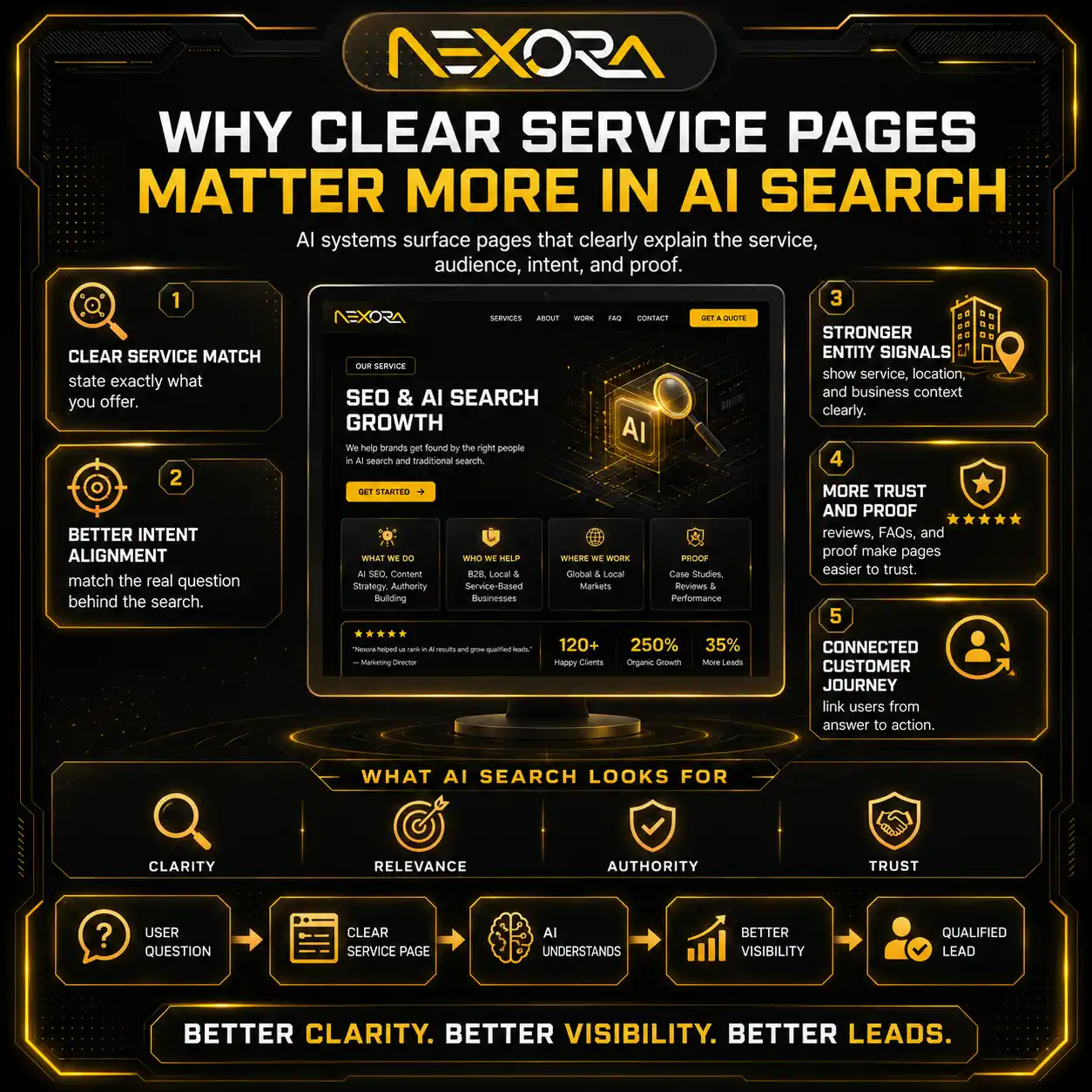
Clear service pages matter more in AI search because AI-powered systems need specific, accessible, and trustworthy information before they can confidently connect a business with a customer’s question.
A service page should clearly explain:
- What the business provides
- Who the service is for
- Which problem it solves
- What is included
- Where the service is available
- What affects cost or timing
- Why the provider should be trusted
- What the customer should do next
A vague page may still contain the right keyword, but it gives search and AI systems less useful information to retrieve, interpret, and reference.
For example, a page titled Business Growth Solutions may not clearly communicate whether the company provides:
- SEO
- Website development
- CRM automation
- Consulting
- Paid advertising
- AI voice agents
A page titled Local SEO Services for Home-Service Companies creates a much clearer relationship between the service, audience, and intended outcome.
Google says website owners do not need special AI markup or a separate optimization trick for AI Overviews and AI Mode. Existing SEO fundamentals still apply, including crawlability, internal links, useful text, accurate structured data, and people-first content.
At Nexora Creation, we treat service-page clarity as both a search requirement and a conversion requirement.
The page must help search systems understand the offer, but it must also help a real customer decide whether to contact the business.
What is a clear service page?
A clear service page is a focused webpage dedicated to one meaningful service or one closely related group of services.
It explains the offer in language that both customers and search systems can understand without guessing.
A strong page normally identifies:
- Service name
- Target customer
- Customer problem
- Deliverables
- Service process
- Scope and exclusions
- Pricing factors
- Service area
- Evidence
- Next step
The purpose is not to publish a separate page for every small variation of a keyword.
The purpose is to give every important customer need a clear destination.
For example, a roofing company may need separate pages for:
- Roof Repair
- Roof Replacement
- Storm Damage Roofing
These services belong to the same industry, but they have different:
- Search intent
- Customer concerns
- Processes
- Pricing factors
- Urgency
- Conversion paths
Combining them into one short Roofing Services page can reduce clarity.
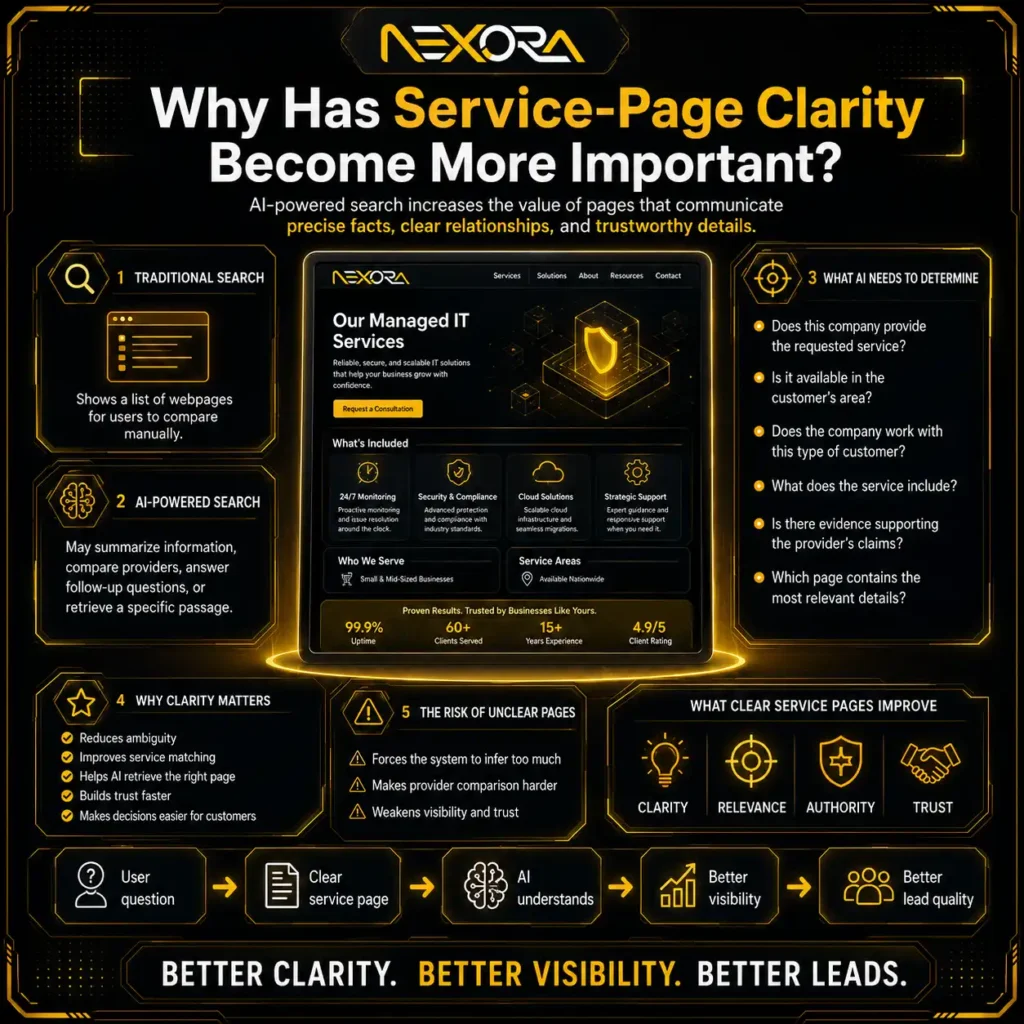
Why has service-page clarity become more important?
Traditional search often presents a list of webpages and allows users to evaluate each result.
AI-powered search may summarize information, compare providers, answer follow-up questions, or retrieve a specific passage from a page.
That increases the value of pages that communicate precise facts and relationships.
An AI system may need to determine:
- Does this company provide the requested service?
- Is it available in the customer’s area?
- Does the company work with this type of customer?
- What does the service include?
- Is there evidence supporting the provider’s claims?
- Which page contains the most relevant details?
A clear service page reduces ambiguity around these questions.
An unclear page forces the system—and the customer—to infer too much.
Does AI search replace normal service-page SEO?
No.
AI search builds on many of the same foundations as traditional SEO.
Google’s guidance for AI features continues to emphasize:
- Crawl access
- Indexing eligibility
- Internal linking
- Useful page text
- Page experience
- Accurate structured data
- Current business information
A page must first be technically accessible and useful enough to appear in Search before it can be considered as a supporting source in Google’s AI features.
This means a service page still needs:
- Relevant title tag
- Descriptive H1
- Clean URL
- Correct canonical
- Internal links
- Mobile usability
- Fast loading
- Useful content
- Trust signals
- Clear CTA
AI optimization does not remove traditional SEO work.
It makes service-page quality more important.
Why does one large Services page often create problems?
A Services hub is useful for introducing everything a business provides.
The problem begins when it is the only page explaining those services.
Imagine an agency with one page listing:
- Website Development
- SEO
- Local SEO
- UI/UX Design
- CRM Automation
- AI Voice Agents
Each service may receive one short paragraph.
That creates limited space to explain:
- Who needs the service
- What is included
- How the service works
- What affects cost
- Which problems it solves
- How it differs from related services
- What proof supports the offer
- What action the user should take
The page is trying to represent several different intents at once.
A customer searching for an AI receptionist may land on a page dominated by website and SEO copy.
A customer looking for CRM automation may need to scroll through unrelated services before finding one short description.
A better structure is:
- Main Services hub
- One dedicated page for each core service
- Supporting articles and case studies connected to those pages
The hub provides navigation.
The dedicated pages provide depth.
Should every small service have a separate page?
No.
Separate pages should reflect genuine differences in customer intent, scope, process, or commercial value.
Create a dedicated page when the service:
- Has meaningful search demand
- Solves a distinct problem
- Uses a different process
- Requires different proof
- Has different pricing factors
- Targets a different customer
- Needs a different CTA
- Can support substantial useful information
Keep services together when:
- They are minor parts of one main offer
- Customers do not search for them separately
- The process is essentially the same
- A separate page would be thin or repetitive
- The business cannot provide meaningful unique detail
The goal is not maximum page count.
The goal is maximum clarity.
How do clear service pages improve topic understanding?
A dedicated page gives one subject enough space to become clearly identifiable.
For example, a page about AI Voice Agent and Chatbot Services can explain:
- AI call answering
- Lead qualification
- Appointment booking
- Human transfers
- CRM integration
- After-hours coverage
- Failure handling
- Service limitations
That creates a stronger topic than a short homepage card saying:
“Automate communication with AI.”
Clear service pages also help establish relationships.
The AI Voice Agent page can link to:
- CRM Automation
- Missed-call recovery
- Lead qualification
- Appointment booking
- Relevant industry use cases
These connections help both users and search systems understand how the service fits within the wider business offering.
Why should the service name be specific?
A specific service name reduces uncertainty.
Weak names include:
- Business Solutions
- Growth Services
- Digital Innovation
- Customer Experience
- Complete Support
These phrases may sound professional, but they do not describe a clear commercial offer.
Stronger names include:
- Technical SEO Services
- Local SEO for Service Businesses
- WordPress Website Development
- CRM Automation Services
- AI Voice Receptionist Setup
- Google Business Profile Optimization
The service name should use language that customers recognize.
Alternative names can be explained naturally.
Example:
“An AI voice receptionist, also called an AI phone agent, can answer calls, collect customer details, qualify enquiries, and route calls according to predefined business rules.”
Do not create a list of forced synonyms merely to target keywords.
What should the H1 communicate?
The H1 should identify the primary service and, where useful, the intended customer or location.
Examples:
- Local SEO Services for Home-Service Companies
- Emergency AC Repair in Tampa
- Weekly Pool Cleaning in Scottsdale
- Roof Replacement Services for Residential Properties
- CRM Automation for Small Service Businesses
Avoid H1s such as:
- Grow Your Business Today
- Better Solutions for Modern Brands
- Experience the Difference
- Your Success Starts Here
The H1 should answer:
- What is this page about?
- Is it relevant to me?
A customer should not need to interpret a slogan before understanding the service.
What should appear immediately below the H1?
The supporting copy should define the service and its primary value.
Example:
H1: CRM Automation Services for Small Businesses
Supporting copy:
“We connect website enquiries, phone leads, follow-up tasks, appointments, and customer status in one organized workflow so fewer opportunities are lost.”
This copy explains:
- What the service connects
- Which operational problem it addresses
- The intended outcome
The first section should normally include:
- Direct service explanation
- Intended customer
- Main benefit
- Relevant CTA
- Trust signal
- Location where necessary
Do not begin with several paragraphs of broad industry background.
Why should every service page answer customer questions directly?
AI-powered and traditional searches increasingly reflect complete questions.
A customer may ask:
- What does local SEO include?
- How much does an SEO audit cost?
- Can an AI receptionist transfer urgent calls?
- Does weekly pool cleaning include chemicals?
- When should a roof be replaced instead of repaired?
A service page should answer the questions that influence the purchase decision.
Useful sections may include:
- What is included?
- Who is the service for?
- How does the process work?
- What affects pricing?
- How long does implementation take?
- What is not included?
- Which areas are served?
- What happens after I contact the company?
Direct answers reduce friction for customers and make important information easier to identify.
Should answers appear near the top of each section?
Yes.
Each important section should begin with its main answer before adding context.
Example:
Does local SEO guarantee top Maps rankings?
“No. Local SEO can improve relevance, authority, profile quality, and website signals, but rankings also depend on competition, distance, prominence, and the customer’s location.”
This structure provides:
- Direct answer
- Limitation
- Supporting factors
A weak section might spend several paragraphs describing local SEO before revealing that rankings cannot be guaranteed.
Answer-first structure improves clarity without making the content shallow.
How much detail should a service page include?
A service page should contain enough detail to help a qualified customer evaluate the offer.
The page does not need to be long for its own sake.
It needs to be complete.
A useful page may explain:
- Main service
- Customer problems
- Deliverables
- Process
- Timeline factors
- Pricing factors
- Requirements
- Exclusions
- Proof
- FAQs
- CTA
Google recommends content that provides original information, substantial coverage, first-hand expertise, and a satisfying experience for the intended audience.
A 700-word page may be enough for a simple service.
A complex CRM or AI implementation service may require significantly more detail.
Length should follow the decision complexity.
Why are scope and exclusions important?
A clear service page should explain not only what the business does, but also what it does not do.
This creates accurate expectations.
For example, a Local SEO page might explain that the service includes:
- Google Business Profile optimization
- Local keyword research
- Service and location pages
- Citation review
- Review strategy
- Technical checks
- Local reporting
It may also clarify that it does not include:
- Guaranteed ranking positions
- Fake reviews
- Fake office locations
- Unlimited content
- Paid advertising spend
- Immediate results
Scope improves customer qualification.
It also makes the page more trustworthy because the offer is not presented as an unlimited solution for every problem.
Why should pricing factors be explained?
Many businesses cannot publish one fixed price because the work depends on:
- Website size
- Number of services
- Locations
- Current technical condition
- Competition
- Required integrations
- Content needs
- Project scope
The page should still explain why pricing varies.
Example:
“Local SEO pricing depends on the number of locations, current website condition, competition, content requirements, and whether Google Business Profile, citation, or technical work is required.”
This gives customers useful decision information without forcing the business to publish an inaccurate fixed fee.
A page that says only “Contact us for pricing” leaves an important question unanswered.
How does proof improve service-page clarity?
Proof helps customers and search systems distinguish an actual service capability from promotional claims.
Useful proof may include:
- Case studies
- Project examples
- Customer reviews
- Screenshots
- Sample deliverables
- Named methodology
- Team experience
- Certifications
- Industry partnerships
If a page claims the company builds conversion-focused websites, it should support that claim through evidence such as:
- Form-flow improvements
- Mobile redesign examples
- Call tracking
- Before-and-after layouts
- Conversion measurement process
Proof should be relevant to the service on the page.
A general five-star review may not provide strong evidence for a specialized technical service.
Should proof appear close to the claim?
Yes.
A common mistake is placing every testimonial and accreditation in one section near the bottom.
Instead, connect proof to the claim it supports.
Example:
Claim
“We build CRM workflows that reduce missed follow-up.”
Supporting proof
Explain the workflow:
- Form submitted
- CRM record created
- Lead assigned
- Confirmation sent
- Follow-up task generated
- Outcome recorded
A relevant case study or interface screenshot can appear beside this explanation.
Placing proof near the claim reduces the work required from the reader.
How do internal links strengthen service pages?
Internal links help show how services, problems, industries, and supporting information connect.
A strong structure may include:
- Services hub → Local SEO
- Local SEO → Google Business Profile Optimization
- Local SEO → Service-area page strategy
- Local SEO blog → Local SEO service page
- Case study → Relevant service
- Industry page → Relevant service
Use descriptive anchor text.
Better anchors include:
- Local SEO services
- CRM automation for lead follow-up
- AI voice agent implementation
- Website development for service businesses
Avoid relying only on:
- Click here
- Learn more
- Read more
Google recommends making important content easy to discover through internal links as part of its standard and AI-search guidance.
How should a Services hub support dedicated pages?
The main Services page should provide a concise overview of each offering and direct visitors to the focused page.
A useful hub structure includes:
Service name
One or two sentences explaining:
- What it does
- Who it helps
- Main outcome
Then add a descriptive link.
Example:
CRM Automation
“Connect website leads, phone enquiries, follow-up tasks, appointments, and sales outcomes in an organized workflow.”
Link:
Explore CRM Automation Services
The Services hub should not attempt to replace every dedicated page.
Its job is navigation and orientation.
How do topic clusters support service-page visibility?
A topic cluster gives the main service page supporting depth.
For example, an AI Search Optimization service cluster might include:
- How Small Businesses Can Appear in AI Search
- AI Search Optimization Checklist
- GEO vs Traditional SEO
- How to Structure Content for AI Answers
- Why Clear Service Pages Matter in AI Search
- How to Measure AI Search Visibility
Each supporting article should answer a different question.
The articles should link back to the most relevant service page.
This creates a clear relationship between:
- Educational content
- Commercial service
- Brand expertise
- Customer action
Do not publish multiple articles that repeat the same advice with slightly changed titles.
Google recommends useful, original, people-first content rather than scaled pages that add little new value.
Does structured data make a service page clear?
Structured data can help describe business or page information, but it cannot replace clear visible content.
Relevant markup may include:
- Organization
- LocalBusiness
- Service
- BreadcrumbList
- Article
- Person
Google explicitly states that there is no special schema required for AI Overviews or AI Mode. Structured data should also match what users can see on the page.
Do not use schema to represent:
- Services that are not described
- Fake locations
- Invented reviews
- False ratings
- Unsupported prices
- Hidden authors
The correct order is:
- Build a clear page.
- Add accurate structured data.
- Validate the implementation.
- Maintain both over time.
How does entity clarity affect service visibility?
An AI system may need to determine whether the business, service, author, profile, and third-party references belong to the same organization.
Keep core information consistent across:
- Website
- Google Business Profile
- Bing Places
- Social profiles
- Business directories
- Industry profiles
- Review platforms
Important details include:
- Official business name
- Website
- Phone number
- Main category
- Services
- Service areas
- Team
- Contact information
For example:
“Nexora Creation is a digital growth agency providing website development, SEO, local SEO, CRM automation, UI/UX design, and AI customer-communication systems for service businesses.”
Each service page can then explain one offer in depth.
The wider identity remains consistent.
Why do location and service-area details matter?
Local customers need to know whether the company can serve them.
A service page may state:
- Main city
- Service region
- Priority areas
- ZIP codes
- Route restrictions
- Remote or in-person availability
Example:
“Weekly pool cleaning is available across selected Scottsdale, Tempe, Paradise Valley, and North Phoenix routes.”
Avoid vague claims such as:
“Serving customers everywhere.”
Also avoid creating fake office locations merely to appear local.
A location statement should reflect real operating coverage.
Should every city and service combination have a page?
No.
A company with five services and twenty cities could create one hundred service-location pages.
Most businesses cannot provide enough unique value for that volume.
Create a city-service page when:
- The service has meaningful demand in that city
- The business genuinely serves the location
- The page can include local proof
- Pricing or availability differs
- Customer needs differ
- The page supports a strategic market
Otherwise, use:
- Strong core service pages
- A Service Areas hub
- Priority city pages
- Natural local references
Do not create thin combinations simply to target keywords.
How should a service page handle industry-specific customers?
A core service page can explain the general offer.
Industry pages can explain how it applies to a specific business type.
For example:
Core service
AI Voice Agent and Chatbot Services
Industry applications
- AI Receptionist for HVAC Companies
- AI Call Handling for Roofing Businesses
- AI Lead Qualification for Pool Companies
- AI Appointment Booking for Clinics
Create these pages only when the use cases, workflows, customer questions, or integrations differ meaningfully.
Do not publish the same service copy with only the industry name replaced.
Why is page design part of service-page clarity?
Clear copy can still fail when the design hides or fragments it.
Review:
- Heading hierarchy
- Font size
- Contrast
- Section spacing
- Mobile layout
- Button labels
- Form length
- Table responsiveness
- Popup behavior
- Chat-widget placement
The first mobile screen should normally show:
- Service
- Customer or location
- Main value
- CTA
- Trust signal
Avoid forcing visitors to move through:
- Background videos
- Large sliders
- Newsletter popups
- Generic brand statements
- Unrelated service cards
Why must service pages still convert human visitors?
AI visibility is not the final business objective.
A cited or recommended page still needs to help the visitor take action.
Every service page should provide:
- Relevant CTA
- Visible contact method
- Trust proof
- Clear process
- Service expectations
- Working form
- Mobile usability
A Technical SEO page might use:
Request a Technical SEO Audit
An AI Voice Agent page might use:
Discuss Your Call Workflow
A Weekly Pool Cleaning page might use:
Check Weekly Service Availability
Avoid using the same generic CTA on every page.
How should the contact form match the service?
The form should collect the information needed for the initial qualification.
For an SEO service:
- Name
- Website
- Main service needed
- Main challenge
For a local home service:
- Name
- Phone
- ZIP code
- Service needed
- Short problem description
For CRM automation:
- Current CRM
- Lead sources
- Main follow-up issue
- Number of users
- Desired workflow
Do not ask for every technical detail before the first conversation.
Long forms can reduce conversions.
How can CRM connect the page to business results?
The CRM should record which service page generated the lead.
Capture:
- Source
- Landing page
- Service requested
- Location
- Qualified status
- Appointment
- Proposal
- Won or lost outcome
- Revenue
Example:
- Source: Google Organic
- Landing page: CRM Automation Services
- Service: CRM Automation
- Status: Qualified
- Outcome: Consultation booked
Without service-level attribution, the business may know it received a lead but not which page or topic produced it.
Can clear service pages help ChatGPT Search visibility?
Clear public pages may become easier to discover and reference when they provide useful, accessible information.
OpenAI says any public website may appear in ChatGPT Search. It recommends allowing OAI-SearchBot when publishers want content to be discovered, surfaced, cited, and linked in summaries or snippets.
Review whether OAI-SearchBot is blocked through:
- Robots.txt
- CDN settings
- Firewall rules
- Security plugins
- Hosting bot protection
Allowing access does not guarantee citation or recommendation.
The content must still be relevant and useful for the query.
How should service-page performance be measured?
Measure three layers.
Visibility
- Rankings
- Impressions
- AI-feature visibility
- Citations
- Branded searches
Engagement
- Page visits
- CTA clicks
- Phone clicks
- Forms
- Chat enquiries
- AI referral traffic
Business outcomes
- Qualified leads
- Appointments
- Proposals
- Customers
- Revenue
Do not judge a service page only by:
- Word count
- Ranking position
- AI citation screenshot
- Total traffic
A lower-traffic page can be highly valuable when it attracts the correct customer.
What are the biggest service-page mistakes?
Avoid:
- One page for every service
- Vague service names
- Generic H1s
- Long introductions
- No direct service definition
- No target customer
- No scope
- No exclusions
- No pricing guidance
- No proof
- Weak internal links
- Fake locations
- Misleading schema
- Generic CTAs
- Broken forms
- No lead attribution
- Publishing thin pages for every keyword variation
AI Voice Agent & Chatbot Services
The page should reduce uncertainty rather than create more marketing noise.
What should small businesses improve first?
First priority
- Identify core services
- Create one clear page per distinct service
- Rewrite vague H1s
- Add direct definitions
- Add relevant CTAs
- Test forms and phone links
Second priority
- Explain service scope
- Add pricing factors
- Add process
- Add proof
- Improve internal links
- Connect supporting articles
Third priority
- Improve entity consistency
- Add accurate schema
- Develop case studies
- Strengthen industry pages
- Track AI and organic referrals
- Connect leads to CRM
Do not start by publishing dozens of new pages.
Improve the pages closest to revenue first.
What is the clear service-page checklist?
Page purpose
- One primary service
- Clear target customer
- Clear problem
- No unrelated offers competing for focus
First screen
- Descriptive H1
- Direct service explanation
- Main value
- Trust signal
- Relevant CTA
Service detail
- What is included
- What is excluded
- Process
- Timeline factors
- Pricing factors
- Requirements
- Locations
Proof
- Reviews
- Case studies
- Examples
- Team experience
- Credentials
- Sample deliverables
Structure
- Logical H2s
- Direct answers
- Short readable paragraphs
- Useful lists
- Responsive tables
- Descriptive internal links
Technical SEO
- Crawlable
- Indexable
- Correct canonical
- Sitemap inclusion
- Mobile-friendly
- Fast loading
- Accurate structured data
Conversion
- Specific CTA
- Visible phone or form
- Form tested
- Confirmation message
- Source tracked
- CRM connected
How can Nexora Creation improve service pages?
Nexora Creation helps service businesses create dedicated pages that support traditional SEO, AI search visibility, customer trust, and lead conversion.
Our work can include:
- Service-page audit
- Search-intent mapping
- Website architecture
- Dedicated service-page development
- SEO copywriting
- Direct-answer content
- Internal linking
- Structured data
- Mobile UI/UX
- Case studies
- Conversion tracking
- CRM attribution
- AI crawler review
The objective is not to create the largest number of pages.
The objective is to create the clearest and most useful page for every commercially important service.
Conclusion
Clear service pages matter more in AI search because visibility increasingly depends on whether systems can identify and use specific information about a business.
A strong service page clearly communicates:
- What the service is
- Who it helps
- Which problem it solves
- What is included
- What affects cost
- Where it is available
- Why the provider is credible
- What the customer should do next
AI search has not removed the need for traditional SEO.
It has increased the value of:
- Focused pages
- Direct answers
- Clear headings
- Useful evidence
- Accurate business information
- Internal relationships
- Strong conversion paths
Website Development Services
A vague page may mention the correct service but still fail to explain it.
A clear page gives traditional search engines, AI-powered systems, and real customers something precise and useful to work with.
For small service businesses, that clarity can support more than rankings or citations.
It can improve lead quality, customer confidence, and the likelihood that visibility becomes revenue.
FAQs
Why are service pages important for AI search?
Service pages clearly define what a business offers, who it serves, what the service includes, and why the provider is relevant to a customer’s question.
Should every service have a separate page?
Important services with different intent, process, scope, pricing, or customer needs should usually have separate pages.
Is one Services page bad for SEO?
A Services hub is useful, but it should normally link to focused pages for commercially important services.
Does structured data guarantee an AI citation?
No. Structured data can clarify page information, but Google says no special schema guarantees inclusion in AI Overviews or AI Mode.
How long should a service page be?
It should be long enough to explain the service, scope, process, pricing factors, proof, limitations, and next step without unnecessary repetition.
Do service pages need FAQs?
FAQs are useful when they answer genuine customer questions that are not already resolved clearly in the main content.
Can a clear service page appear in ChatGPT Search?
Any public webpage may appear. Allowing OAI-SearchBot supports discovery and citation eligibility, but inclusion is not guaranteed.
How should service-page success be measured?
Track rankings, AI visibility, calls, forms, qualified leads, appointments, customers, and revenue.