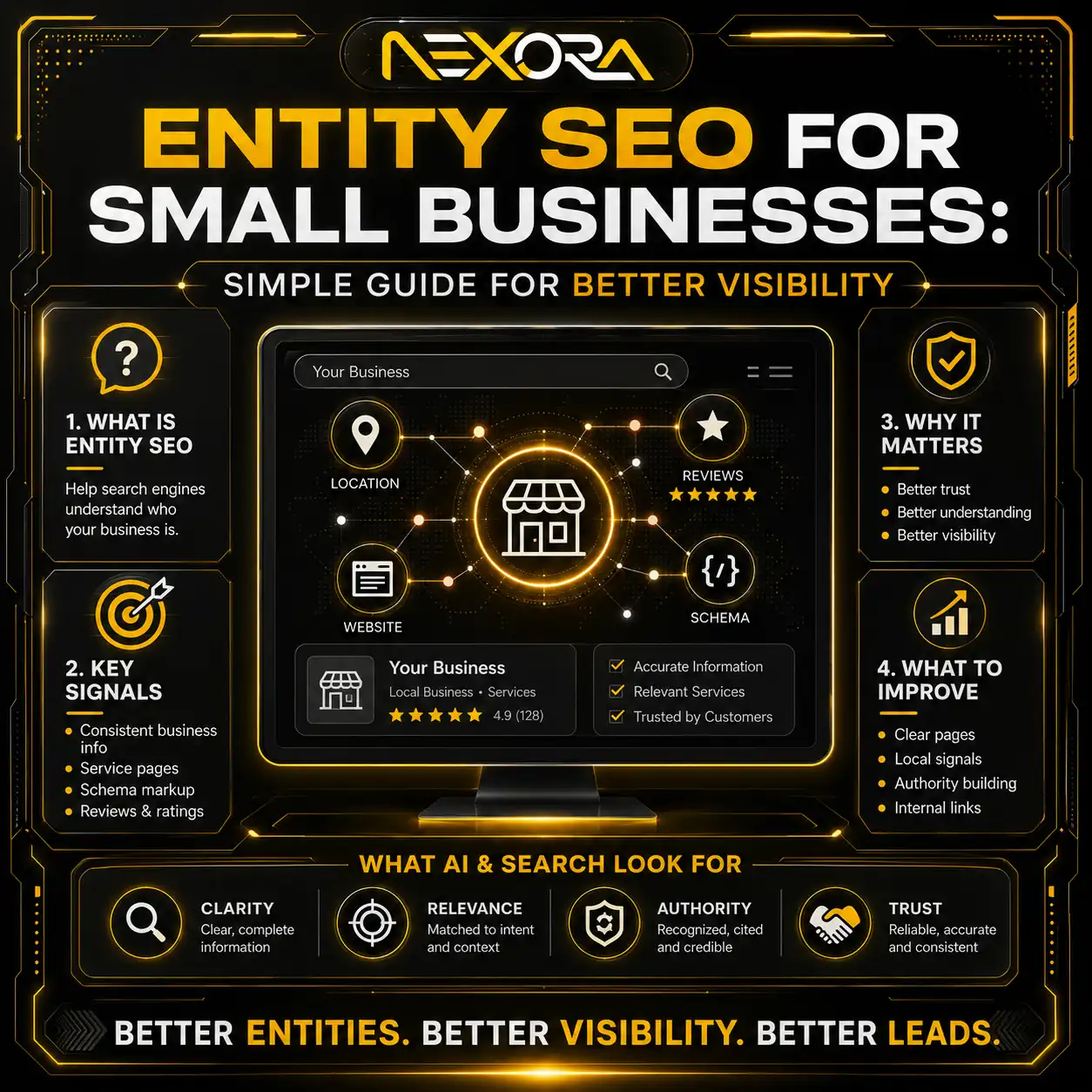
Entity SEO helps search engines and AI-powered systems understand exactly who a business is, what it offers, where it operates, and how it relates to relevant services, people, locations, and topics.
For small businesses, this does not require building a complicated knowledge graph or becoming a structured-data expert.
It begins with making the business consistent and verifiable across:
- Its website
- Google Business Profile
- Important service pages
- About and contact information
- Structured data
- Review platforms
- Business directories
- Industry websites
- Social and professional profiles
A local roofing company should be clearly identifiable as:
- A real company
- Providing roof repair and replacement
- Serving genuine locations
- Supported by customer reviews
- Connected to relevant people, projects, and industry sources
A digital agency should make equally clear:
- Its official business name
- Its primary service categories
- The industries it serves
- The people or team responsible
- The pages that explain each service
- The external sources that confirm its existence and expertise
Google states that Organization structured data can help it understand administrative details about a company and distinguish that organization from others. Google also uses information from homepages, structured data, Business Profiles, public web sources, and references across the web to understand official business details.
At Nexora Creation, we treat entity SEO as a layer of clarity and trust built on top of normal SEO.
It does not replace keywords, technical SEO, service pages, local SEO, reviews, or backlinks.
It connects those elements into one consistent picture of the business.
What is entity SEO?
Entity SEO is the process of helping search systems identify a specific business, person, place, service, product, or concept as a distinct thing and understand its relationships with other things.
An entity may be:
- A company
- A founder
- A service
- A city
- A product
- A professional
- An organization
- A topic
For example, “Nexora Creation” may be understood as an organization.
That organization may be connected to:
- Website development
- Search engine optimization
- Local SEO
- CRM automation
- AI voice agents
- Service businesses
- Its official website
- Its team
- Its public business profiles
Entity SEO tries to make those connections clear and consistent.
It is less about repeating the company name and more about giving search systems reliable information they can associate with the correct business.
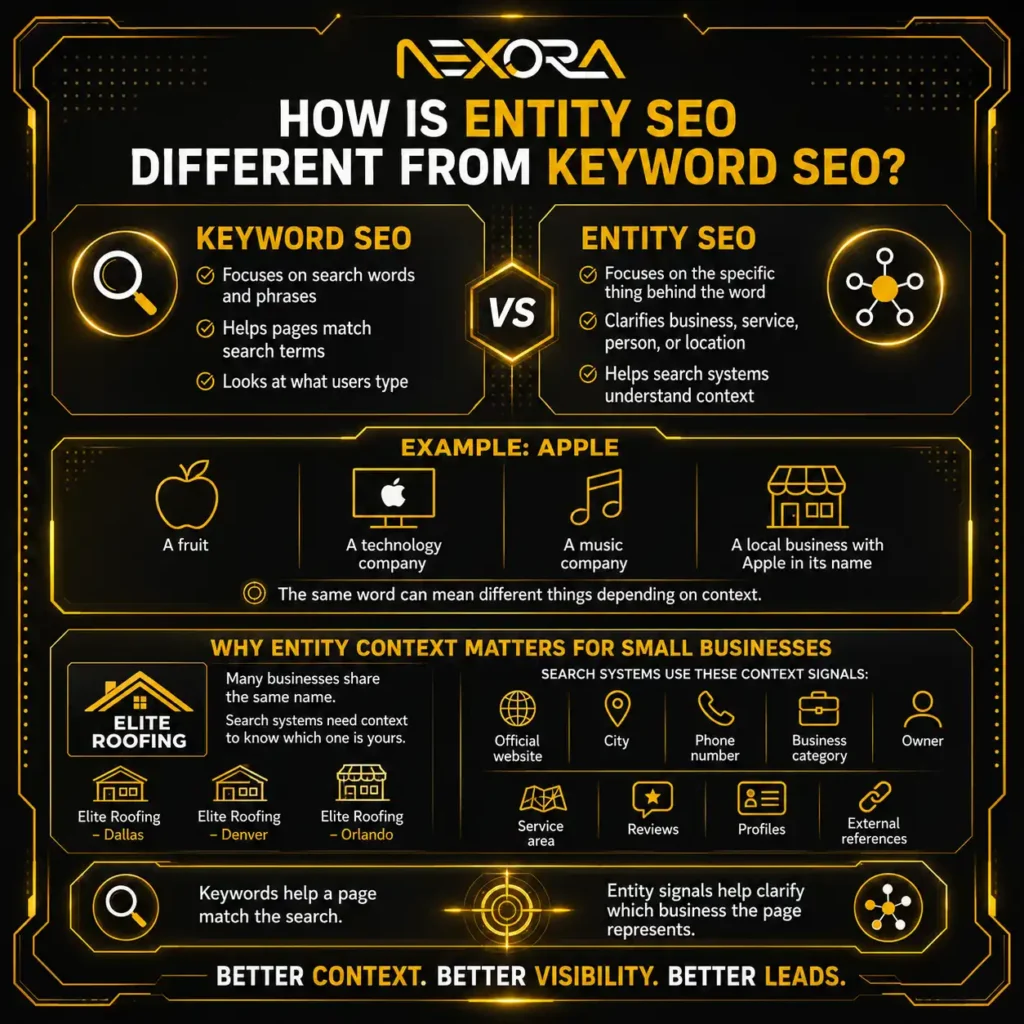
How is entity SEO different from keyword SEO?
Keyword SEO focuses on the words people use when searching.
Entity SEO focuses on the identifiable things those words refer to.
Consider the term:
Apple
Depending on context, it may refer to:
- A fruit
- A technology company
- A music company
- A local business with Apple in its name
A keyword-based system sees the same word.
An entity-aware system tries to determine which specific thing the user means.
The same principle applies to small businesses.
A company called “Elite Roofing” may share its name with several unrelated companies.
Search systems need context such as:
- Official website
- City
- Phone number
- Business category
- Owner
- Service area
- Reviews
- Profiles
- External references
Keywords help a page match the search.
Entity signals help clarify which business, service, person, or location the page represents.
Does entity SEO replace normal SEO?
No.
Entity SEO cannot compensate for a website that is:
- Blocked from crawling
- Excluded from indexing
- Missing service pages
- Slow or broken on mobile
- Thin on useful content
- Poorly linked
- Inconsistent with its Business Profile
- Unsupported by real customer evidence
Google says standard SEO best practices remain relevant for AI Overviews and AI Mode. Pages still need to be crawlable, indexed, useful, internally linked, and eligible to appear in normal Search. Google does not require special AI markup or a unique entity shortcut for these features.
A sensible order is:
- Fix technical accessibility.
- Clarify the website structure.
- Build dedicated service pages.
- Correct local business information.
- Add accurate structured data.
- Strengthen external confirmation.
- Monitor visibility and leads.
Entity SEO works best when the business already has a solid search foundation.
Why does entity SEO matter for small businesses?
Small businesses often have limited authority compared with national brands.
However, they may have stronger:
- Local relevance
- Real customer relationships
- Specialist expertise
- Service-area knowledge
- First-hand experience
- Community connections
Entity SEO helps make those strengths easier to understand.
It can support clarity around:
- The official business identity
- Services offered
- Locations served
- Team or ownership
- Industry specialization
- Customer reputation
- Relationships with relevant organizations
This can improve the wider foundation for:
- Branded searches
- Local results
- Knowledge-style search features
- AI-generated answers
- Business recommendations
- Customer trust
It does not guarantee that Google or an AI platform will recommend the business.
It makes the business easier to identify and verify.
What makes a business a clear entity online?
A clear business entity normally has consistency across several layers.
Website identity
The website clearly states:
- Official name
- Business type
- Services
- Target customers
- Service area
- Contact information
Structured identity
Relevant structured data describes:
- Organization
- Local business
- Logo
- URL
- Contact details
- Profiles
- Address where applicable
Platform identity
Important public profiles use consistent information.
Examples include:
- Google Business Profile
- Bing Places
- Relevant directories
- Review platforms
- Industry associations
Independent confirmation
External sources mention or verify the business.
Examples include:
- Customer reviews
- Local news
- Supplier directories
- Professional memberships
- Partner pages
- Industry publications
No single layer guarantees authority.
Together, they create a clearer picture.
What should the homepage say about the business?
The homepage should provide a clear entity statement near the beginning.
A visitor and search system should quickly understand:
- Business name
- Main category
- Core services
- Intended customer
- Geographic or industry focus
- Main action
Weak homepage copy:
Modern Solutions for a Better Future
This does not identify the company or service.
Stronger copy:
SEO, Website Development, and AI Automation for Service Businesses
Supporting text:
“Nexora Creation helps HVAC, roofing, pool service, contractor, and professional-service companies improve search visibility, website conversion, lead tracking, and customer communication.”
This statement establishes:
- Organization name
- Service categories
- Target customers
- Business purpose
The homepage can then link to dedicated pages for each service.
Why do dedicated service pages matter for entity SEO?
Dedicated service pages clarify the relationship between the company and each major service.
Suppose a company lists these services on one page:
- SEO
- Website Development
- CRM
- AI Chatbots
- UI/UX Design
If each receives only a sentence, search systems have little context about:
- What the service includes
- Who needs it
- How it works
- What makes the provider relevant
- Which customer questions it answers
A dedicated CRM Automation page can explain:
- Lead capture
- Follow-up workflows
- Pipeline stages
- Appointment reminders
- Source attribution
- Integrations
- Limitations
That page strengthens the relationship:
Business → CRM Automation
Supporting articles and case studies can strengthen it further.
Should service pages use the same business description?
The core identity should remain consistent, but every page should not repeat the exact same paragraph.
Use a stable organization description across major identity surfaces.
Then adapt the service context.
Example organization statement:
“Nexora Creation is a digital growth agency serving local and service-based businesses.”
Example service-page statement:
“Nexora Creation provides technical and local SEO services that help service businesses improve crawlability, service-page relevance, local visibility, and qualified lead tracking.”
The organization remains the same.
The page adds a specific service relationship.
How important is the About page?
The About page helps search systems and customers understand who stands behind the organization.
It should include accurate information about:
- Business history
- Leadership or team
- Roles
- Experience
- Industries served
- Operating approach
- Credentials
- Contact details
Avoid generic statements such as:
- We are passionate about success.
- We believe in innovation.
- We always put customers first.
Add details that can be understood and verified.
For example:
- Types of businesses supported
- Areas of technical expertise
- Named team roles
- Real processes
- Relevant certifications
- Professional profiles
A strong About page also helps distinguish the business from similarly named companies.
Should small businesses identify authors and experts?
Yes, particularly for informational content that offers professional advice.
Useful author or reviewer information may include:
- Name
- Role
- Expertise
- Experience
- Professional profile
- Articles reviewed
- Relevant credentials
For team-created content, a valid attribution may be:
“Reviewed by the Nexora Creation SEO and Web Strategy Team.”
Do not create fake experts or exaggerated biographies.
The purpose is accountability.
A reader should be able to understand who created or reviewed the information and why their perspective is relevant.
What business information should remain consistent?
Keep the following stable across important platforms:
- Official business name
- Website URL
- Phone number
- Address where applicable
- Service area
- Business category
- Logo
- Core service description
- Opening hours
- Social profiles
Inconsistencies that should be corrected include:
- Old phone numbers
- Different business names
- Outdated addresses
- Incorrect websites
- Conflicting opening hours
- Services listed in one place but not offered anymore
Google says public web content can contribute to Business Profile information, making website accuracy especially important.
Consistency does not mean every description must be word-for-word identical.
It means the facts should not conflict.
How does Google Business Profile support entity SEO?
Google Business Profile helps define a local business through structured and visible information such as:
- Name
- Category
- Address or service area
- Phone number
- Hours
- Services
- Photos
- Reviews
- Website
For local searches, Google says results are mainly influenced by relevance, distance, and prominence. Complete and accurate business information can help Google match a company with relevant searches.
The profile should match the website.
For example, the website should not claim:
- Additional locations that do not exist
- Unsupported service areas
- Different opening hours
- Services not listed or offered
- A different company name
Do not add keywords to the official business name unless they are genuinely part of it.
Are name, address, and phone citations still important?
Accurate business listings still matter, especially for local companies.
They help customers and platforms confirm basic facts such as:
- Identity
- Location
- Contact information
- Business category
However, small businesses do not need hundreds of low-quality directory listings.
Prioritize:
- Google Business Profile
- Bing Places
- Relevant local directories
- Industry directories
- Professional associations
- Chamber listings
- Important review platforms
Correct inaccurate listings before creating many new ones.
A smaller number of accurate, relevant sources is better than a large collection of weak or outdated profiles.
What is Organization schema?
Organization schema is structured data that provides machine-readable information about an organization.
Google says adding Organization structured data to the homepage can help it understand administrative details and disambiguate the organization in search results.
Useful properties may include:
- Name
- URL
- Logo
- Description
- Telephone
- Address
- Contact point
- Relevant identifiers
- Official profiles
Only include accurate information.
The markup should match what users can verify through the website.
What is LocalBusiness schema?
LocalBusiness structured data describes a local business and can provide information such as:
- Business type
- Address
- Phone number
- Opening hours
- URL
- Geographic details
Google explains that LocalBusiness markup can communicate details such as opening hours and business information.
Use the most accurate business subtype available.
A service-area business should not create fake LocalBusiness entities for every city page.
If one company serves several cities from one genuine location, the structured data should represent the real business rather than invented branches.
Does every service need Service schema?
Service schema can describe an actual service, but markup alone will not create entity authority or AI visibility.
First ensure the visible page clearly explains:
- Service name
- Provider
- Customer
- Scope
- Area served
- Deliverables
Then structured data may reinforce the information where appropriate.
Do not add Service schema for:
- Services not provided
- Thin pages
- Keyword variations
- Fake location combinations
- Hidden offers
Schema should clarify strong content.
It should not attempt to manufacture a business-service relationship that the page does not establish.
Does schema guarantee better rankings or AI mentions?
No.
Structured data helps search systems understand information, but it does not guarantee:
- Better organic rankings
- A Knowledge Panel
- Rich results
- AI citations
- ChatGPT recommendations
- Local pack visibility
Google’s structured-data guidance says markup should accurately represent visible content and must not mislead users or impersonate entities.
Schema is one part of entity clarity.
It must work alongside:
- Useful pages
- Consistent profiles
- External mentions
- Reviews
- Technical SEO
- Strong internal linking
What are sameAs links?
The sameAs property can connect an organization or person to official profiles or reference pages representing the same entity.
Potential links may include:
- LinkedIn company profile
- Official social profiles
- Relevant entity reference pages
- Verified business profiles where technically appropriate
Do not add every directory listing.
Use profiles that clearly and officially represent the same organization.
The purpose is disambiguation, not link building.
Every linked profile should be:
- Accurate
- Current
- Controlled or genuinely representative
- Consistent with the website
AI Voice Agent & Chatbot Services
Does a small business need Wikidata?
Usually not.
Wikidata can be useful for notable entities with sufficient independent and verifiable information, but it is not a basic requirement for small-business SEO.
A local plumber, roofer, clinic, or pool company does not need to create a Wikidata entry simply to improve rankings.
Creating an unsupported or promotional entry may lead to removal and does not guarantee:
- Knowledge Graph inclusion
- A Knowledge Panel
- AI recommendations
- Higher rankings
Focus first on:
- Clear website identity
- Google Business Profile
- Strong service pages
- Accurate Organization or LocalBusiness schema
- Genuine reviews
- Relevant directories
- Independent mentions
Wikidata may become appropriate when a business or founder has real notability and reliable independent sourcing.
Does a business need a Wikipedia page?
No.
Most small businesses will not meet Wikipedia’s notability requirements.
A Wikipedia page is not a normal SEO deliverable and should not be created as promotional content.
Do not:
- Write an undisclosed article about your own business
- Pay someone to create unsupported coverage
- Use weak sources to manufacture notability
- Treat Wikipedia as a ranking shortcut
Build real visibility first through:
- Industry contributions
- Local news
- Original research
- Community impact
- Professional recognition
- Independent editorial coverage
A Wikipedia page should be the result of genuine notability, not the starting point of entity SEO.
What are independent entity signals?
Independent entity signals are references or confirmations from sources outside the company’s own website.
Examples include:
- Customer reviews
- News coverage
- Professional directories
- Industry memberships
- Partner pages
- Supplier profiles
- Conference listings
- Podcast appearances
- Expert quotations
- Client case studies on external websites
These sources can support claims that:
- The business exists
- It operates in a particular category
- It serves real customers
- It has relevant experience
- It is associated with a topic or location
Not every mention has equal value.
A relevant industry publication generally provides more useful confirmation than an unrelated directory created only for SEO listings.
Are unlinked brand mentions valuable?
An unlinked mention may support awareness, reputation, and entity association, even though it does not pass link value in the same way as a backlink.
For example, a local publication might mention:
“Nexora Creation provided website strategy for a local service-business initiative.”
This can reinforce the relationship between:
- Brand
- Website strategy
- Service businesses
However, do not treat every mention as a confirmed ranking signal.
The business value may come from:
- Recognition
- Referral traffic elsewhere
- Trust
- Branded searches
- Future links
- Wider entity corroboration
Where appropriate, a relevant editorial link is still useful.
Do backlinks still matter in entity SEO?
Yes.
Backlinks can support:
- Discovery
- Page authority
- Brand verification
- Referral traffic
- Topic association
Good links often come from:
- Industry publications
- Local news
- Business partners
- Professional associations
- Supplier directories
- Original research citations
- Community organizations
Avoid:
- Bulk link packages
- Private blog networks
- Irrelevant foreign directories
- Paid links disguised as editorial coverage
- Automated guest-post networks
Entity SEO is not an alternative to link building.
It encourages link earning that also confirms who the business is and what it is known for.
How do customer reviews support entity visibility?
Reviews provide public evidence of customer experience.
Useful review patterns may clarify:
- Service received
- Business location
- Reliability
- Communication
- Outcome
- Professionalism
Google says review count and positive ratings can contribute to local prominence.
Ask customers for honest feedback.
Do not ask them to:
- Include forced keywords
- Mention a city unnaturally
- Copy prepared text
- Leave only positive feedback
- Post fake reviews
A genuine detailed review is more useful than a generic artificial testimonial.
Should reviews be added to service pages?
Relevant reviews should appear on the service pages they support.
For example:
- Roof repair review → Roof Repair page
- Weekly cleaning review → Pool Maintenance page
- CRM implementation review → CRM Automation page
- Website redesign review → Website Development page
Do not place the same testimonial on every page.
Service-specific proof strengthens the relationship between:
- Business
- Service
- Customer experience
Where possible, keep review wording accurate and obtain permission before publishing customer details.
What role do internal links play?
Internal links help explain the relationships inside the website.
A clear structure may include:
- Homepage → Services hub
- Services hub → Dedicated service page
- Service page → Related case study
- Blog article → Relevant service
- Industry page → Applicable solution
- About page → Team profile
- Location page → Available service
Use descriptive anchors.
Better:
- Local SEO services
- CRM automation for lead follow-up
- AI voice agent implementation
- Website development for service businesses
Weaker:
- Click here
- Learn more
- Read more
Internal links help both users and search systems understand how topics and entities connect.
How should a topic cluster support entity SEO?
A topic cluster strengthens the association between a business and an area of expertise.
For example, an AI search optimization cluster may include:
- How Small Businesses Can Appear in AI Search
- AI Search Optimization Checklist
- GEO vs Traditional SEO
- How to Structure Content for AI Answers
- Why Clear Service Pages Matter in AI Search
- Entity SEO for Small Businesses
Each article should answer a distinct question.
They should link to:
- The pillar page
- Relevant supporting content
- The appropriate service page
This creates a consistent association:
Nexora Creation → SEO → AI Search Visibility → Service Businesses
Avoid publishing many overlapping posts that repeat the same entity SEO definition.
Depth comes from answering connected questions, not duplicating content.
How does local entity SEO differ from general entity SEO?
Local entity SEO places stronger emphasis on geographic accuracy and customer proximity.
Important elements include:
- Google Business Profile
- Real address or service area
- Local phone number
- Local reviews
- Priority city pages
- Local projects
- Relevant directories
- Local links and mentions
Google’s local systems evaluate relevance, distance, and prominence.
A company cannot eliminate distance merely by adding city names to pages.
Do not create:
- Fake offices
- Virtual locations that do not meet platform rules
- Invented local staff
- False schema locations
- Duplicate city pages
Entity accuracy matters more than geographic keyword volume.
How should service areas be represented?
Service-area businesses should clearly state the locations they genuinely serve.
The website may include:
- Main service region
- Priority cities
- ZIP codes where useful
- Route or travel limitations
- Remote service availability
Example:
“Weekly pool service is available across selected Scottsdale, Tempe, Paradise Valley, and North Phoenix routes.”
The Google Business Profile should use accurate service areas.
The website should not claim national or statewide coverage when the company only serves a limited radius.
Accurate boundaries improve trust and lead quality.
Does social media help entity SEO?
Social profiles can support entity consistency and public recognition, but posting frequently is not automatically a ranking tactic.
Useful profiles should contain:
- Correct business name
- Website
- Logo
- Service description
- Location or service area
- Current contact information
Prioritize platforms relevant to the business.
Examples:
- LinkedIn for B2B services
- Instagram for visual local businesses
- YouTube for demonstrations and educational content
- Facebook for local communities
Do not create inactive profiles on every platform merely to produce sameAs links.
A smaller set of maintained profiles is more credible.
How important is LinkedIn for founders and agencies?
LinkedIn can help clarify professional relationships such as:
- Person → Organization
- Person → Role
- Organization → Industry
- Person → Expertise
A founder or specialist profile should accurately state:
- Current role
- Company
- Areas of work
- Professional history
- Website
The company page should link to the official website and use consistent branding.
LinkedIn does not replace:
- An About page
- Real author profiles
- Independent evidence
- Service content
It is one supporting identity surface.
UI/UX Design Services
Can AI systems use entity information?
AI-powered search and answer systems may use web retrieval, search indexes, structured information, and public sources to identify companies and topics.
Clear entity information can help make a business easier to:
- Identify
- Distinguish
- Associate with services
- Connect to public profiles
- Verify against other sources
However, no business can guarantee a mention in:
- Google AI Overviews
- Google AI Mode
- ChatGPT
- Copilot
- Perplexity
- Other AI platforms
Google says normal SEO best practices remain the foundation for its AI features.
Entity clarity improves eligibility and understanding.
It does not create guaranteed placement.
Does entity SEO require an llms.txt file?
No universal search or AI platform requires an llms.txt file for entity visibility.
Such files may be experimental or useful within particular workflows, but they do not replace:
- Crawlability
- Indexing
- Business profiles
- Service pages
- Structured data
- Reviews
- External mentions
Google explicitly says no new AI file is required for its AI search features.
Small businesses should not prioritize experimental files while important pages remain unclear or inaccessible.
What entity SEO myths should small businesses avoid?
Myth: Keywords no longer matter
Keywords still reveal customer language, demand, and search intent.
Myth: Schema creates authority
Schema describes information. It does not prove expertise or reputation.
Myth: Every business needs Wikidata
Most local small businesses do not need or qualify for it.
Myth: A Knowledge Panel can be guaranteed
No legitimate provider can guarantee one.
Myth: Directory quantity creates trust
Relevant and accurate listings matter more than volume.
Myth: Brand mentions automatically improve rankings
Mentions may support recognition and corroboration, but they are not a simple guaranteed ranking input.
Myth: Entity SEO replaces links and content
It relies on strong content, profiles, evidence, and external confirmation.
Myth: AI recommendations can be engineered with one markup change
AI platforms use different systems, sources, and retrieval methods. No single implementation guarantees recommendations.
How can small businesses audit entity consistency?
Create a simple spreadsheet with these columns:
- Platform
- Business name
- Website
- Phone
- Address
- Category
- Description
- Logo
- Status
- Correction needed
Review:
- Homepage
- About page
- Contact page
- Google Business Profile
- Bing Places
- Important directories
- Review sites
- Industry profiles
Look for:
- Old details
- Spelling variations
- Former domains
- Duplicate profiles
- Incorrect categories
- Unsupported claims
Fix the most visible and authoritative sources first.
How can a business check what Google understands?
Search for:
- Exact business name
- Business name plus city
- Business name plus service
- Founder name plus company
- Main service plus brand name
Review:
- Which website appears
- Whether the correct profile appears
- Whether another company is confused with the brand
- Which services are associated with the business
- Whether old information appears
- Whether important pages are indexed
Use Google Search Console to check:
- Branded queries
- Service queries
- Indexed pages
- Search appearance
- Page performance
Do not use one search result as the only measure of entity strength.
How should entity SEO performance be measured?
Measure several levels.
Identity visibility
- Branded search impressions
- Correct business information
- Site-name consistency
- Brand-result coverage
- Knowledge-style features where available
Service association
- Business plus service queries
- Service-page rankings
- Non-branded service impressions
- Local search visibility
- AI mentions where observable
Authority
- Relevant backlinks
- Editorial mentions
- Reviews
- Directory accuracy
- Industry references
Business outcomes
- Calls
- Forms
- Qualified leads
- Appointments
- Sales
- Revenue
Entity work should not be judged only by whether a Knowledge Panel appears.
The real objective is improved discoverability, trust, and customer acquisition.
How can CRM attribution support entity SEO measurement?
A CRM can help identify whether branded and service visibility produces real business outcomes.
Capture:
- Source
- Landing page
- Branded or non-branded search
- Service requested
- Location
- Qualified status
- Appointment
- Proposal
- Customer
- Revenue
Example:
- Source: Google Organic
- Query type: Branded
- Landing page: Local SEO Services
- Service: Local SEO
- Status: Qualified
- Outcome: Consultation booked
This helps show whether increased recognition becomes commercial value.
What should a small business improve first?
Phase 1: Clarify the identity
- Select one official business name
- Define the main business category
- Clarify primary services
- Correct website contact information
- Improve homepage positioning
- Strengthen the About page
Phase 2: Build service relationships
- Create dedicated service pages
- Add descriptive internal links
- Publish relevant case studies
- Add service-specific reviews
- Build focused topic clusters
Phase 3: Align external profiles
- Optimize Google Business Profile
- Claim Bing Places
- Correct important directories
- Update LinkedIn and social profiles
- Remove duplicate or outdated listings
Phase 4: Add structured data
- Add Organization or LocalBusiness schema
- Include accurate official properties
- Connect legitimate profiles
- Validate markup
- Remove misleading data
Phase 5: Build independent confirmation
- Earn customer reviews
- Join relevant associations
- Develop local partnerships
- Contribute expert commentary
- Earn editorial mentions
- Publish original resources
Phase 6: Measure outcomes
- Track branded searches
- Monitor service visibility
- Review external mentions
- Track calls and forms
- Connect leads to CRM
- Measure revenue
What is the entity SEO checklist?
Business identity
- One official name
- Clear category
- Consistent logo
- Correct URL
- Current phone
- Accurate address or service area
Website
- Clear homepage
- Strong About page
- Complete contact page
- Dedicated service pages
- Real team or leadership information
- Descriptive internal links
Structured data
- Organization or LocalBusiness
- Accurate name and URL
- Correct logo
- Genuine contact information
- Appropriate official-profile links
- Validated implementation
Local presence
- Google Business Profile complete
- Bing Places claimed
- Categories accurate
- Service areas genuine
- Hours updated
- Reviews collected
External confirmation
- Relevant directories
- Industry profiles
- Professional memberships
- Partner mentions
- Editorial references
- Customer reviews
Content
- Clear expertise topics
- Distinct content clusters
- First-hand examples
- Case studies
- Reliable sources
- Named authors or reviewers
Measurement
- Branded queries tracked
- Service queries tracked
- Profiles audited
- Backlinks reviewed
- Leads qualified
- CRM attribution enabled
Website Development Services
How can Nexora Creation help with entity SEO?
Nexora Creation helps small and service-based businesses clarify their identity, services, expertise, and public presence across traditional and AI-powered search.
Our work can include:
- Entity consistency audit
- Homepage positioning
- Service-page architecture
- About-page strategy
- Organization and LocalBusiness schema
- Google Business Profile optimization
- Local SEO
- Citation cleanup
- Topic-cluster planning
- Internal linking
- Case-study development
- Review strategy
- AI search readiness
- Conversion and CRM tracking
The objective is not to manufacture a digital identity through fake listings or unsupported markup.
The objective is to make the real business easier to discover, distinguish, verify, trust, and contact.
Conclusion
Entity SEO helps small businesses communicate a consistent and verifiable identity across their website and the wider web.
It connects:
- Business name
- Services
- Team
- Location
- Website
- Profiles
- Reviews
- Content
- External mentions
It does not replace traditional SEO.
A business still needs:
- Crawlable pages
- Strong service content
- Local optimization
- Accurate profiles
- Internal links
- Reviews
- Backlinks
- Useful customer experiences
The most important first step is clarity.
Use one official identity.
Explain each major service.
Keep public information accurate.
Support claims with real evidence.
Add structured data that matches the visible website.
Build independent recognition through genuine customers, partners, directories, and publications.
When those elements reinforce one another, search engines, AI systems, and customers have a clearer basis for understanding who the business is and why it is relevant.
FAQs
What is entity SEO in simple terms?
Entity SEO helps search systems understand that a specific business, person, service, or location is a distinct and verifiable thing with clear relationships to other topics and sources.
Is entity SEO different from normal SEO?
Yes, but they work together. Normal SEO improves pages and rankings, while entity SEO strengthens identity, relationships, consistency, and external confirmation.
Does a small business need Organization schema?
Organization schema can help Google understand official business details. Local companies may use an appropriate LocalBusiness subtype instead or alongside relevant organization information.
Does entity SEO require Wikidata?
No. Most small businesses should prioritize their website, Business Profile, service pages, schema, reviews, and relevant external profiles first.
Can entity SEO create a Google Knowledge Panel?
It may strengthen the information Google can use, but no implementation can guarantee a Knowledge Panel.
Are backlinks part of entity SEO?
Yes. Relevant backlinks and editorial mentions can confirm the business’s identity, expertise, location, or relationship with a topic.
How long does entity SEO take?
There is no fixed timeline. Correcting website and profile information may happen quickly, while building meaningful reviews, authority, and independent mentions takes longer.
How should entity SEO success be measured?
Track branded searches, service associations, local visibility, accurate business information, external mentions, qualified leads, customers, and revenue.