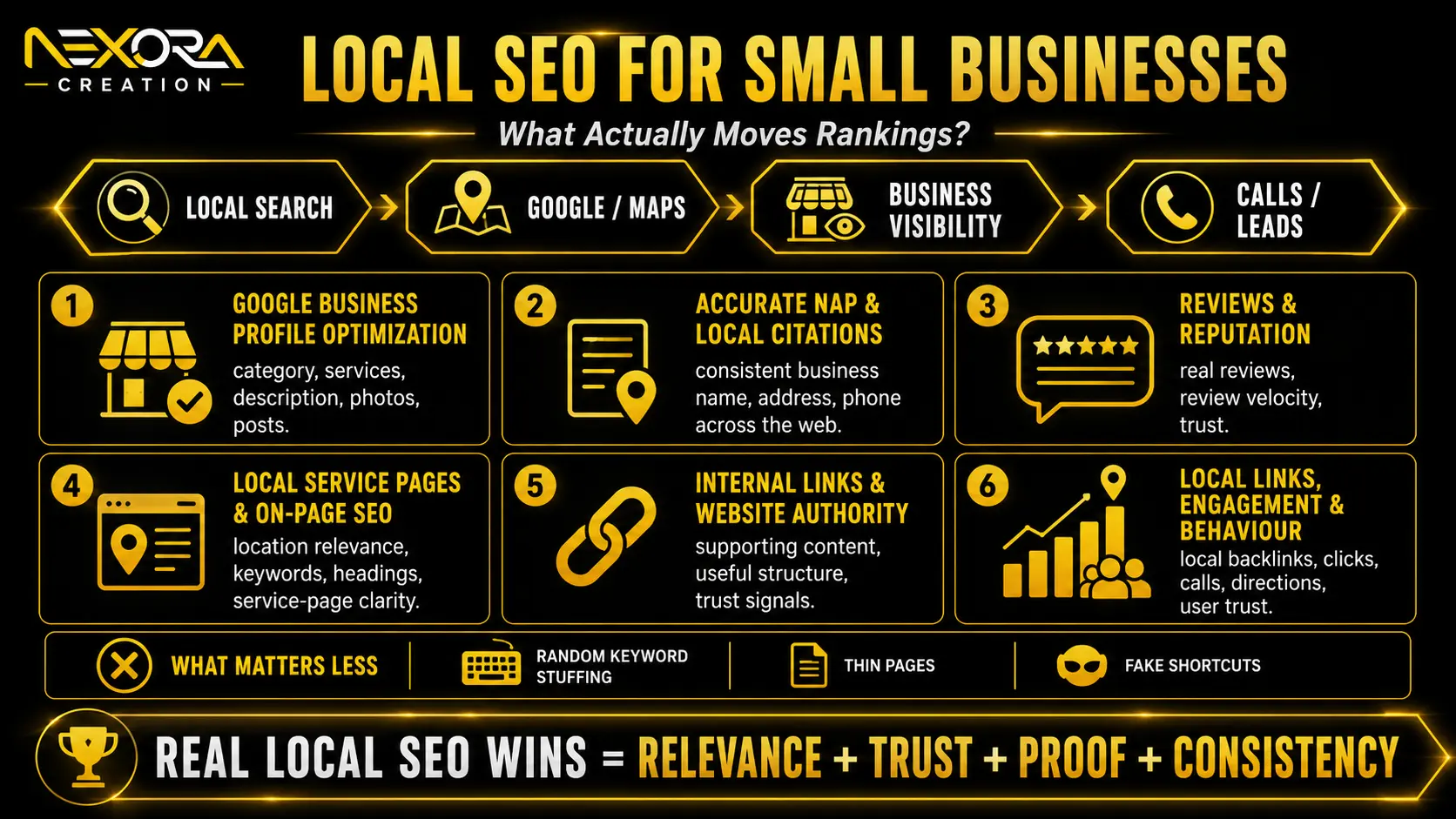
Local SEO for small businesses works when your business becomes more relevant, trustworthy, visible, and easy to choose in your local market.
The simple answer is this:
Local SEO rankings are mainly influenced by relevance, distance, and prominence. But in practical terms, the things that actually move rankings include a complete Google Business Profile, correct business categories, strong reviews, clear service pages, local website content, consistent business information, local backlinks, user engagement, and a website that converts visitors into leads.
For small businesses, local SEO is not only about appearing on Google.
It is about appearing when nearby customers are ready to call, visit, book, or request a quote.
A local customer may search for:
- Plumber near me
- Roofing company in Tampa
- Dentist in Multan
- HVAC repair near me
- Cleaning service in Dallas
- Local SEO agency
- Web design company near me
If your business does not appear in those local searches, your competitors may get the lead.
At Nexora Creation, we see local SEO as a complete visibility and lead-generation system. A Google Business Profile alone is not enough. Your website, reviews, service pages, local content, tracking, and follow-up process all need to work together.
In this guide, we will explain what actually moves local SEO rankings for small businesses and what you should focus on first.
What is local SEO?
Local SEO is the process of improving your online presence so your business can appear for location-based searches.
It helps your business show up when people search for services near them or in a specific city.
Local SEO can help you appear in:
- Google Maps
- Google Local Pack
- Local organic results
- Google Business Profile results
- Near me searches
- Service area searches
- Location-based AI answers
- Review-based discovery
For example, if someone searches:
“emergency plumber near me”
Google tries to show businesses that are relevant to the search, close enough to the searcher, and prominent enough to trust.
Local SEO is important for businesses that serve customers in a specific area.
This includes:
- Roofing companies
- HVAC companies
- Plumbers
- Electricians
- Dentists
- Clinics
- Law firms
- Cleaning companies
- Landscapers
- Restaurants
- Gyms
- Local agencies
- Home service businesses
- Real estate businesses
Local SEO helps these businesses get discovered by people who are already looking for their services.
Relevant Blog : Roofing SEO in Dallas: How Storm Damage Pages Bring Better Leads
What actually moves local SEO rankings?
The things that actually move local SEO rankings are the signals that help Google understand what your business does, where it operates, and why it should be trusted.
The most important areas include:
- Google Business Profile optimization
- Primary and secondary categories
- Accurate business information
- Service and product details
- Reviews and review responses
- Local website service pages
- Location relevance
- Local content
- Consistent citations
- Local backlinks
- Website authority
- On-page SEO
- Internal linking
- User engagement
- Mobile experience
- Conversion signals
- Business prominence
There is no single magic trick.
Local SEO improves when many small signals become stronger together.
A complete profile helps relevance.
Reviews help prominence.
Service pages help Google understand your services.
Local content helps connect your website to your area.
A fast and clear website helps users convert.
That is why local SEO should be treated as a system, not a one-time setup.
How does Google decide local rankings?
Google explains local rankings through three main factors:
- Relevance
- Distance
- Prominence
Relevance
Relevance means how well your business matches what someone is searching for.
For example, if someone searches “emergency roof repair,” Google needs to understand whether your business actually provides emergency roof repair.
Relevance is influenced by:
- Business category
- Business description
- Services
- Website content
- Reviews
- Posts
- Photos
- Local landing pages
- Keywords used naturally on your website
Distance
Distance means how close your business is to the searcher or the location mentioned in the search.
For example, if someone searches “dentist near me,” Google considers where the person is searching from.
You cannot fully control distance.
But you can clearly show your service areas, address, city, and local coverage.
Prominence
Prominence means how well-known and trusted your business appears online and offline.
Prominence can be influenced by:
- Reviews
- Ratings
- Backlinks
- Citations
- Brand mentions
- Website authority
- Local reputation
- Press mentions
- Direct searches
- Business activity
A business that is relevant, close enough, and prominent has a better chance of ranking locally.
Does Google Business Profile still matter?
Yes, Google Business Profile still matters a lot for local SEO.
For many small businesses, Google Business Profile is one of the most important local visibility assets.
A complete profile can help customers:
- Find your business
- Call you
- Get directions
- Visit your website
- Read reviews
- View photos
- Check services
- See opening hours
- Ask questions
- Request appointments
- Compare you with competitors
A weak or incomplete profile can reduce trust and visibility.
Your Google Business Profile should include:
- Correct business name
- Accurate category
- Address or service area
- Phone number
- Website link
- Business hours
- Services
- Products, if relevant
- Photos
- Business description
- Appointment link
- Reviews
- Updates or posts
- Questions and answers
Small businesses should not create a profile and forget it.
A profile should be maintained like a local landing page.
What Google Business Profile fields matter most?
The most important Google Business Profile fields are the ones that help customers and Google understand your business clearly.
Focus on:
1. Primary category
Your primary category should match your main service.
For example:
- Roofing contractor
- Dentist
- HVAC contractor
- Plumber
- Law firm
- Cleaning service
- Website designer
- Marketing agency
Do not choose a broad category if a more specific one fits better.
2. Secondary categories
Secondary categories help cover related services.
For example, an HVAC company may add categories related to heating, air conditioning, or repair services where relevant.
3. Business name
Use your real business name.
Do not stuff keywords into the business name if they are not part of your official name.
4. Services
Add your actual services clearly.
For example:
- Roof repair
- Roof replacement
- Emergency roof leak repair
- Roof inspection
5. Business hours
Keep hours accurate.
Wrong hours can frustrate customers and reduce trust.
6. Photos
Use real photos of your team, projects, office, vehicles, products, or work.
Real photos usually build more trust than generic stock images.
7. Website link
Link to the most relevant page.
For some businesses, the homepage is fine.
For others, a local service page or booking page may be better.
Do reviews help local SEO rankings?
Yes, reviews can help local SEO because they influence trust, prominence, and customer decisions.
Reviews matter because local customers often compare businesses before contacting one.
They look at:
- Star rating
- Number of reviews
- Review freshness
- Review detail
- Owner responses
- Keywords in reviews
- Service mentions
- Location mentions
- Overall sentiment
For example, a review that says:
“They repaired our roof leak in Tampa the same day and explained everything clearly.”
is more useful than:
“Great service.”
Detailed reviews help future customers understand what the business actually did.
How should small businesses improve reviews?
Small businesses should:
- Ask happy customers for reviews
- Make the review process easy
- Respond to reviews professionally
- Thank customers for positive reviews
- Address negative reviews calmly
- Never buy fake reviews
- Never review-gate customers
- Encourage specific, honest feedback
- Keep reviews consistent over time
Reviews are not only ranking signals.
They are conversion signals.
A business with strong reviews may get more calls even if it ranks near competitors.
Does responding to reviews matter?
Yes, responding to reviews matters because it shows that your business is active and cares about customers.
Review responses can improve trust.
A good response should be:
- Short
- Professional
- Specific
- Friendly
- Natural
- Not keyword-stuffed
Example:
“Thank you for trusting us with your roof repair. We are glad our team could help quickly and explain the process clearly.”
Avoid robotic responses like:
“Thank you for your review.”
Also avoid stuffing keywords like:
“Thank you for choosing our best roof repair company in Tampa for emergency roof repair services.”
That feels unnatural.
Responding to reviews helps potential customers see how your business communicates.
Do local service pages move rankings?
Yes, local service pages can move rankings when they are useful, specific, and connected to real services.
Many small businesses rely only on a homepage.
That is usually not enough.
If you offer multiple services, each important service should have its own clear page.
For example, a roofing company may need pages like:
- Roof Repair Services
- Roof Replacement Services
- Emergency Roof Leak Repair
- Roof Inspection Services
- Commercial Roofing Services
- Roofing Services in Tampa
A good local service page should include:
- Service and location headline
- Problem explanation
- Service details
- Process
- Benefits
- Reviews or proof
- FAQs
- Service area section
- Internal links
- Clear CTA
- Phone number or form
Service pages help Google and customers understand exactly what you offer.
If your website only has one general services page, it may be too broad.
If your local service pages are thin or missing, Nexora Creation can help build SEO-friendly service pages through its website development and SEO services.
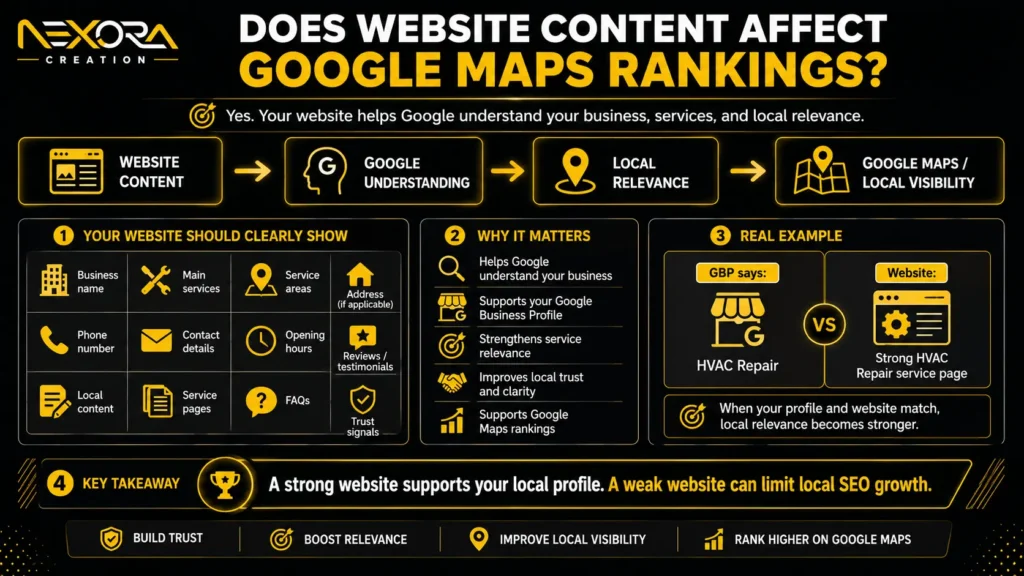
Does website content affect Google Maps rankings?
Yes, website content can support Google Maps rankings because your website helps Google understand your business, services, and location relevance.
Google Business Profile and your website should support each other.
Your website should clearly show:
- Business name
- Main services
- Service areas
- Address, if applicable
- Phone number
- Contact details
- Opening hours
- Reviews or testimonials
- Local content
- Service pages
- FAQs
- Trust signals
For example, if your Google Business Profile says you offer HVAC repair, your website should have a strong HVAC repair page.
If your profile lists multiple services but your website does not explain them, your local relevance may be weaker.
A strong website helps support your local profile.
A weak website can limit local SEO growth.
Do citations still matter for local SEO?
Citations can still matter, especially for business consistency and trust.
A citation is an online mention of your business information.
It usually includes:
- Business name
- Address
- Phone number
- Website
- Category
- Hours
- Description
Citations may appear on:
- Local directories
- Business directories
- Industry directories
- Chamber of commerce sites
- Review platforms
- Social profiles
- Map platforms
- Local news websites
The goal is consistency.
Your business information should be accurate across the web.
Inconsistent information can confuse customers and search systems.
Common citation problems include:
- Old phone numbers
- Wrong address
- Duplicate listings
- Different business names
- Wrong categories
- Old website URLs
- Incorrect hours
Citations alone will not solve local SEO.
But they support trust and consistency.
Do backlinks help local SEO?
Yes, backlinks can help local SEO when they are relevant and trustworthy.
Backlinks from local or industry-relevant websites can improve prominence.
Useful local backlink sources include:
- Local news sites
- Business associations
- Local sponsorships
- Community organizations
- Partner businesses
- Local directories
- Industry blogs
- Local event pages
- Chamber of commerce
- Supplier or vendor pages
Avoid low-quality backlinks.
Do not rely on:
- Link farms
- Spam directories
- Fake guest posts
- Irrelevant backlinks
- Paid links that violate guidelines
- Mass link-building packages
A few relevant local links are often better than many low-quality links.
For small businesses, local authority matters.
If your business is mentioned by trusted local sources, it can support prominence.
Does proximity control local rankings?
Proximity matters, but you cannot fully control it.
Google considers how close a business is to the searcher or the area mentioned in the search.
For example, a plumber located near the searcher may have an advantage for “plumber near me.”
You cannot move your business for every searcher.
But you can improve other signals.
You can strengthen:
- Relevance
- Service clarity
- Reviews
- Website content
- Prominence
- Local backlinks
- Service area pages
- Google Business Profile completeness
- Local trust signals
Google’s local ranking system is not only distance.
A business farther away may still rank if it is more relevant or prominent.
That is why small businesses should not obsess over proximity alone.
Focus on what you can improve.
Do photos help local SEO?
Photos can help local SEO indirectly by improving trust, engagement, and profile quality.
Customers often look at photos before contacting a business.
Useful photos include:
- Team photos
- Office photos
- Storefront photos
- Service vehicles
- Before and after work
- Product photos
- Project photos
- Equipment photos
- Interior and exterior photos
- Customer-facing spaces
Photos make the business feel real.
For home service businesses, project photos can be especially powerful.
For clinics and offices, interior photos help customers know what to expect.
For restaurants, product photos matter.
Photos may not be a magic ranking factor, but they support engagement and trust.
That can improve customer actions such as calls, website visits, and direction requests.
Do Google Business Profile posts matter?
Google Business Profile posts can help keep your profile active and informative.
Posts can be used for:
- Offers
- Updates
- Seasonal services
- New services
- Events
- Promotions
- Educational tips
- Project highlights
- Announcements
For example, a roofing company can post:
“Storm damage roof inspections available this week.”
A dental clinic can post:
“Now accepting appointments for teeth cleaning.”
An agency can post:
“Free website audit for local businesses.”
Posts may not be the strongest ranking factor, but they can improve engagement and customer awareness.
They also give customers more reasons to contact you.
Does local content help rankings?
Yes, local content can help if it is useful and relevant.
Local content should not be fake or thin.
Good local content includes:
- Service area pages
- Local project examples
- Local customer FAQs
- City-specific service explanations
- Local guides
- Case studies
- Neighborhood service details
- Local comparison content
- Local problem-solving blogs
For example:
- How to Choose a Roofing Company in Tampa
- Common AC Problems in Dallas Homes
- Best Landing Page Structure for Home Service Google Ads
- Local SEO Checklist for Small Businesses in Multan
- Why Local Service Websites Need Better Service Pages
Local content helps connect your business to real locations and customer needs.
Avoid creating many duplicate city pages with only the city name changed.
That can create low-value content.
Each local page should be genuinely useful.
Does on-page SEO matter for local rankings?
Yes, on-page SEO matters because it helps search engines and users understand each page.
Local on-page SEO includes:
- Localized title tags
- Clear meta descriptions
- Service and location headings
- Natural keyword use
- Local FAQs
- Internal links
- Schema markup
- NAP details
- Service area content
- Reviews or testimonials
- Clear CTA
- Helpful content
For example, instead of a page title like:
“Services”
use something more specific:
“Roof Repair Services in Tampa”
This helps both users and search engines understand the page.
On-page SEO should be clear, not spammy.
Do not stuff the city name into every sentence.
Use local terms naturally.
Does schema help local SEO?
Schema can help search engines understand your business and website content more clearly.
For local SEO, useful schema may include:
- LocalBusiness schema
- Organization schema
- Service schema
- Review schema, where eligible
- FAQ schema
- Breadcrumb schema
- Article schema
Schema does not guarantee rankings.
But it can support clarity.
For example, LocalBusiness schema can help define:
- Business name
- Address
- Phone number
- Opening hours
- Website
- Business type
- Service area
Schema should match visible content.
Do not add fake reviews or misleading data.
Structured data works best when your actual page content is already strong.
Does website speed affect local SEO?
Website speed can affect local SEO indirectly because it affects user experience and conversions.
If your website loads slowly, visitors may leave before calling or submitting a form.
This matters especially on mobile.
Local searchers often need quick action.
A slow website can reduce:
- Calls
- Form submissions
- Booking clicks
- Engagement
- Trust
- Conversion rate
Common speed issues include:
- Large images
- Heavy themes
- Too many plugins
- Poor hosting
- Unoptimized scripts
- No caching
- Large videos
- Too many third-party tags
A fast website helps visitors take action quickly.
If your local SEO brings traffic but the website is slow or hard to use, you may lose leads.
Does mobile experience affect local leads?
Yes, mobile experience strongly affects local leads.
Many local searches happen on phones.
A user may search, compare businesses, read reviews, call, or request directions directly from mobile.
A mobile-friendly local website should have:
- Fast loading speed
- Clear headline
- Easy-to-tap buttons
- Click-to-call phone number
- Simple navigation
- Short forms
- Visible reviews
- Clear service areas
- Sticky CTA
- Readable text
- No intrusive popups
If your website is difficult on mobile, local SEO visibility may not turn into leads.
Local SEO should not stop at ranking.
The website should help convert the visitor.
What role does user behavior play in local SEO?
User behavior can support local performance because Google wants to show useful results.
For small businesses, customer actions matter.
These actions may include:
- Calls
- Website clicks
- Direction requests
- Review engagement
- Photo views
- Booking clicks
- Profile interactions
- Searcher engagement
- Repeat branded searches
You should make these actions easy.
Your profile and website should clearly encourage:
- Call now
- Get directions
- Book appointment
- Request quote
- Visit website
- View services
- Read reviews
If people engage with your business often, that can support visibility and conversions.
But do not try to manipulate engagement.
Focus on making your business profile useful.
What local SEO mistakes stop rankings from improving?
Common local SEO mistakes include:
- Incomplete Google Business Profile
- Wrong primary category
- Inconsistent NAP information
- Few or weak reviews
- Not responding to reviews
- No service pages
- Thin location pages
- Poor website speed
- Bad mobile experience
- No local content
- No internal links
- No local backlinks
- Duplicate listings
- Wrong business hours
- Keyword stuffing business name
- Fake reviews
- No lead tracking
- No clear CTA
- Not updating the profile
Each mistake creates friction.
Some affect rankings.
Some affect conversions.
Both matter.
A business that ranks but does not get calls still has a local SEO problem.
What local SEO actions should small businesses prioritize first?
Small businesses should prioritize local SEO actions that improve relevance, trust, and conversion.
Start with this order:
1. Fix Google Business Profile
Complete your profile, choose the right category, add services, photos, hours, and contact information.
2. Build strong service pages
Create clear pages for your main services.
3. Improve reviews
Ask for reviews consistently and respond professionally.
4. Fix website basics
Improve speed, mobile usability, navigation, and contact options.
5. Add local content
Create useful content based on local customer questions.
6. Build citations
Make sure business information is consistent across important directories.
7. Build local links
Earn mentions from relevant local sources.
8. Track leads
Measure calls, forms, bookings, and profile actions.
This order helps you fix the foundation before chasing advanced tactics.
How should small businesses track local SEO success?
Small businesses should track local SEO by measuring visibility and leads.
Important local SEO metrics include:
- Google Business Profile views
- Calls from profile
- Website clicks from profile
- Direction requests
- Booking clicks
- Search queries
- Review growth
- Average rating
- Local rankings
- Organic traffic
- Service page visits
- Form submissions
- Phone calls
- CRM leads
- Lead quality
- Closed customers
Do not only track rankings.
A business can rank higher and still get poor leads.
The real question is:
Is local SEO generating calls, enquiries, bookings, and customers?
If not, the issue may be your website, offer, reviews, CTA, or follow-up process.
How can CRM automation improve local SEO results?
CRM automation can improve local SEO results by helping you respond to leads faster.
Local leads are often time-sensitive.
If someone contacts three businesses and you respond last, you may lose the lead.
A CRM can help you:
- Capture form leads instantly
- Store lead source
- Notify your team
- Send automatic confirmations
- Assign follow-up tasks
- Track call outcomes
- Organize local leads
- Measure lead quality
- Follow up with missed enquiries
This helps turn local visibility into real business.
If your local SEO is generating enquiries but your team is slow to follow up, Nexora Creation can help connect your website and lead forms with CRM automation.
How can Nexora Creation help with local SEO?
Nexora Creation helps small businesses improve local SEO with a complete visibility and lead-generation approach.
Local SEO is not only about Google Business Profile.
It also includes:
- Website structure
- Service pages
- Local content
- Reviews
- Technical SEO
- Internal linking
- Local landing pages
- Mobile UX
- Conversion tracking
- CRM follow-up
- AI chatbot support
Our services can help with:
- Google Business Profile optimization
- Local SEO strategy
- Local service pages
- Website development
- Technical SEO
- Review strategy
- Internal linking
- Local content planning
- Landing page optimization
- Conversion-focused CTAs
- CRM automation
- Lead tracking
If your business is not showing up locally or your local traffic is not turning into enquiries, Nexora Creation can help review the full local SEO system.
What is the best local SEO strategy for small businesses?
The best local SEO strategy for small businesses is to improve the signals that help Google and customers trust your business.
A practical strategy includes:
- Complete Google Business Profile
- Correct primary category
- Accurate business information
- Strong reviews
- Review responses
- Clear service pages
- Local content
- Consistent citations
- Local backlinks
- Website speed
- Mobile-friendly design
- Internal links
- Local schema
- Trust signals
- Conversion tracking
- CRM follow-up
The goal is not only to rank higher.
The goal is to become the obvious local choice.
Conclusion
Local SEO for small businesses works when you improve the things that actually matter.
Google local rankings are mainly based on relevance, distance, and prominence.
You cannot fully control distance.
But you can improve relevance and prominence through better profile optimization, service pages, reviews, local content, citations, backlinks, website structure, and trust signals.
The most important local SEO actions are:
- Complete your Google Business Profile
- Choose the right categories
- Keep information accurate
- Build strong reviews
- Respond to reviews
- Create useful service pages
- Add local content
- Improve website speed and mobile UX
- Build internal links
- Track calls and leads
- Follow up quickly
Local SEO is not one trick.
It is a system.
When your profile, website, reviews, content, and follow-up process work together, your small business has a better chance of ranking, earning trust, and turning local searches into real customers.
FAQs
What moves local SEO rankings the most?
The biggest local SEO ranking drivers are relevance, distance, and prominence. In practice, this means Google Business Profile optimization, correct categories, reviews, service pages, local content, citations, backlinks, and website quality.
Does Google Business Profile help local SEO?
Yes, Google Business Profile is one of the most important local SEO assets. A complete and active profile can help customers find, trust, and contact your business on Google Search and Maps.
Do reviews improve local rankings?
Reviews can support local SEO by improving prominence and trust. Review quantity, quality, freshness, detail, and responses can influence customer decisions and local visibility.
Do service pages help local SEO?
Yes, service pages help Google and customers understand what your business offers. Clear service pages can improve relevance for specific local searches.
How important is distance in local SEO?
Distance is important, but you cannot fully control it. A nearby business may have an advantage, but strong relevance and prominence can also help a business appear in local results.
Do citations still matter for local SEO?
Citations still matter for business consistency and trust. Your name, address, phone number, website, and business details should be accurate across important directories.
Does website speed affect local SEO?
Website speed affects user experience and conversions. A slow site can reduce calls, form submissions, and engagement from local visitors.
How do I know if local SEO is working?
Track Google Business Profile actions, calls, website clicks, direction requests, reviews, service page visits, form submissions, CRM leads, and closed customers.