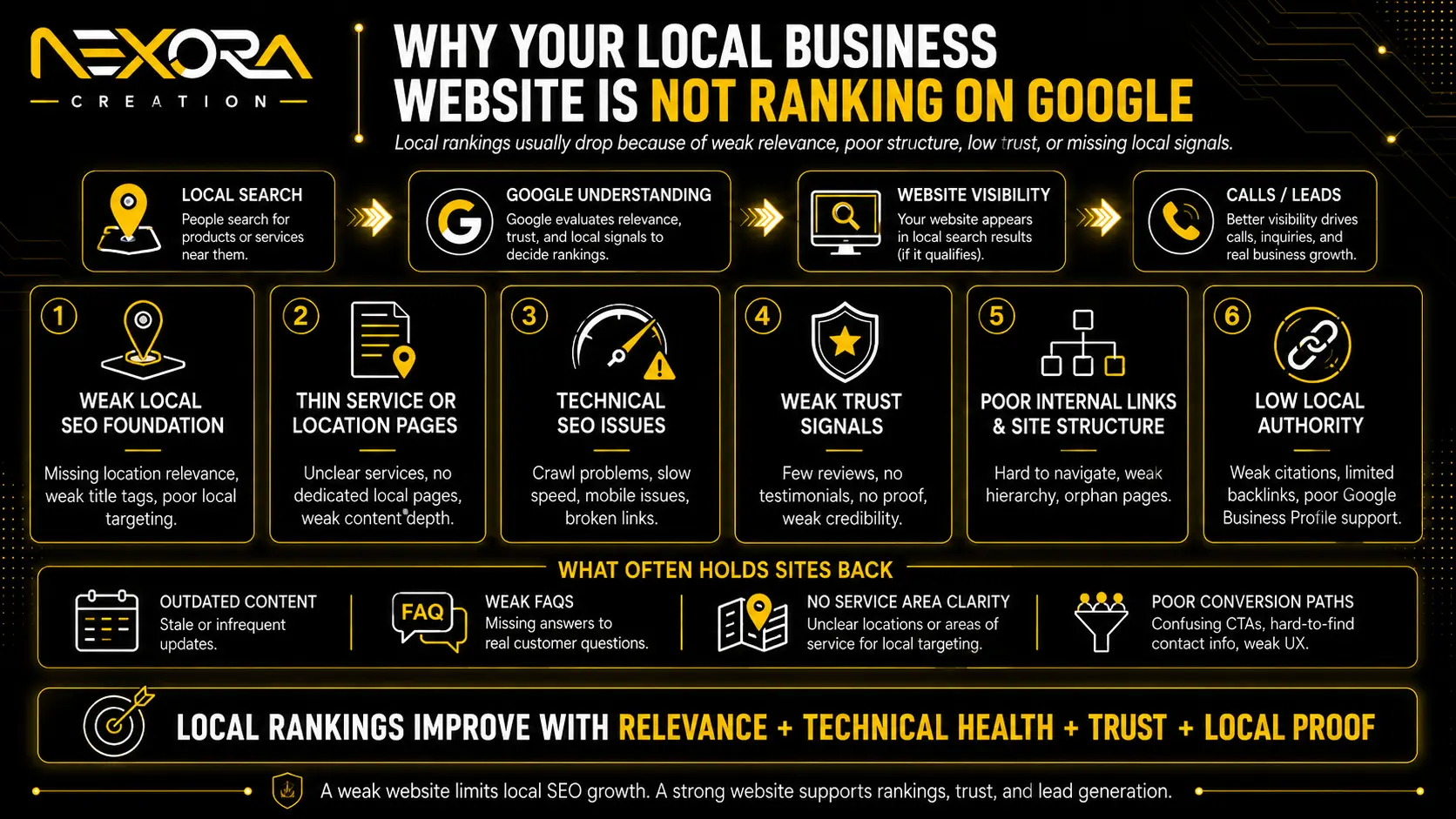
Your local business website may not be ranking on Google because Google does not clearly understand what you offer, where you serve, why your business is trustworthy, or which search queries your website should appear for.
In most cases, the problem is not one single issue.
A local business website may struggle to rank because of:
- Weak Google Business Profile optimization
- Missing local service pages
- Poor website structure
- Thin content
- Slow website speed
- Poor mobile experience
- Few reviews
- Weak local relevance
- Inconsistent business information
- No local backlinks
- No internal linking
- Poor technical SEO
- No clear trust signals
- Weak content strategy
- No conversion tracking
Local SEO is not only about adding your city name to a page.
It is about proving relevance, trust, and usefulness to both Google and customers.
A local customer may search for:
- Plumber near me
- Roofing company in Tampa
- Dentist in Multan
- HVAC repair near me
- Local SEO agency
- Web design company near me
- Cleaning service in Dallas
If your website and Google Business Profile do not clearly support those searches, competitors may rank above you.
At Nexora Creation, we review local business websites by looking at the full system: Google Business Profile, website structure, service pages, local SEO, reviews, technical SEO, user experience, and lead generation.
In this guide, we will explain why your local business website is not ranking on Google and what you can do to fix it.
What does it mean when a local business website is not ranking?
When a local business website is not ranking, it usually means your business is not appearing where potential customers are searching.
This can happen in different ways.
Your business may not appear in:
- Google organic results
- Google Maps
- Local Pack
- Google Business Profile results
- Near me searches
- Service + city searches
- Location-based AI answers
- Local comparison searches
For example, if you are a roofing company in Tampa, you may want to rank for:
- Roof repair Tampa
- Roofing company near me
- Emergency roof leak repair Tampa
- Roof replacement Tampa
- Best roofing contractor in Tampa
If your website does not appear for these searches, your local visibility is weak.
This can reduce:
- Website traffic
- Phone calls
- Quote requests
- Form submissions
- Bookings
- Store visits
- Local leads
- Revenue opportunities
The goal of local SEO is not only to rank.
The goal is to rank for searches that can turn into real customers.
Why is my local business not showing up on Google?
Your local business may not be showing up on Google because your online presence is incomplete, unclear, or not strong enough compared to competitors.
Common reasons include:
- Your Google Business Profile is not fully optimized.
- Your website does not have service-specific pages.
- Your business information is inconsistent online.
- Your website content is too thin.
- Your pages are not indexed.
- Your website loads slowly.
- Your site is hard to use on mobile.
- Your business has fewer reviews than competitors.
- Your website does not mention service areas clearly.
- Your competitors have better local content.
- Your competitors have stronger authority.
- Your profile category is wrong.
- Your website does not build enough trust.
Google needs to understand three things:
- What your business does
- Where your business operates
- Why your business is relevant and trustworthy
If those signals are weak, your website may not rank well.
How does Google rank local businesses?
Google ranks local businesses mainly based on relevance, distance, and prominence.
Relevance
Relevance means how closely your business matches what the searcher is looking for.
For example, if someone searches “emergency plumber near me,” Google needs to understand whether you actually offer emergency plumbing services.
Relevance can be supported by:
- Google Business Profile category
- Services listed on your profile
- Website service pages
- Local keywords used naturally
- Reviews mentioning services
- Business description
- Local content
- FAQs
- Structured data
Distance
Distance means how close your business is to the searcher or to the location mentioned in the query.
You cannot fully control distance.
But you can clearly show your address, service areas, city pages, nearby areas, and local relevance.
Prominence
Prominence means how well-known and trusted your business appears online.
Prominence can be influenced by:
- Reviews
- Ratings
- Backlinks
- Local citations
- Website authority
- Brand mentions
- Local content
- Business activity
- Online reputation
A local business that is relevant, close enough, and prominent has a better chance of ranking.
Is your Google Business Profile incomplete?
An incomplete Google Business Profile is one of the most common reasons local businesses struggle to rank.
Your Google Business Profile helps Google and customers understand your business.
It should include:
- Correct business name
- Accurate primary category
- Relevant secondary categories
- Address or service area
- Phone number
- Website link
- Business hours
- Services
- Products, if relevant
- Business description
- Photos
- Reviews
- Updates or posts
- Appointment or booking link
If your profile is incomplete, Google may not understand your business clearly.
For example, if you offer roof repair but your profile only says “contractor,” your relevance may be weaker.
If your hours are missing or wrong, customers may hesitate.
If your photos are outdated or missing, your business may look less active.
Your profile should not be treated as a one-time setup.
It should be maintained regularly.
Are you using the wrong Google Business Profile category?
Using the wrong primary category can hurt local relevance.
Your primary category is one of the strongest signals that tells Google what your business is.
For example:
A roofing company should choose a roofing-related category.
A dental clinic should choose a dentist-related category.
A web design agency should choose a website designer or marketing-related category depending on its main service.
Do not choose a broad category if a more specific category fits better.
Also use secondary categories where relevant.
For example, a home service company may have one main category and related secondary categories.
But do not add categories that do not match your real services.
Wrong categories can confuse Google and attract the wrong customers.
Does your website have clear local service pages?
Your website may not rank because it does not have clear local service pages.
Many small businesses only have a homepage and one general services page.
That is usually not enough.
If you offer multiple services, each important service should have its own page.
For example, a roofing company may need:
- Roof Repair Services
- Roof Replacement Services
- Emergency Roof Leak Repair
- Commercial Roofing Services
- Roof Inspection Services
- Roofing Services in Tampa
A local clinic may need:
- Dental Cleaning Services
- Teeth Whitening
- Emergency Dentist
- Family Dentistry
- Dental Implants
- Dentist in [City]
A local agency may need:
- Website Development Services
- SEO Services
- Local SEO Services
- CRM Automation
- AI Chatbot Services
Each service page should include:
- Service-specific headline
- Location relevance
- Problem explanation
- Service details
- Benefits
- Process
- FAQs
- Reviews or proof
- Internal links
- CTA
- Contact options
If your website does not have focused service pages, Google may not know which services to rank you for.
If your local business website needs stronger service pages, Nexora Creation can help build SEO-friendly website pages that support rankings and lead generation.
Is your website content too thin?
Thin content is a major reason local business websites do not rank.
Thin content means the page does not provide enough useful information.
A thin service page may only say:
“We provide professional plumbing services. Contact us today.”
That is not enough.
A stronger page explains:
- What service you provide
- Who needs it
- What problems you solve
- Where you provide it
- How the process works
- Why customers should trust you
- What makes your service different
- What questions customers ask
- How to contact you
Google wants to show useful results.
Users also want useful pages.
If your competitors have detailed service pages with reviews, FAQs, local content, and clear CTAs, your thin page may struggle.
Every important local service page should be useful enough to help a customer make a decision.
Is your website missing local keywords?
Your website may not rank because it does not clearly mention the services and locations you want to target.
Local keywords connect your services to your area.
Examples include:
- Roof repair in Tampa
- Dentist in Multan
- HVAC repair in Dallas
- Local SEO services for small businesses
- Cleaning company in Miami
- Web design agency near me
But local keyword use should be natural.
Do not stuff the city name into every sentence.
A good page should mention:
- Main service
- City or service area
- Nearby areas where relevant
- Local customer problems
- Local examples
- Location-specific FAQs
For example:
“Need roof repair in Tampa? Our team helps homeowners with storm damage, leaks, missing shingles, and urgent roof repair needs across Tampa and nearby areas.”
This is clear and natural.
Keyword stuffing is not needed.
Clarity is needed.
Are your reviews too weak compared to competitors?
Reviews can affect both rankings and conversions.
If competitors have more reviews, better ratings, and more detailed customer feedback, they may look more trustworthy.
Customers often compare:
- Review count
- Star rating
- Review freshness
- Review detail
- Owner responses
- Service mentions
- Location mentions
For example, a review that says:
“They repaired our AC in Dallas the same day and explained the issue clearly.”
is stronger than:
“Good service.”
Detailed reviews help customers understand what you do.
They may also support relevance by mentioning services and locations naturally.
To improve reviews:
- Ask happy customers after service completion.
- Make the review process simple.
- Respond to all reviews professionally.
- Do not buy fake reviews.
- Do not pressure customers.
- Encourage honest, specific feedback.
Reviews are not only ranking signals.
They are trust signals.
Is your business information inconsistent online?
Inconsistent business information can hurt trust.
Your business name, address, phone number, website, and hours should be consistent across important platforms.
These details are often called NAP:
- Name
- Address
- Phone number
Inconsistencies can happen when:
- You changed phone numbers
- You moved locations
- You changed your website URL
- Old directories still show old information
- Duplicate listings exist
- Business names are written differently
- Hours are outdated
- Categories are wrong
Important places to check include:
- Google Business Profile
- Website
- Yelp
- Bing Places
- Apple Maps
- Local directories
- Industry directories
- Chamber of commerce listings
Consistency helps customers and search systems trust your information.
Is your website slow?
A slow website can hurt local SEO performance and lead generation.
If your website takes too long to load, visitors may leave before contacting you.
This is especially important for mobile users.
Local searchers often want fast action.
They may be trying to:
- Call a plumber
- Book a clinic appointment
- Request an HVAC repair
- Get a roofing quote
- Find a nearby service provider
Common speed issues include:
- Large images
- Cheap hosting
- Heavy themes
- Too many plugins
- Large videos
- No caching
- Unoptimized scripts
- Bloated page builders
- Large fonts
- Too many tracking tags
A fast website improves user experience.
It can also help conversion rates.
If your local website gets visits but people leave quickly, speed may be part of the problem.
Is your website hard to use on mobile?
Your website may not rank or convert well if the mobile experience is poor.
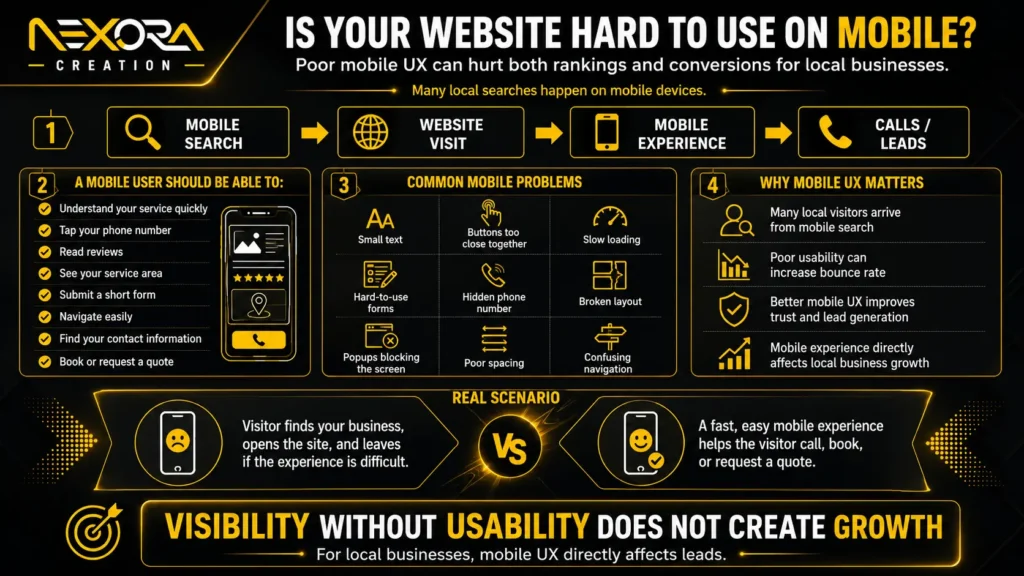
Many local searches happen on mobile devices.
A mobile user should be able to:
- Understand your service quickly
- Tap your phone number
- Read reviews
- See your service area
- Submit a short form
- Navigate easily
- Find your contact information
- Book or request a quote
Common mobile problems include:
- Small text
- Buttons too close together
- Slow loading
- Hard-to-use forms
- Hidden phone number
- Broken layout
- Popups blocking the screen
- Poor spacing
- Confusing navigation
For local businesses, mobile UX directly affects leads.
A customer may find your business, open your site, and leave if the experience is difficult.
Visibility without usability does not create growth.
Are your title tags and meta descriptions weak?
Weak title tags and meta descriptions can reduce clicks and clarity.
Your title tag tells search engines and users what the page is about.
A weak title:
“Services”
A better title:
“Roof Repair Services in Tampa | Company Name”
A weak meta description:
“We provide quality services. Contact us today.”
A better meta description:
“Need roof repair in Tampa? Get help with leaks, storm damage, missing shingles, and roof inspections from a trusted local roofing team.”
Good title tags should include:
- Main service
- Location where relevant
- Business name, if useful
- Clear value
Good meta descriptions should include:
- Service
- Location
- Benefit
- CTA or reason to click
This helps both rankings and click-through rate.
Is your website missing internal links?
Internal links help Google and users understand your website structure.
Many local business websites have blogs, service pages, and contact pages that are not properly connected.
That creates missed opportunities.
Internal links should connect:
- Homepage to service pages
- Blogs to service pages
- Service pages to related services
- Location pages to service pages
- Case studies to services
- FAQ sections to helpful pages
- Old blogs to updated pages
For example:
A blog about local SEO should link to SEO services.
A blog about website speed should link to website development services.
A blog about lead follow-up should link to CRM automation services.
Internal links should not be random.
They should guide the reader to the next logical step.
If your blog traffic is not becoming enquiries, Nexora Creation can help improve internal linking and service page paths through its SEO services.
Is your website missing local content?
Local content helps connect your business to your area.
Local content can include:
- City-specific service pages
- Service area pages
- Local project examples
- Local FAQs
- Local guides
- Local case studies
- Neighborhood pages
- Local customer problems
- Seasonal local service topics
For example:
A roofing company can create:
- Common Roof Problems in Tampa After Storms
- Roof Repair vs Roof Replacement in Tampa
- How to Choose a Roofing Contractor in Tampa
A clinic can create:
- How to Choose a Dental Clinic in Multan
- Common Dental Problems for Families
- Emergency Dentist Guide for Local Patients
A local agency can create:
- Local SEO for Small Businesses
- Why Local Business Websites Do Not Rank on Google
- Best Website Structure for Local Service Businesses
Local content should be useful.
Do not create duplicate city pages where only the city name changes.
Each local page should provide real value.
Are you missing backlinks and local mentions?
Backlinks and local mentions can support prominence.
If your competitors are mentioned on local websites, directories, news sites, or industry platforms, they may look more established.
Useful local backlink sources include:
- Local business directories
- Chamber of commerce
- Industry directories
- Local newspapers
- Community sponsorships
- Partner websites
- Local blogs
- Supplier websites
- Event pages
- Associations
Avoid spammy backlinks.
Do not buy cheap link packages or use link farms.
Low-quality backlinks can create risk.
For small businesses, a few relevant local links can be more useful than many weak links.
Local authority builds over time.
Is your website technically blocking Google?
Sometimes a website does not rank because technical settings are blocking Google from accessing or indexing important pages.
Technical issues may include:
- Noindex tags
- Robots.txt blocking pages
- Broken sitemap
- Wrong canonical tags
- Redirect loops
- 404 errors
- Server errors
- Duplicate pages
- Poor crawl structure
- Orphan pages
- JavaScript content not visible
- Broken internal links
These issues can stop your pages from ranking even if the content looks good.
Every local business should check:
- Are important pages indexed?
- Is the sitemap submitted?
- Are service pages crawlable?
- Are URLs clean?
- Are internal links working?
- Are old pages redirected properly?
- Is Google Search Console showing errors?
Technical SEO is not optional.
It is the foundation.
Is your website missing trust signals?
Your local business website may not rank or convert well if it does not build enough trust.
Customers want to know:
- Is this business real?
- Can I trust them?
- Do they serve my area?
- Have they helped others?
- Are they experienced?
- How can I contact them?
- What happens after I request service?
Trust signals include:
- Reviews
- Testimonials
- Case studies
- Portfolio examples
- Before and after photos
- Business address or service area
- Phone number
- Team photos
- Certifications
- Licenses
- Years in business
- Clear policies
- Contact page
- Google Business Profile link
Trust signals support conversions.
They also support your overall online credibility.
If your website looks generic or incomplete, visitors may choose a competitor.
Are you relying only on your homepage?
Relying only on your homepage is a common local SEO mistake.
A homepage is usually broad.
It cannot rank well for every service and every location.
For example, if you offer:
- Roof repair
- Roof replacement
- Roof inspection
- Emergency roof leak repair
- Commercial roofing
One homepage cannot properly cover all of those services.
Each important service needs its own page.
That helps Google understand your services.
It also helps customers find exactly what they need.
A strong local business website should have:
- Homepage
- Main services page
- Individual service pages
- Location or service area pages
- Blog section
- About page
- Contact page
- Review or testimonial section
- Case studies or portfolio
This creates a stronger local SEO structure.
Are competitors simply stronger than you?
Sometimes your website is not ranking because competitors have stronger SEO signals.
They may have:
- Better Google Business Profile
- More reviews
- Stronger service pages
- Better website content
- More local backlinks
- Better technical SEO
- Faster website
- More local content
- Better brand recognition
- More complete citations
- Stronger user engagement
This does not mean you cannot compete.
It means you need a strategy.
Start by reviewing:
- Which competitors rank?
- What categories do they use?
- How many reviews do they have?
- What services do they highlight?
- What pages rank?
- What content do they publish?
- What backlinks do they have?
- How strong is their website?
- What trust signals do they show?
Then build a better plan.
Do not copy competitors.
Understand why they rank and improve your own website in a more useful way.
Are you tracking rankings but not leads?
Ranking is important, but rankings alone do not grow a business.
A local business should track:
- Google Business Profile calls
- Website clicks
- Direction requests
- Form submissions
- Phone calls
- Booking clicks
- Service page visits
- Blog-to-service clicks
- Contact page visits
- CRM leads
- Lead quality
- Closed customers
If you only track rankings, you may miss the real issue.
For example:
- You may rank for keywords that do not bring leads.
- You may get traffic but no calls.
- You may get calls but poor lead quality.
- You may get form submissions but no follow-up.
- You may get blog traffic but no service page clicks.
Local SEO should be measured by visibility and business results.
If your website gets traffic but does not generate leads, the issue may be your CTA, service pages, forms, trust signals, or follow-up process.
Can CRM automation help local SEO results?
CRM automation can help local SEO results by making sure leads are captured and followed up quickly.
Local leads are often time-sensitive.
If someone contacts your business and you respond late, they may choose a competitor.
A CRM can help you:
- Capture website form leads
- Store lead source
- Notify your team
- Send automatic confirmation
- Track follow-up status
- Assign leads
- Record call outcomes
- Measure lead quality
- Improve response speed
SEO brings visitors.
CRM helps protect the opportunity.
If your local SEO is generating enquiries but your team is losing leads during follow-up, Nexora Creation can help connect your website with CRM automation.
How can you fix a local business website that is not ranking?
You can fix a local business website that is not ranking by improving the full local SEO system.
Start with this checklist:
1. Optimize Google Business Profile
Complete your profile, choose the right categories, add services, photos, hours, and business information.
2. Build clear service pages
Create focused pages for each important service.
3. Improve local relevance
Mention service areas, cities, nearby locations, and local customer problems naturally.
4. Get more reviews
Ask happy customers for honest reviews and respond professionally.
5. Fix technical SEO
Check indexing, sitemap, crawlability, redirects, and broken links.
6. Improve website speed
Compress images, improve hosting, reduce scripts, and test mobile performance.
7. Improve mobile UX
Make calls, forms, navigation, and CTAs easy on phones.
8. Add local content
Create useful local blogs, FAQs, case studies, and service area pages.
9. Build internal links
Connect blogs, service pages, and contact pages naturally.
10. Add trust signals
Use reviews, testimonials, project photos, certifications, and business details.
11. Build local citations
Make business information consistent across important directories.
12. Earn local backlinks
Get mentioned by relevant local or industry websites.
13. Track leads
Measure calls, forms, bookings, and CRM leads.
This checklist helps improve both rankings and conversions.
How can Nexora Creation help your local business rank on Google?
Nexora Creation helps local businesses improve Google visibility with a complete SEO and website strategy.
Ranking on Google is not only about adding keywords.
It requires:
- Google Business Profile optimization
- Technical SEO
- Local service pages
- Website development
- Local content strategy
- Internal linking
- Review strategy
- Speed optimization
- Mobile UX
- Trust signals
- Conversion-focused CTAs
- CRM automation
- Lead tracking
If your local business website is not ranking, the issue may be your website structure, service pages, content, technical SEO, reviews, or local profile setup.
Our SEO and website development services can help identify what is stopping your website from ranking and create a practical plan to improve visibility and leads.
What is the fastest way to improve local rankings?
The fastest way to improve local rankings is to fix the highest-impact issues first.
For most local businesses, the best starting points are:
- Complete Google Business Profile
- Choose the right primary category
- Add all services
- Improve reviews
- Create or improve service pages
- Fix indexing issues
- Add local keywords naturally
- Improve website speed
- Add internal links
- Add clear CTAs
- Track calls and forms
You may not rank overnight.
But fixing these basics can create real progress.
Local SEO is an ongoing process.
The businesses that win are usually the ones that keep improving their profile, website, content, reviews, and customer experience.
Conclusion
Your local business website may not be ranking on Google because Google does not have enough clear, trusted, and relevant signals about your business.
The issue may be your Google Business Profile, service pages, reviews, local content, website speed, mobile UX, technical SEO, citations, backlinks, or internal links.
Local SEO works when everything supports the same goal:
Help Google and customers understand what you do, where you serve, and why your business is trustworthy.
To improve rankings, focus on:
- Relevance
- Distance
- Prominence
- Google Business Profile optimization
- Clear local service pages
- Strong reviews
- Local content
- Technical SEO
- Website speed
- Mobile experience
- Trust signals
- Lead tracking
Ranking is not the final goal.
The real goal is to turn local searches into calls, enquiries, bookings, and customers.
A strong local SEO strategy should help your business get found, trusted, and contacted.
FAQs
Why is my local business website not ranking on Google?
Your local business website may not rank because of weak Google Business Profile optimization, missing service pages, thin content, poor reviews, slow speed, weak local relevance, technical SEO issues, or stronger competitors.
How does Google rank local businesses?
Google local rankings are mainly based on relevance, distance, and prominence. These help Google match local businesses with customer searches.
Does Google Business Profile help website rankings?
Google Business Profile helps local visibility on Google Search and Maps. Your website and profile should support each other with clear services, accurate information, reviews, and local relevance.
Do reviews help local SEO?
Yes, reviews can help local SEO by improving trust and prominence. More positive, detailed, and fresh reviews can help customers choose your business.
Do service pages help local rankings?
Yes, clear service pages help Google understand what your business offers. Each important service should have its own useful page with local relevance, FAQs, proof, and CTA.
Why is my website not showing for near me searches?
Your website may not show for near me searches because your profile, location signals, reviews, service pages, or local relevance are weaker than competitors.
How long does local SEO take?
Local SEO can take weeks or months depending on competition, website quality, reviews, profile strength, and how many issues need fixing.
What should I fix first for local SEO?
Start with Google Business Profile, correct categories, service pages, reviews, technical SEO, local content, website speed, mobile UX, and lead tracking.