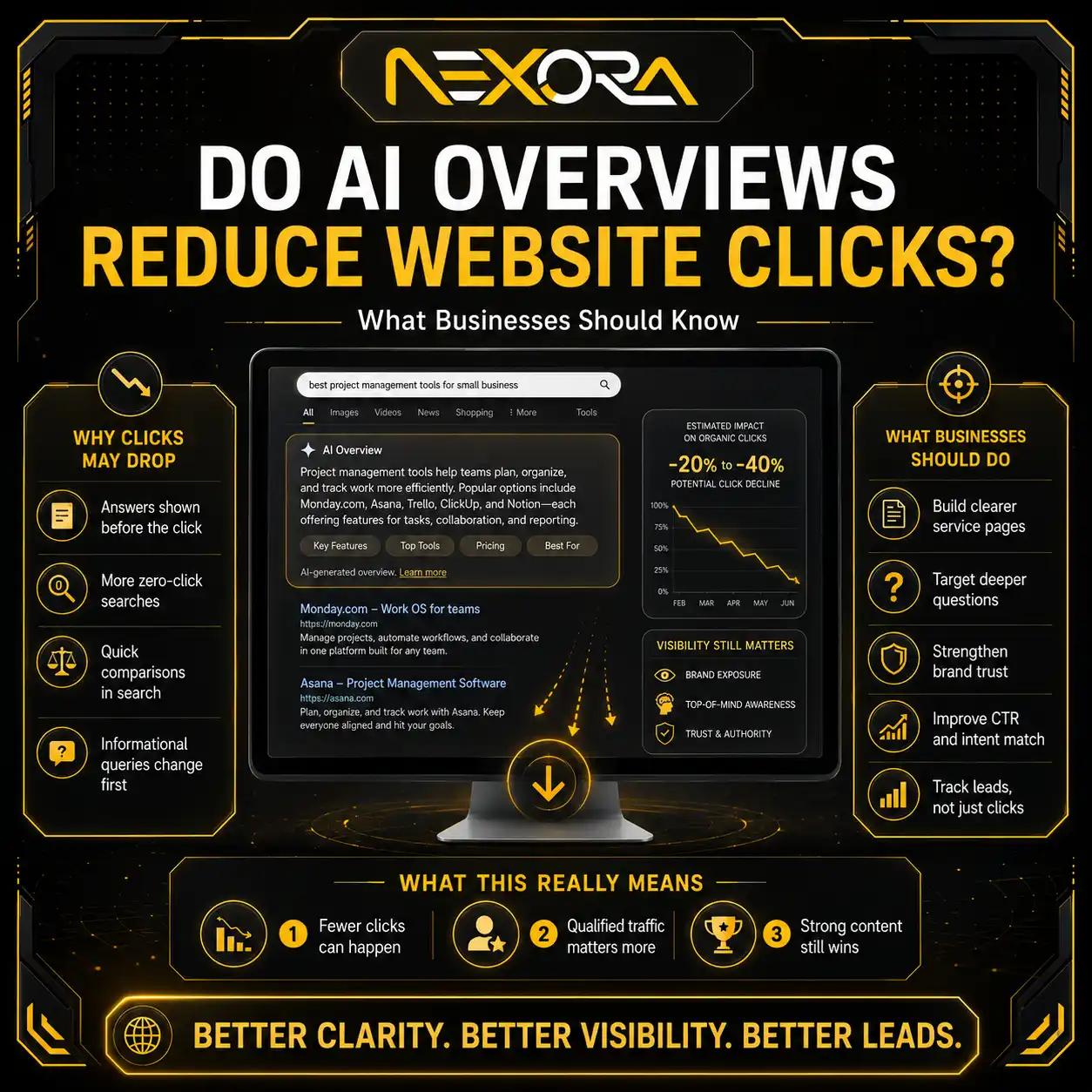
Yes, AI Overviews can reduce website clicks, particularly for informational searches that Google can answer directly on the results page.
However, the impact is not identical for every:
- Keyword
- Website
- Industry
- Ranking position
- Search intent
- Page type
- Customer journey
Ahrefs initially reported that AI Overviews correlated with a 34.5% lower click-through rate for the top-ranking page in its 2025 study of 300,000 keywords. Its later analysis using December 2025 data estimated a 58% reduction for position-one results when an AI Overview appeared.
Pew Research Center found a similar pattern from user browsing behavior. People clicked a traditional result during 8% of visits where an AI summary appeared, compared with 15% of visits without one. Links inside the AI summaries themselves received clicks in only a small share of visits.
These findings do not mean SEO is dead.
They mean businesses can no longer judge search performance only through:
- Ranking position
- Organic traffic
- Click-through rate
- Total sessions
A business may now receive value through:
- Traditional organic clicks
- AI Overview citations
- Brand mentions
- Branded searches
- High-intent visits
- Assisted conversions
- Calls or enquiries completed without a long research journey
At Nexora Creation, we treat AI Overviews as a change in how search demand is distributed—not as a reason to abandon SEO.
The practical response is to protect high-value commercial pages, improve content that deserves a click, build brand recognition, and connect visibility to qualified leads and revenue.
What are Google AI Overviews?
AI Overviews are AI-generated summaries that Google may display within search results when its systems determine that a generated response adds value beyond traditional listings.
They may:
- Summarize a topic
- Combine information from several sources
- Answer related questions
- Present supporting links
- Help users compare options
- Provide a starting point for further exploration
AI Overviews are different from AI Mode.
AI Overviews usually appear within the standard results experience.
AI Mode supports more detailed, conversational exploration and follow-up questions.
Google says both experiences may use query fan-out, where its systems issue several related searches across subtopics and data sources before generating a response.
This means one customer question may cause Google to retrieve information about:
- Definitions
- Costs
- Comparisons
- Risks
- Locations
- Providers
- Supporting evidence
A business no longer competes only for one exact keyword.
It may compete to become a useful source for one part of a larger generated answer.
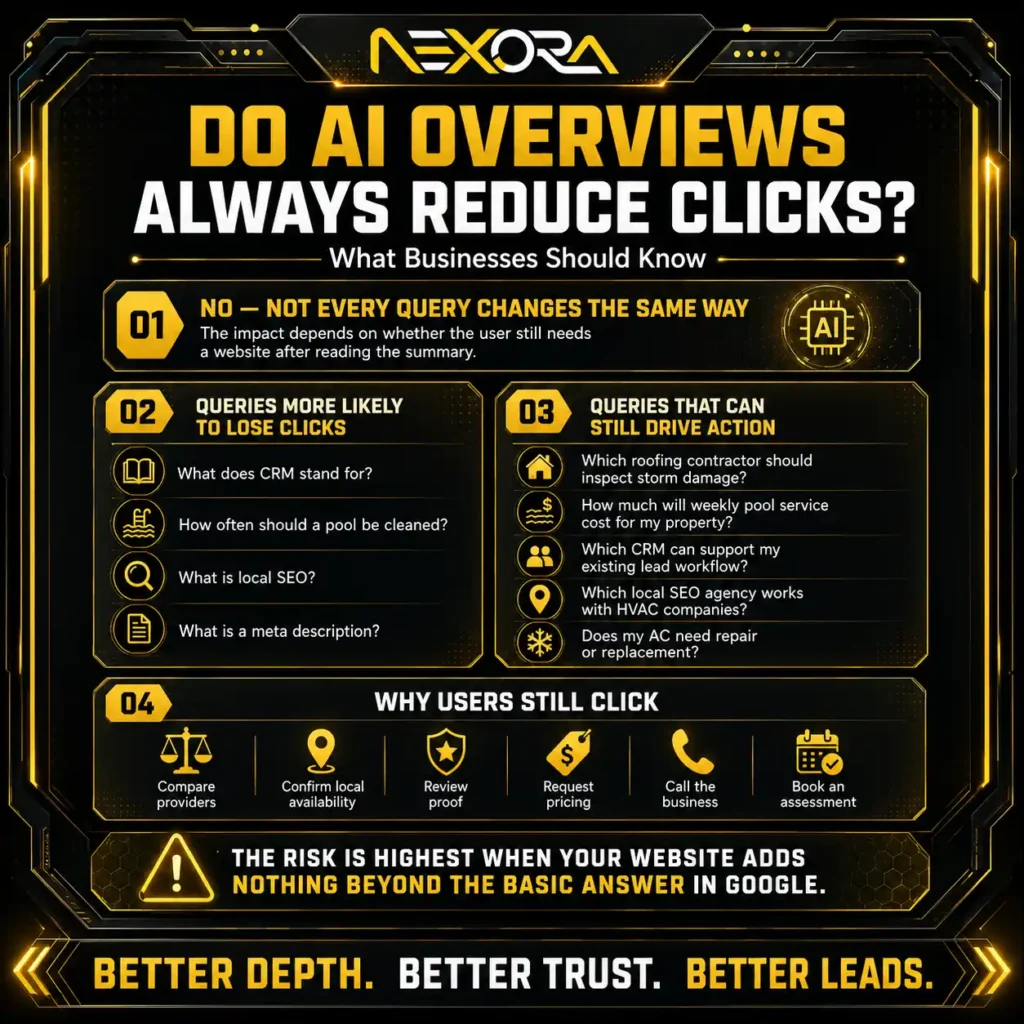
Do AI Overviews always reduce clicks?
No.
AI Overviews do not produce the same result for every query.
Their effect depends heavily on whether the user still needs to visit a website after reading the summary.
A simple informational query may be answered without a click.
Examples include:
- What does CRM stand for?
- How often should a pool be cleaned?
- What is local SEO?
- What is a meta description?
More complex or commercially sensitive questions may still encourage further action.
Examples include:
- Which roofing contractor should inspect storm damage?
- How much will weekly pool service cost for my property?
- Which CRM can support my existing lead workflow?
- Which local SEO agency works with HVAC companies?
- Does my AC need repair or replacement?
The AI response may provide initial guidance, but the customer may still need to:
- Compare providers
- Confirm local availability
- Review proof
- Request pricing
- Call the business
- Book an assessment
- Purchase a service
The risk is therefore highest when the website provides nothing beyond the basic answer already visible in Google.
Is the 34.5% click reduction still accurate?
The 34.5% figure describes a specific Ahrefs study, not a permanent rule for every business.
The original study compared:
- 150,000 informational keywords with AI Overviews
- 150,000 informational keywords without AI Overviews
- Aggregated desktop Search Console CTR
- March 2024 and March 2025 data
Ahrefs estimated that the presence of an AI Overview correlated with a 34.5% reduction in position-one CTR compared with its forecast for those searches without AI Overviews.
There are important limitations:
- The analysis focused on informational intent.
- It used aggregated data.
- It showed correlation rather than proving that every CTR decline was caused only by AI Overviews.
- It did not represent every country, device, industry, or search type.
- Google’s results and AI presentation continue to change.
More importantly, Ahrefs later reran the analysis using December 2025 data and estimated that AI Overviews correlated with a 58% lower position-one CTR.
The accurate conclusion is not:
“AI Overviews reduce every website’s clicks by exactly 34.5%.”
It is:
“Multiple datasets show that AI Overviews can materially reduce traditional organic CTR, especially for informational searches.”
What did Pew Research find?
Pew Research Center analyzed browsing behavior from U.S. adults who agreed to share their web activity.
It found that users:
- Clicked traditional search results in 8% of visits with an AI summary
- Clicked traditional results in 15% of visits without an AI summary
- Rarely clicked links presented inside the AI summary
- Were more likely to end the browsing session when an AI summary appeared
These results suggest AI summaries often satisfy enough of the immediate information need to reduce further browsing.
The study does not prove that every business loses half of its search traffic.
It does provide direct evidence that user behavior changes when an AI-generated answer appears.
Why does Google say AI Overview clicks are higher quality?
Google says visitors who click from search pages containing AI Overviews may spend more time on the destination website.
Its explanation is that users can develop a clearer understanding of the topic before clicking, which may make the resulting visit more engaged.
This claim and the independent click-loss studies can both be true.
For example:
- One hundred people may previously have clicked.
- After an AI Overview appears, only sixty may click.
- Those sixty visitors may be more informed and engaged.
- Total traffic declines, but lead quality may stay stable or improve.
Businesses should therefore measure both:
- Traffic volume
- Traffic value
A decline in sessions is serious when leads and revenue also decline.
It is less damaging when weaker informational visits decrease but qualified enquiries remain stable.
Which search queries are most likely to lose clicks?
Informational searches face the greatest risk because Google can often answer them directly.
Examples include:
- Definitions
- Basic instructions
- Simple calculations
- Short comparisons
- General explanations
- Common FAQs
- Introductory research
A page titled “What Is Local SEO?” may lose more clicks than a page titled “Local SEO Services for Roofing Companies.”
The first query may be satisfied by a summary.
The second may require:
- Provider evaluation
- Industry experience
- Pricing
- Case studies
- Contact
Businesses should classify search demand by intent rather than treating every keyword equally.
High click-loss risk
- What is technical SEO?
- What is a CRM?
- What does pool maintenance include?
- How long does a roof last?
- What is an AI receptionist?
Lower click-loss risk
- Technical SEO audit for my website
- CRM automation company for contractors
- Weekly pool cleaning quote
- Roof inspection near me
- AI receptionist setup service
Commercial and local searches can still be affected, but they usually involve actions Google cannot fully complete through a short summary.
Are local service businesses protected from click loss?
They are not fully protected, but their highest-value searches may be more resilient.
A homeowner searching:
Why is my pool turning green?
may receive enough information from an AI Overview to understand the cause without visiting a website.
The same homeowner searching:
Green pool cleanup company near me
still needs a real provider.
The business should therefore connect informational visibility with a commercial next step.
A useful green-pool article should:
- Explain the likely causes
- Identify when professional help is needed
- Show what cleanup involves
- Explain service limitations
- Link to the Green Pool Cleanup service page
- Include a relevant local CTA
The article may receive fewer clicks than before.
The clicks it does receive should have a clear path toward service.
Does a lower CTR mean the ranking has lost all value?
No.
A top ranking can still contribute to:
- AI Overview source selection
- Brand recognition
- Customer trust
- Branded searches
- Future visits
- Assisted conversions
- Links and references
However, rankings should no longer be valued in isolation.
A business ranking first for a broad informational keyword may generate:
- High impressions
- Low CTR
- Few leads
Another page ranking fifth for a commercial query may generate:
- Lower impressions
- Higher CTR
- More qualified calls
- More revenue
The correct question is not only:
“Where do we rank?”
It is:
“What business outcome does this visibility create?”
What is the difference between a citation and a mention?
A citation is a source link associated with an AI-generated answer.
A mention occurs when the answer names a company, product, person, or brand.
A business may receive:
- A citation without being named prominently
- A brand mention without a direct link
- Both a mention and citation
- Neither, despite ranking organically
These outcomes create different value.
Citation value
A citation may generate:
- Referral traffic
- Source credibility
- Visibility near the answer
- Future brand recognition
Mention value
A mention may generate:
- Brand awareness
- Branded searches
- Perceived category relevance
- Assisted discovery
Neither one guarantees:
- A click
- A lead
- A customer
- Higher rankings
- Future inclusion
AI Overview sources can change, so businesses should treat citation visibility as dynamic rather than equivalent to a fixed ranking position.
Is appearing in an AI Overview always a sign of authority?
It shows that Google’s systems found the page useful as supporting material for that specific response.
It does not automatically prove that:
- The page is the best source in the industry
- Google endorses the business
- The website will retain the citation
- The business is a recommended provider
- The page will generate leads
Do not make unsupported marketing claims such as:
“Featured in Google AI means Google recommends us.”
A more accurate statement would be:
“Our content has appeared as a supporting source in Google’s AI-generated search results.”
Should businesses stop creating informational content?
No, but they should become more selective.
Basic commodity content faces the highest click-loss risk.
An article that only provides a definition Google can summarize in two sentences may attract fewer visits than it did previously.
Informational content remains valuable when it provides something the summary cannot fully replace.
Examples include:
- Original research
- Local data
- First-hand experience
- Detailed processes
- Diagnostic tools
- Templates
- Calculators
- Case studies
- Before-and-after examples
- Decision frameworks
- Expert interpretations
Weak topic:
What Is Website Speed?
Stronger topic:
How We Diagnose Website Speed Problems That Block Mobile Service Leads
The stronger article gives the reader:
- A method
- Real scenarios
- Commercial context
- Actions
- Expertise
Create content that deserves the click after the basic answer has already been summarized.
Website Development Services
What does “information gain” mean for businesses?
Information gain means adding useful value beyond what competing pages already repeat.
A service business can contribute information through:
- Real customer questions
- Operational experience
- Local conditions
- Project lessons
- Common failure patterns
- Qualification criteria
- Pricing drivers
- Process details
- Limitations
For example, many articles may say:
“Respond to leads quickly.”
A more useful service-business insight would be:
“When a website form creates only an email notification, leads can remain unassigned. We recommend creating a CRM record, assigning an owner, sending confirmation, and setting a timed follow-up task within the same workflow.”
The second passage provides a repeatable process.
It gives users and search systems a stronger reason to reference the page.
How should informational articles connect to revenue?
Every article should have a next step related to its search intent.
An article about:
Why is my AC not cooling?
may link to:
- Emergency AC Repair
- HVAC Inspection
- AC Maintenance
An article about:
What is local SEO?
may link to:
- Local SEO Services
- Google Business Profile Optimization
- SEO Audit
An article about:
How do AI voice agents work?
may link to:
- AI Voice Agent Services
- CRM Automation
- Consultation
The CTA should not interrupt the answer.
It should appear after the reader understands when the service is relevant.
Should businesses publish fewer blog posts?
Many businesses should publish fewer low-value posts and invest more in:
- Core service pages
- Conversion pages
- Case studies
- Original resources
- Existing content updates
- Commercial comparisons
- Local proof
Publishing four generic articles each month may create less value than producing one strong resource supported by:
- Real examples
- First-party knowledge
- Useful visuals
- Expert review
- Internal links
- A clear conversion path
Content volume is not a defence against AI summaries.
Distinctive value is.
How should service pages be improved?
Service pages should answer the questions an AI summary cannot resolve for the individual customer.
Include:
- Clear service definition
- Target customer
- Problems addressed
- What is included
- What is excluded
- Service process
- Pricing factors
- Location or availability
- Proof
- Limitations
- CTA
For example, an AI Overview may explain what an SEO audit is.
A Nexora Creation service page should explain:
- Which websites need an audit
- What we review
- What the client receives
- Which issues we prioritize
- How implementation works
- What we cannot guarantee
- How to request the audit
That page gives the user a reason to move from information to evaluation.
Do clearer titles and descriptions still matter?
Yes.
Lower overall CTR makes every qualified click more valuable.
A generic title such as:
AI Search Guide
may be less useful than:
How AI Overviews Affect Website Traffic and Leads
A meta description should also clarify the page’s additional value.
Example:
“See what independent studies reveal about AI Overview click loss, which pages face the greatest risk, and how to protect leads and revenue.”
Avoid clickbait such as:
- Google Just Killed SEO
- Your Traffic Is About to Disappear
- AI Overviews Destroy Every Website
- The 34.5% Traffic Disaster
Accurate titles attract better-qualified readers and build trust.
Does traditional SEO still matter?
Yes.
Google says the same foundational practices remain relevant for AI Overviews and AI Mode.
Pages considered as supporting links must be:
- Indexed
- Eligible to appear in Search
- Eligible for a snippet
- Compliant with Search requirements and policies
Google also recommends:
- Allowing crawling
- Making pages discoverable through internal links
- Providing good page experience
- Keeping important information in text
- Using accurate structured data
- Maintaining current Business Profile information
It says there is no special AI schema, AI file, or separate technical requirement for inclusion.
Businesses should not abandon technical SEO or keyword strategy in favour of unproven AI tricks.
What technical issues can prevent AI visibility?
Common problems include:
- Robots.txt blocks
- Accidental
noindex - Incorrect canonicals
- Broken internal links
- Server errors
- Content hidden behind login
- Essential information unavailable in text
- CDN or firewall blocks
- Poor mobile rendering
- Orphan pages
Check priority content through Google Search Console.
Confirm:
- URL is accessible
- Correct version is indexed
- Canonical is accurate
- Page is internally linked
- Content appears in rendered HTML
- Structured data matches visible information
A page cannot become a useful supporting source when Google cannot reliably access it.
Does schema improve AI Overview visibility?
Structured data can help Google understand visible page information, but it does not guarantee an AI Overview citation.
Relevant types may include:
- Organization
- LocalBusiness
- Article
- Service
- Product
- BreadcrumbList
Google explicitly says no special structured data is required for AI Overviews or AI Mode.
Do not add:
- Fake reviews
- Invented ratings
- False locations
- Services not shown
- Unsupported authors
- Misleading prices
Schema should reinforce a page that already communicates clearly.
Do backlinks and brand mentions still matter?
Relevant backlinks continue to support:
- Discovery
- Authority
- Referral traffic
- Brand recognition
- Independent confirmation
Brand mentions may also help customers and platforms associate the business with a topic, even when they do not contain a link.
Useful sources include:
- Industry publications
- Local news
- Professional associations
- Partner websites
- Supplier directories
- Original research references
- Community organizations
Avoid buying unrelated link packages.
AI search increases the value of being known and verified beyond the company’s own website.
Should businesses optimize for citations instead of clicks?
Businesses should optimize for visibility, qualified clicks, and conversions together.
A page designed only for extraction may give away the entire value without creating a reason to visit.
A page designed only to force a click may provide a poor search experience.
The stronger approach is:
- Answer the immediate question clearly.
- Add depth that cannot fit inside a short summary.
- Show first-hand expertise.
- Provide tools, evidence, examples, or decision support.
- Offer a relevant next step.
The goal is not to hide the answer.
It is to make the full resource more valuable than the summary.
How can a business create content that earns the click?
Give the visitor something practical to do, evaluate, or use.
Examples include:
- Downloadable checklist
- Interactive calculator
- Service eligibility assessment
- Detailed comparison
- Template
- Step-by-step process
- Video demonstration
- Original dataset
- Local benchmark
- Before-and-after example
- Case study
For example, Google may summarize the factors that affect website redesign costs.
A detailed agency page can still provide:
- Scope calculator
- Platform comparison
- Example project structures
- Timeline ranges
- Required assets
- Common hidden costs
- Consultation CTA
The AI answer handles initial education.
The website supports the decision.
Should brands build owned audiences?
Yes.
AI search reinforces the risk of depending on one acquisition platform.
Owned or direct channels include:
- Email list
- CRM database
- Customer community
- Direct traffic
- Repeat visitors
- SMS where appropriate
- Branded search demand
A customer who already recognizes the business is less dependent on generic discovery results.
Content should therefore encourage appropriate repeat relationships through:
- Useful newsletters
- Saved resources
- Follow-up sequences
- Tools
- Customer education
- Consistent brand experience
Do not use aggressive popups that damage the initial visit.
What should local businesses do differently?
Local service businesses should prioritize high-intent pages and real-world proof.
Focus on:
- Google Business Profile
- Core service pages
- Priority locations
- Genuine reviews
- Local projects
- Click-to-call experience
- Route or availability information
- Quote forms
- Missed-call follow-up
AI Overviews may reduce traffic to broad educational articles.
They cannot fully replace:
- A local inspection
- Service availability confirmation
- Property-specific pricing
- Appointment booking
- Trust evaluation
- Emergency response
Make the commercial path easy to find.
UI/UX Design Services
What should ecommerce businesses do differently?
Ecommerce pages should provide product and decision information beyond generic summaries.
Useful elements include:
- Accurate specifications
- Availability
- Pricing
- Shipping information
- Returns
- Original product images
- Demonstration videos
- Comparison tools
- Verified customer reviews
- Buying guidance
Keep Merchant Center and product data current.
Google specifically includes updated Merchant Center information among the fundamentals for AI-powered Search visibility.
How can companies identify traffic affected by AI Overviews?
Start in Google Search Console.
Look for pages showing:
- Rising impressions
- Stable or improving positions
- Falling clicks
- Declining CTR
This pattern may indicate that search visibility remains strong while fewer users click.
However, it does not prove AI Overviews caused the decline.
Other causes may include:
- Changed titles
- New SERP features
- Competitor improvements
- Search-intent shifts
- Seasonality
- Brand changes
- Device mix
- Ranking volatility
Segment the data by:
- Query
- Page
- Device
- Country
- Date
- Search appearance where available
Then manually review the current results for high-value queries.
Then manually review the current results for high-value queries.
Can Search Console separate AI Overview traffic?
Historically, Google included AI Overview and AI Mode activity within the Performance report’s Web search type rather than providing complete separation.
In June 2026, Google announced dedicated generative AI performance views for some Search Console properties. These reports provide visibility into impressions across generative AI Search experiences while the data remains part of overall Search reporting.
Availability may vary by property and rollout stage.
Businesses should combine Search Console with:
- Google Analytics
- Call tracking
- Form tracking
- CRM data
- Manual SERP reviews
No single report currently provides the full customer journey.
What should businesses measure instead of traffic alone?
Measure three layers.
Search visibility
- Rankings
- Impressions
- AI citations
- Brand mentions
- Cited pages
- Branded searches
Website engagement
- Organic sessions
- Engaged visits
- CTA clicks
- Phone clicks
- Forms
- Return visitors
Commercial performance
- Qualified leads
- Appointments
- Quotes
- Sales
- New recurring customers
- Revenue
- Customer lifetime value
A content page may lose 30% of its visits but retain nearly all assisted conversions.
Another page may maintain traffic while producing no leads.
Commercial measurement reveals the difference.
How should CRM attribution be configured?
Capture:
- Traffic source
- Landing page
- Service requested
- Customer location
- Lead type
- Qualified status
- Appointment
- Proposal
- Sale
- Revenue
Example:
- Source: Google Organic
- Landing page: AI Overviews and Website Clicks
- Service: SEO
- Status: Qualified
- Outcome: Audit booked
Also ask new customers:
“How did you first hear about us?”
A prospect may see the company inside an AI answer, later search the brand directly, and then submit a form.
Analytics may classify that conversion as direct or branded organic rather than AI-assisted.
Should a traffic decline automatically trigger a content rewrite?
No.
Diagnose before changing the page.
Review:
- Search demand
- Rankings
- Impressions
- CTR
- AI Overview presence
- Competing results
- Conversion rate
- Lead quality
- Revenue
- Page freshness
A page with declining clicks may still support:
- Strong conversions
- AI citations
- Brand visibility
- Links
- Assisted leads
Rewrite when the page:
- No longer satisfies intent
- Contains outdated information
- Repeats generic advice
- Has weak commercial relevance
- Lacks original value
- Has no conversion path
Do not delete useful content solely because traffic declined.
Should low-value informational pages be removed?
Some may need to be:
- Updated
- Consolidated
- Redirected
- Repositioned
- Removed
Evaluate whether the page provides:
- Search visibility
- Backlinks
- Assisted conversions
- Internal-link value
- Brand authority
- Customer support value
Several thin definitions may be combined into one stronger guide.
Overlapping articles may be consolidated to reduce cannibalization.
A page should not be removed without checking its historical links and commercial contribution.
What is the best content strategy after AI Overview click loss?
Use a balanced portfolio.
Commercial pages
Build and improve:
- Service pages
- Product pages
- Location pages
- Pricing pages
- Booking pages
Decision content
Publish:
- Comparisons
- Cost guides
- Provider-selection guides
- Problem diagnosis
- Eligibility content
Proof content
Create:
- Case studies
- Original research
- Project examples
- Testimonials
- Methodology pages
Utility content
Develop:
- Tools
- Calculators
- Templates
- Checklists
- Assessments
Authority content
Contribute:
- Expert analysis
- Industry commentary
- Local data
- Original frameworks
This strategy supports both visibility and reasons to visit.
What mistakes should businesses avoid?
Avoid:
- Treating 34.5% as a universal fixed loss
- Assuming every traffic decline is caused by AI
- Abandoning informational content completely
- Publishing generic AI-written articles at scale
- Optimizing only for citations
- Ignoring service and product pages
- Celebrating mentions without measuring leads
- Depending entirely on Google traffic
- Using misleading “Google recommended” claims
- Buying low-quality backlinks
- Adding special AI schema that does not exist
- Tracking rankings without revenue
- Making major content changes without diagnosis
The search landscape is changing, but panic is not a strategy.
What should businesses do first?
Phase 1: Measure the impact
- Review Search Console trends
- Find pages with falling CTR
- Identify AI Overview queries
- Compare traffic with conversions
- Record current visibility
Phase 2: Protect revenue pages
- Improve service pages
- Clarify commercial intent
- Add proof
- Explain pricing factors
- Strengthen CTAs
- Test mobile forms and calls
Phase 3: Improve content value
- Update generic articles
- Add first-hand experience
- Publish original examples
- Create decision tools
- Consolidate overlapping pages
Phase 4: Build authority
- Earn relevant links
- Develop industry mentions
- Collect genuine reviews
- Publish case studies
- Strengthen entity consistency
Phase 5: Diversify and track
- Build email and CRM audiences
- Track calls and forms
- Capture source attribution
- Monitor branded demand
- Measure revenue by landing page
SEO Services
What is the AI Overview traffic checklist?
Search data
- Impressions reviewed
- Clicks reviewed
- CTR reviewed
- Rankings reviewed
- Device differences checked
- High-value queries manually inspected
Content
- Immediate question answered
- Original value included
- Evidence provided
- Examples included
- Information current
- Relevant next step available
Technical SEO
- Page crawlable
- Page indexable
- Canonical correct
- Internal links present
- Important content in text
- Structured data accurate
Commercial pages
- Services clearly defined
- Pricing factors explained
- Proof visible
- CTA specific
- Phone clickable
- Forms tested
Authority
- Reviews genuine
- Backlinks relevant
- Brand information consistent
- External mentions monitored
- Authors or experts identified
Measurement
- Analytics configured
- Calls tracked
- Forms tracked
- Qualified leads recorded
- CRM attribution enabled
- Revenue connected to landing pages
How can Nexora Creation help businesses respond?
Nexora Creation helps service businesses adapt their SEO and website strategy as AI-generated search experiences change how clicks and visibility are distributed.
Our work can include:
- AI Overview impact analysis
- Search Console review
- Technical SEO
- Commercial page optimization
- Content consolidation
- AI-search content strategy
- Service-page architecture
- Original content development
- Internal linking
- Conversion-focused UI/UX
- Call and form tracking
- CRM attribution
- AI visibility monitoring
The objective is not to preserve every low-value informational click.
The objective is to protect and grow the search visibility that contributes to:
- Qualified leads
- Appointments
- Customers
- Recurring revenue
Conclusion
AI Overviews can reduce traditional website clicks, especially when a search can be answered directly within Google.
Independent research supports that conclusion.
Ahrefs initially estimated a 34.5% reduction in position-one CTR and later reported a 58% reduction using newer data. Pew found that users clicked traditional results during 8% of visits with an AI summary, compared with 15% without one.
Those numbers should be treated as evidence of a broad behavioral shift—not as a guaranteed loss for every business.
The impact depends on:
- Search intent
- Industry
- Page type
- Customer need
- Commercial relevance
- Content value
Businesses should not abandon SEO.
They should improve it.
That means:
- Creating content that adds value beyond a summary
- Strengthening service and product pages
- Building recognizable brands
- Earning citations and external trust
- Giving users a reason to visit
- Measuring qualified leads rather than traffic alone
- Building owned customer relationships
Search may send fewer clicks for some informational questions.
The businesses that remain useful after the summary—and make the next action easy—will be better positioned to earn the clicks and customers that still matter.
FAQs
Do AI Overviews reduce website clicks?
Research indicates that they often reduce traditional organic CTR, especially for informational searches, but the exact impact varies by query, position, device, and industry.
Is the 34.5% reduction accurate for every website?
No. It came from one Ahrefs study and represents an aggregate estimate for its dataset. Ahrefs later reported a larger 58% reduction using newer data.
Does appearing in an AI Overview generate traffic?
It can generate traffic through source links, but users click AI Overview citations relatively infrequently. It may also create awareness without a direct visit.
Should businesses stop publishing blog content?
No. They should prioritize experience-based, original, commercial, and useful content that offers more value than a generated summary.
Does traditional SEO still help with AI Overviews?
Yes. Google says standard technical, content, internal-linking, and page-experience practices remain the foundation for eligibility.
Can schema guarantee an AI Overview citation?
No. Google says no special structured data or AI markup is required or guaranteed to produce inclusion.
How can businesses tell whether AI Overviews caused a traffic decline?
Review Search Console impressions, clicks, CTR, rankings, query intent, current search results, and conversion data. A CTR decline alone does not prove the cause.
What should businesses measure besides traffic?
Track citations, branded searches, engaged visits, calls, forms, qualified leads, appointments, customers, and revenue.