
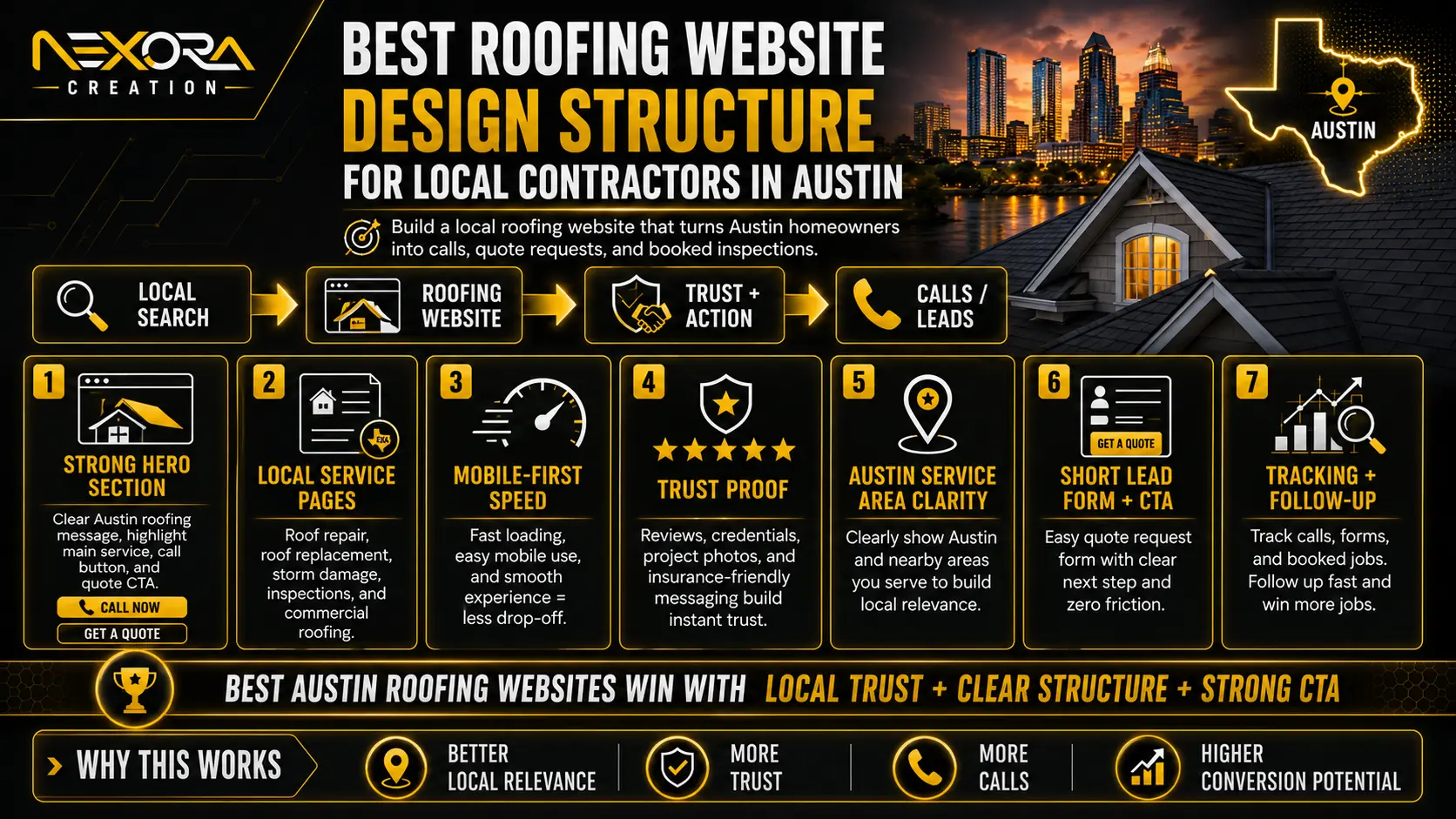
The best roofing website design structure for local contractors in Austin is a clear, fast, mobile-friendly website that helps homeowners understand your services, trust your company, and contact you quickly.
A roofing website should not only look professional.
It should generate calls, roof inspection requests, quote requests, and booked jobs.
Austin homeowners may visit your website after searching for:
- Roof repair Austin
- Roofing contractor near me
- Storm damage roof repair Austin
- Hail damage roof inspection Austin
- Roof leak repair Austin
- Emergency roof repair Austin
- Roof replacement Austin
- Metal roofing Austin
- Commercial roofing Austin
Each visitor has a different problem.
Some need urgent leak repair.
Some want storm damage inspection.
Some are comparing roof replacement options.
Some are checking if your company is local, trusted, and easy to contact.
That means your website structure matters.
A weak roofing website may look clean but still lose leads if the phone number is hidden, service pages are thin, reviews are missing, pages load slowly, or the visitor cannot find the right service.
At Nexora Creation, we see roofing website design as a lead-generation system. The website should support local SEO, Google Business Profile, Google Ads, storm damage searches, mobile calls, CRM follow-up, and conversion tracking.
In this guide, we will explain the best roofing website design structure for local contractors in Austin and how each section can help turn visitors into leads.
Why does roofing website structure matter for Austin contractors?
Roofing website structure matters because homeowners usually visit with a specific need.
They are not only looking for a nice website.
They want answers.
They want to know:
- Do you repair roofs in Austin?
- Do you handle storm damage?
- Can I request an inspection?
- Do you offer emergency roof repair?
- Are you licensed and insured?
- Do you have reviews?
- Can I call now?
- What happens after I submit a form?
If your website does not answer these questions quickly, visitors may leave.
Austin roofing contractors also compete in a local market where trust matters.
After storms, hail, or heavy wind, homeowners may compare several roofers.
A strong website structure can help your company look more credible, easier to contact, and more relevant to the search.
Your website should guide the visitor from problem to trust to action.
What should a roofing website homepage include?
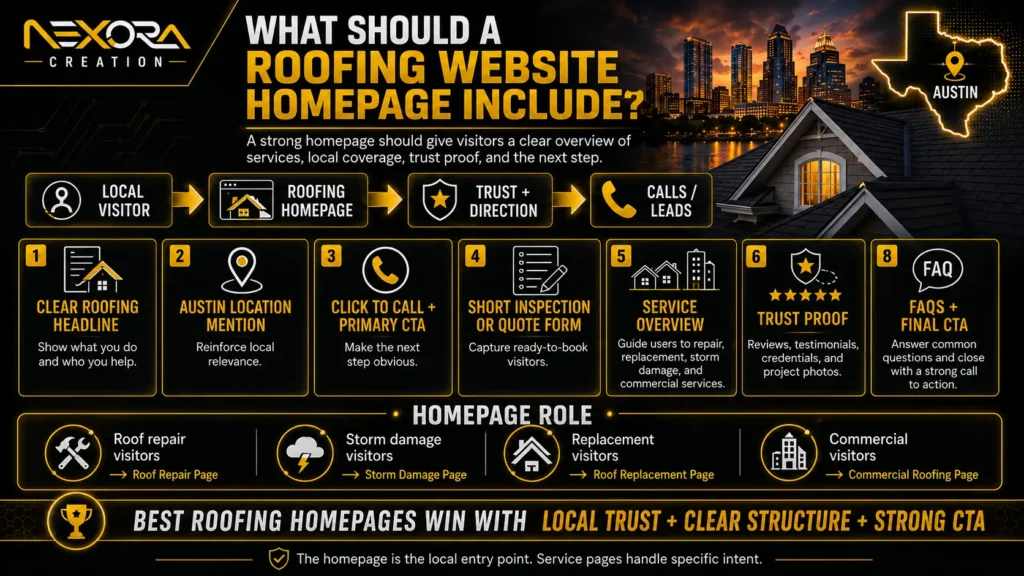
A roofing website homepage should give visitors a clear overview of your main services, local coverage, trust proof, and next step.
A strong homepage should include:
- Clear roofing headline
- Austin location mention
- Click-to-call phone number
- Primary CTA
- Short inspection or quote form
- Service overview
- Storm damage section
- Reviews and testimonials
- Project photos
- Service area section
- Process section
- FAQs
- Final CTA
The homepage should not try to explain everything in full detail.
It should guide visitors to the right service page.
For example:
- Roof repair visitors should go to roof repair page.
- Storm damage visitors should go to storm damage page.
- Replacement visitors should go to roof replacement page.
- Commercial visitors should go to commercial roofing page.
A homepage should act like a strong local entry point.
Service pages should handle specific intent.
Section 1: Hero section with Austin roofing intent
The hero section is the first thing visitors see.
It should immediately explain what you do, where you serve, and how to contact you.
A weak hero headline says:
“Quality Roofing Services You Can Trust”
That sounds professional, but it is too generic.
A stronger hero headline says:
“Roof Repair and Replacement in Austin”
or:
“Austin Roofing Contractor for Repairs, Storm Damage, and Roof Replacement”
A strong hero section should include:
- Main service
- Austin location
- Clear benefit
- Phone CTA
- Secondary CTA
- Trust signal
- Real roofing image
Example hero copy:
“Roof Repair and Replacement in Austin”
“Need roof repair, storm damage inspection, or replacement help? Call now or request an inspection from a local roofing team.”
CTA buttons:
“Call Now”
“Request Roof Inspection”
Trust line:
“Serving Austin homeowners with roof repair, replacement, and storm damage roofing support.”
This structure makes the page clear within seconds.
If your roofing website has a vague hero section, Nexora Creation can help redesign the page around stronger message clarity, mobile calls, and lead generation.
Section 2: Click-to-call header and sticky mobile button
A roofing website should make calling easy.
Many roofing visitors come from mobile searches.
A homeowner may be standing under a ceiling stain, checking missing shingles, or comparing roofers after a storm.
They should not have to search for your phone number.
Add the phone number in:
- Header
- Hero section
- Sticky mobile bar
- Service pages
- Contact section
- Final CTA
A sticky mobile button can say:
- Call Now
- Request Roof Inspection
- Emergency Roof Help
- Tap to Call
- Schedule Roofing Estimate
For emergency roof repair, phone CTA should be primary.
For roof replacement, form and estimate CTA can also work well.
The website should support both types of visitors.
A simple test:
Can a mobile visitor call in less than 3 seconds?
If not, your website may be losing roofing leads.
Section 3: Service cards for main roofing services
The homepage should include clear service cards that link to dedicated service pages.
Useful roofing service cards include:
- Roof Repair
- Roof Replacement
- Storm Damage Roofing
- Hail Damage Inspection
- Wind Damage Repair
- Emergency Roof Repair
- Roof Leak Repair
- Metal Roofing
- Flat Roof Repair
- Commercial Roofing
- Roof Inspection
Each card should have:
- Short heading
- One or two-line explanation
- CTA link
- Relevant image or icon
Example:
Roof Repair
Leaks, missing shingles, flashing damage, or storm-related issues? Request a roof repair inspection.
CTA:
“View Roof Repair Services”
These service cards help users find the page that matches their need.
They also support internal linking and local SEO.
Section 4: Dedicated roof repair page
Roof repair should have its own page because it is one of the highest-intent roofing searches.
Target searches may include:
- Roof repair Austin
- Roof leak repair Austin
- Roofing repair near me
- Shingle repair Austin
- Emergency roof repair Austin
A strong roof repair page should include:
- Roof repair and Austin in the headline
- Common repair problems
- Signs homeowners should watch for
- Inspection process
- Trust proof
- Reviews
- Short form
- Click-to-call button
- FAQs
- Final CTA
Common problems include:
- Roof leaks
- Missing shingles
- Lifted shingles
- Damaged flashing
- Cracked pipe boots
- Damaged vents
- Granule loss
- Storm damage
- Ceiling stains
- Loose ridge caps
The CTA should be clear:
“Call Now for Roof Repair”
or:
“Request Roof Repair Inspection”
This page should not be buried inside a general services page.
It should be easy to access from the homepage, menu, and internal links.
Section 5: Storm damage roofing page
Austin and Central Texas can experience storms, hail, and wind events, so storm damage roofing should have its own page if the contractor offers it.
A storm damage page can target:
- Storm damage roof repair Austin
- Hail damage roof inspection Austin
- Wind damage roof repair Austin
- Roof inspection after storm Austin
- Roof leak after storm Austin
This page should explain:
- Common storm damage signs
- Why inspection matters
- Hail damage concerns
- Wind damage concerns
- Roof leak risks
- Emergency repair options
- Inspection process
- Insurance-safe next steps
Common signs include:
- Missing shingles
- Dented gutters
- Granule loss
- Roof leaks
- Damaged flashing
- Damaged vents
- Loose ridge caps
- Ceiling stains
- Debris impact
The page should use careful insurance wording.
Safe wording:
“We can inspect visible roof damage, document repair concerns, and help you understand the next steps. Your insurance provider determines coverage based on your policy.”
Avoid promising claim approval.
Storm damage pages can bring strong leads because visitors are usually problem-aware.
Section 6: Roof replacement page
Roof replacement should have its own page because the decision process is different from roof repair.
A homeowner searching for roof replacement may want:
- Estimate process
- Material options
- Timeline
- Warranty details
- Financing information
- Signs replacement is needed
- Project photos
- Trust proof
Target searches may include:
- Roof replacement Austin
- New roof Austin
- Roof installation Austin
- Roofing replacement contractor Austin
- Asphalt shingle roof replacement Austin
A strong replacement page should include:
- Roof replacement headline
- Signs you may need replacement
- Material options
- Process steps
- Estimate CTA
- Project photos
- Reviews
- FAQs
- Financing information, if available
- Final CTA
CTA examples:
- Request Roof Replacement Estimate
- Schedule Roof Consultation
- Get New Roof Quote
Roof replacement leads can be high-value, so the page should build more trust and explain the process clearly.
Section 7: Service area section for Austin neighborhoods and nearby cities
A roofing website should clearly show the areas served.
This helps homeowners know if you work in their location.
Depending on the contractor’s real coverage, the service area section may include:
- Austin
- Round Rock
- Cedar Park
- Pflugerville
- Georgetown
- Leander
- Bee Cave
- Lakeway
- Buda
- Kyle
- Manor
- Dripping Springs
- West Lake Hills
- South Austin
- North Austin
- East Austin
- Zilker
- Hyde Park
- Travis Heights
Only list areas you actually serve.
Example copy:
“We provide roof repair, replacement, and storm damage roofing services across Austin, Round Rock, Cedar Park, Pflugerville, Georgetown, Leander, Buda, Kyle, and nearby Central Texas communities.”
This section supports local clarity.
It also helps visitors feel confident before calling.
Section 8: Reviews and trust proof near CTAs
Roofing is a high-trust service.
Homeowners want to know they are choosing the right contractor.
A roofing website should show trust proof near CTA sections, not only on a separate reviews page.
Trust signals include:
- Google review rating
- Customer testimonials
- Licensed and insured message
- Years in business
- Local service area
- Roofing certifications
- Warranty information
- Team photos
- Project photos
- Before and after images
- Service vehicle photos
- BBB or association badges, if applicable
Place trust proof:
- Under the hero section
- Near service cards
- Near forms
- On service pages
- Before final CTA
Example trust line:
“Trusted by Austin-area homeowners for roof repair, storm damage inspections, and roof replacement.”
Specific trust proof reduces hesitation.
Section 9: Project gallery and before/after photos
Roofing websites should show real work.
A project gallery helps visitors see proof.
Useful gallery items include:
- Roof replacement before and after
- Roof repair photos
- Storm damage inspection photos
- Metal roofing projects
- Commercial roof projects
- Flat roof work
- Roof leak repair examples
- Emergency tarping photos
Each project can include:
- Service type
- Location area
- Brief description
- Problem solved
- Before and after images
- CTA to request similar service
Example:
“Roof replacement project in South Austin after aging shingles and leak issues.”
Photos should be optimized for speed.
Use compressed images and descriptive alt text.
Example alt text:
“Roof replacement project in Austin showing new asphalt shingles after installation.”
Real photos often build more trust than stock images.
Section 10: Roofing process section
A process section helps visitors understand what happens after they contact you.
A simple process can include:
1. Request inspection or estimate
The homeowner calls or fills out the short form.
2. Roof assessment
The roofing team inspects visible damage or project needs.
3. Clear recommendation
The homeowner receives repair or replacement options.
4. Approval and scheduling
The work is scheduled based on scope and availability.
5. Roofing work completed
The team completes the approved repair or replacement.
This section reduces uncertainty.
It also makes the company feel more organized.
For storm damage pages, add:
“We can document visible damage and explain next steps. Your insurance provider determines coverage.”
Section 11: Short forms for inspection and estimates
Roofing forms should be short and easy to complete.
Ask only for what is needed to start the conversation.
Useful fields include:
- Name
- Phone number
- Property ZIP code
- Service needed
- Short message
- Preferred contact time
Optional dropdown:
- Roof repair
- Roof leak
- Storm damage
- Hail damage inspection
- Roof replacement
- Commercial roofing
- Not sure
Button text should be specific:
- Request Roof Inspection
- Schedule Roofing Estimate
- Request Storm Damage Inspection
- Get Roof Repair Help
Avoid “Submit.”
The form should explain the next step.
Also make sure the form:
- Works on mobile
- Sends alerts quickly
- Tracks conversions
- Connects to CRM
- Shows confirmation message
- Has spam protection
A broken form can cost leads.
Section 12: Roofing FAQs
FAQs help answer common homeowner questions and support AEO-friendly content.
Useful roofing FAQs include:
- How do I know if my roof needs repair?
- Should I get a roof inspection after a storm?
- Do you offer emergency roof repair?
- How long does roof replacement take?
- Do you serve my area?
- What should I do if my roof is leaking?
- Do you inspect hail damage?
- How do I request a roofing estimate?
FAQs should be short and helpful.
Do not stuff keywords into every answer.
A good FAQ section helps users make decisions faster.
Section 13: Blog section for roofing SEO
A roofing website should include a blog if the contractor wants long-term SEO growth.
Blog topics should support service pages.
Useful Austin roofing blog topics include:
- How to Tell If Your Roof Has Hail Damage in Austin
- What to Do After a Roof Leak During a Storm
- Roof Repair vs Roof Replacement: How to Decide
- Signs Your Roof Needs Inspection After High Winds
- Best Roofing Materials for Austin Homes
- Emergency Roof Repair Checklist for Homeowners
- How Often Should Austin Homeowners Inspect Their Roof?
- What Happens During a Roof Inspection?
Each blog should link to relevant service pages.
For example:
A blog about hail damage should link to the storm damage or hail inspection page.
A blog about roof leaks should link to the roof repair page.
Blogs should not be dead ends.
They should guide readers toward calls, inspections, or quotes.
Section 14: Contact page and final CTA
The contact page should be simple and complete.
It should include:
- Phone number
- Contact form
- Service areas
- Business hours
- Email, if used
- Google Business Profile link
- Map, if applicable
- Emergency CTA, if offered
- Response expectation
- Trust proof
The final CTA on key pages should be specific.
Examples:
“Need roof repair in Austin? Call now or request a roof inspection.”
“Concerned about storm damage? Schedule an inspection and get clear next steps.”
“Planning roof replacement? Request an estimate from a local roofing team.”
The CTA should match the page intent.
How does roofing website design support local SEO?
Roofing website design supports local SEO by helping Google and users understand your services and service area.
A strong roofing website should support:
- Google Business Profile relevance
- Service-specific pages
- Austin location signals
- Internal links
- Local content
- Reviews
- Project photos
- Schema markup
- Fast mobile loading
- Clear contact details
- Consistent business information
Google local rankings are influenced by relevance, distance, and prominence.
Your website can help improve relevance and support prominence through strong content, reviews, trust signals, and local authority.
If your website is hard to understand, Google may struggle to connect your business with the right searches.
If your website is hard to use, visitors may leave before contacting you.
How should roofing websites support Google Ads?
A roofing website should support Google Ads with dedicated landing pages.
Do not send every paid click to the homepage.
Useful landing pages include:
- Roof Repair in Austin
- Emergency Roof Repair in Austin
- Storm Damage Roof Repair in Austin
- Hail Damage Roof Inspection in Austin
- Roof Replacement in Austin
- Metal Roofing in Austin
- Commercial Roofing in Austin
- Flat Roof Repair in Austin
Each landing page should match the ad and keyword.
Strong message match:
Keyword: roof repair Austin
Ad headline: Roof Repair in Austin
Landing page headline: Roof Repair in Austin
CTA: Request Roof Repair Inspection
This helps visitors feel they landed in the right place.
It can also support better conversion potential.
How can CRM automation improve roofing website leads?
CRM automation helps roofing contractors follow up faster and organize leads.
Roofing leads can come from:
- Contact forms
- Inspection requests
- Phone calls
- Google Ads
- Google Business Profile
- Blog pages
- Chat widgets
- Landing pages
A CRM can help:
- Capture leads instantly
- Store lead source
- Tag service type
- Notify the team
- Assign follow-up
- Send confirmations
- Track inspections
- Track estimates
- Measure booked jobs
- Reduce missed opportunities
If your roofing website generates enquiries but your team loses leads during follow-up, Nexora Creation can help connect website forms, calls, and CRM automation.
Can AI chatbots help roofing websites?
AI chatbots can help roofing websites answer quick questions and capture leads.
A chatbot can answer:
- Do you serve my area?
- Can I request a roof inspection?
- Do you repair roof leaks?
- Do you handle storm damage?
- Can someone call me back?
- What happens after I submit the form?
It can collect:
- Name
- Phone number
- ZIP code
- Roofing issue
- Urgency
- Preferred contact time
This helps capture visitors who are not ready to call.
But a chatbot should not replace the main phone CTA.
For emergency roof leaks, calling should still be the fastest path.
AI Voice Agent & Chatbot Services
What mistakes should Austin roofing websites avoid?
Common roofing website mistakes include:
- Vague homepage headline
- Hidden phone number
- No sticky mobile call button
- Slow mobile speed
- One generic services page
- No roof repair page
- No storm damage page
- No roof replacement page
- No service area section
- No project photos
- No reviews near CTA
- Long forms
- Broken forms
- No internal links
- No local content
- No conversion tracking
- No CRM follow-up
- Stock images only
- Risky insurance wording
Each mistake can reduce trust and leads.
A roofing website should be clear, fast, local, and easy to contact.
How can Nexora Creation help Austin roofing contractors?
Nexora Creation helps local contractors build roofing websites designed for SEO, local visibility, and lead generation.
For Austin roofing contractors, we can help with:
- Roofing website design
- Local SEO strategy
- Roofing service page structure
- Storm damage landing pages
- Roof repair pages
- Roof replacement pages
- Google Ads landing pages
- Mobile call flow
- Review placement
- Project gallery structure
- CTA optimization
- CRM automation
- AI chatbot integration
- Conversion tracking
If your roofing website looks professional but does not generate enough calls, the issue may be structure, mobile UX, service pages, or follow-up flow.
What is the best roofing website design structure for Austin contractors?
The best roofing website design structure includes:
- Homepage with clear Austin roofing message
- Click-to-call header
- Sticky mobile call button
- Service cards
- Roof repair page
- Storm damage page
- Roof replacement page
- Emergency roof repair page
- Commercial roofing page, if offered
- Service area section
- Reviews and trust proof
- Project gallery
- Process section
- Short forms
- FAQs
- Blog section
- Contact page
- CRM and tracking setup
This structure helps visitors find the right service and contact the contractor quickly.
It also helps Google understand what the roofing company offers and where it serves.
Conclusion
The best roofing website design structure for local contractors in Austin is clear, local, fast, and built around lead generation.
A roofing website should not only look modern.
It should help homeowners:
- Understand your services
- See that you serve Austin
- Trust your company
- View real project proof
- Call easily
- Request an inspection
- Get clear next steps
A strong roofing website should include:
- Clear hero section
- Click-to-call CTA
- Sticky mobile button
- Service-specific pages
- Storm damage page
- Roof repair page
- Roof replacement page
- Reviews
- Project photos
- Service area section
- Short forms
- FAQs
- Blog content
- CRM follow-up
- Conversion tracking
For Austin roofing contractors, the website should work like a sales and lead-generation system.
If it only looks good but does not turn visitors into calls, inspections, and quotes, the structure needs improvement.
FAQs
What should a roofing website include?
A roofing website should include a clear homepage, service pages, click-to-call buttons, reviews, project photos, service areas, short forms, FAQs, blog content, and contact options.
Why do Austin roofing contractors need service pages?
Service pages help Google and homeowners understand each roofing service clearly, including roof repair, storm damage, roof replacement, emergency repair, and commercial roofing.
Should roof repair have its own page?
Yes. Roof repair should have its own page because homeowners often search specifically for repair, leaks, missing shingles, and storm-related roof problems.
Do storm damage pages help roofing SEO?
Yes. Storm damage pages can help capture high-intent searches related to hail, wind, leaks, inspections, and emergency roof repair.
Why does mobile design matter for roofing websites?
Many roofing visitors search on mobile, especially after storms or leaks. A mobile-friendly website should make calling and requesting inspections easy.
Should roofing websites show project photos?
Yes. Real project photos, before and after images, and inspection photos build trust and show proof of work.
How can roofing websites generate more leads?
Roofing websites generate more leads with clear CTAs, click-to-call buttons, strong service pages, reviews, fast loading, short forms, local SEO, CRM follow-up, and tracking.
Can AI chatbots help roofing contractors?
Yes. AI chatbots can answer common questions, collect contact details, qualify roofing issues, and help capture leads from visitors who are not ready to call.